

9 Must-Have Montessori Learning Materials for Home Classrooms
Last Updated: October 30, 2026
Quick Summary
The must have Montessori learning materials for home classrooms fall into five categories: practical life, sensorial, math, language, and cultural work. Start with one or two pieces from each category and add as your child's readiness grows.
- Practical life materials like the Busy Board and Kitchen Tools use real, child-sized tools to build hand control.
- Sensorial picks include the Shape Sorting Cube and Garden Shape Sorter, both made from wood.
- Math materials follow a sequence: count real objects, compare quantities, then break a whole into parts.
- Set up one low, open shelf at child height with three to five trays and rotate weekly.
- Check for solid wood, non-toxic finish, self-correction, and one concept per material before buying.
Table of Contents
- Start With These 9 Montessori Materials for Home Classrooms
- Montessori Practical Life Activities at Home: Real Tasks, Real Tools
- Montessori Sensorial Materials That Train the Senses First
- Montessori Math Materials: From Counting to Fractions
- Language Materials and How to Identify Authentic Montessori Toys
- Setting Up a Small Home Classroom: Shelves, Rotation, and Storage
- Build Your Starter Shelf With Project Montessori
- Frequently Asked Questions
Start With These 9 Montessori Materials for Home Classrooms
Building a home classroom does not require a full shelf of specialized equipment, but knowing the must have Montessori learning materials for home classrooms helps you start smart. The must have Montessori learning materials for home classrooms fall into five categories: practical life, sensorial, math, language, and cultural work.
Here is the tension most buying guides skip: Montessori materials are designed to be self-correcting, meaning the child discovers the error without an adult pointing it out. A 2017 review of the evidence base describes Montessori materials as manipulable objects built to teach sensorial concepts like dimension and color, while noting that formal evaluations of the method's effectiveness remain scarce (Montessori education evidence review(https://pmc.ncbi.nlm.nih.gov/articles/PMC6161506/)).
Below, we cover all nine picks by category, what each one teaches, and how to choose without overspending.
Quick Comparison: What Each Material Teaches and Costs
| Material | Category | Teaches | Price |
|---|---|---|---|
| Busy Board | Practical life | Fastenings, fine motor control | $34.45 |
| Kitchen Tools (13 Pieces) | Practical life | Food prep, real tool handling | $44.45 |
| Screwdriver Tool Board | Practical life | Tool use, problem-solving | $44.45 |
| Shape Sorting Cube | Sensorial | Shape and color discrimination | $34.45 |
| Garden Shape Sorter | Sensorial | Matching, planting play | $49.95 |
| Monkey Balance Math Game | Math | Counting, early arithmetic | $39.95 |
| Fraction Learning Circles | Math | Parts of a whole, equivalency | $29.95 |
| Alphabets & Numbers Wooden Flash Cards | Language | Letter and number recognition | $44.45 |
| Sensory Book | Language and sensory | Matching, vocabulary, fine motor | $29.95 |
Montessori Practical Life Activities at Home: Real Tasks, Real Tools
Practical life work is the backbone of a home classroom because it uses the tasks your child already wants to do. Pouring, slicing, fastening, and turning screws build the hand control that writing depends on later.
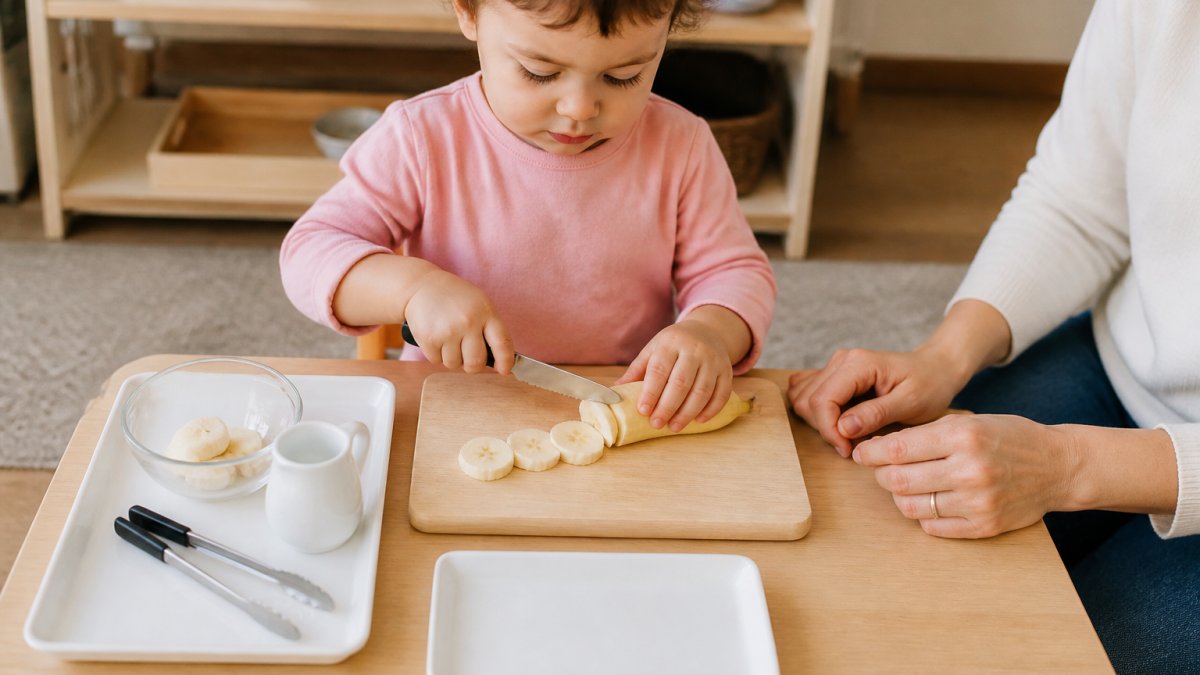
Fastenings, Kitchen Work, and Real Tools
Three practical life materials cover most of what a young child needs at home:
- Montessori Busy Board ($34.45): Shoelaces, a zipper, a snap pocket, and eight buckle types on one soft felt board. Ages 1 to 4. It travels well, which matters for restaurants and long car rides.
- Montessori Kitchen Tools, 13 Pieces ($44.45): A wooden knife, a cooking knife, three serrated toddler knives, two cutting boards, a Y peeler, four sandwich cutters, and a crinkle cutter.
- Montessori Screwdriver Tool Board ($44.45): Beech wood board with 14 screws in seven styles, a wrench, a lock with two keys, a dual-purpose screwdriver, and an L-shaped hex wrench. Ages 3 and up.
If you want to start with real kitchen work, our Montessori kitchen tools set is the piece most families reach for daily.

Safety and Supervision by Age
Real tools are the point of practical life, and real tools require age-aware supervision. A common pattern among Montessori practitioners:
- Ages 1 to 2: Stick to fastenings, pouring dry rice or beans between two small pitchers, and wiping a table with a damp cloth. No blades. The busy board is the right entry point here.
- Ages 2 to 3: Introduce a Y peeler and a crinkle cutter with your hand over your child's hand for the first several sessions. Expect the child to test the tool on something other than food, that is normal, and it is why you stay within arm's reach.
- Ages 3 to 4: Serrated toddler knives and the screwdriver board become reasonable with demonstrated technique. Keep small parts like the screws out of reach of children who still mouth objects.
Household Substitutes Before You Buy
You do not need to purchase anything to begin practical life. Most of the first year's work already lives in your kitchen and laundry room:
- Pouring: two small pitchers and a tray, with dry lentils or rice. Swap in water once the child is steady.
- Transferring: a pair of tongs and a muffin tin, or a spoon and two bowls.
- Sponging: a small sponge and a shallow dish of water; the child wipes a spill and wrings the sponge.
Buy the purpose-built pieces when you want durability, a self-contained tray, and a tool sized correctly for small hands. The busy board and kitchen tools set earn their place because they survive daily use and travel; a basket of household items covers the rest.
Montessori Sensorial Materials That Train the Senses First
Sensorial materials isolate one quality at a time so a child can focus on it completely.
Two picks cover the sensorial shelf well:
Montessori Shape Sorting Cube ($34.45). Natural wood, non-toxic paint, 12 wooden shapes, and a 6.3 by 6.3 by 6.5 inch cube. Ages 3 and up.
Montessori Garden Shape Sorter ($49.95). A rabbit, 12 fruit pieces, 8 carrots, and 10 worms. Children pull carrots from their holes and slot them back, which turns shape matching into harvest play.
The difference between these two comes down to a child's interests. The cube suits a child who likes a clean, repeatable task. The garden sorter suits a child who enjoys pretend play.
Montessori Math Materials: From Counting to Fractions
Math materials move in a sequence: count real objects, then compare quantities, then break a whole into parts. Skipping the middle step is the most common mistake we see. A child who can recite numbers to twenty but cannot tell you whether seven monkeys weigh more than four has not yet built quantity sense.
The sequence in practice:
- Counting with the Montessori Monkey Balance Math Game ($39.95). 65 pieces including 19 monkeys, weighted numbers 1 to 10, and 30 two-sided cards. Children balance the scale to check their own answer, which is the self-correction built in.
- Comparing and combining. The same game handles addition and subtraction once counting is solid.
- Fractions with the Montessori Fraction Learning Circles ($29.95). Nine color-coded circles, each about 3.5 inches across, in a clear storage case.
For the fraction stage, our fraction learning circles are the natural next purchase once your child counts confidently past ten.

Language Materials and How to Identify Authentic Montessori Toys
Montessori language materials are designed to isolate one skill and let the child check their own work. A wooden alphabet card set that shows the full alphabet in order lets a child see where a letter belongs. A plastic set with random letters does not.
What Separates Real Montessori Work From a Lookalike
Use this checklist before you buy anything labeled Montessori:
- Material: solid wood, glass, cloth, wicker, or metal rather than thin plastic
- Finish: smooth edges, non-toxic paint or finish, no splinters
- Self-correction: the piece fits only one way, or the scale balances only when correct
Alphabets & Numbers Wooden Flash Cards ($44.45) are made from solid wood and are 100% non-toxic and BPA-free, sized for small hands, with animal patterns for recognition. Ages 3 and up. The Montessori Sensory Book ($29.95) is designed for ages 2 to 5 and uses reusable peel-and-paste pieces to support fine motor skills.
For a deeper walkthrough of spotting fakes, read our guide on how to identify authentic Montessori toys.
Setting Up a Small Home Classroom: Shelves, Rotation, and Storage
A home classroom needs less space than most parents expect. One low, open shelf within your child's reach does more than a dedicated room. The setup rules that matter:
- Open shelving at child height. If your child cannot see it and reach it, it will not get used.
- One material per tray. Keep each work complete and self-contained.
- Rotate, do not stack. Store extra materials out of sight and swap them in when interest fades.
Small-Space Layouts That Actually Work
Most families do not have a spare room, and they do not need one. Three layouts that fit real homes:
- The corner shelf. A single low bookshelf against a living-room wall, with a work rug in front. This is the most common home setup and covers ages 1 to 4 well. The shelf holds three to five trays; the rug rolls up and stores beside it.
- The closet conversion. A reach-in closet with the door removed or folded back becomes a defined work nook. Add a low shelf and a small table inside; the doorway frames the space and keeps materials out of the main room.
- The rolling cart. A three-tier utility cart holds a week's rotation and moves from kitchen to living room to bedroom. It suits apartments and shared spaces where a fixed shelf is not practical.
What to avoid: a high shelf the child cannot reach, a shelf in a room the family does not use, and a setup that requires an adult to fetch materials. Independence is the design goal, not decoration.
Rotation: A Simple Weekly Cadence
Rotation is the piece families skip. A shelf with nine materials out at once overwhelms a young child; three to five at a time is plenty. A workable cadence:
- Observe for a week. Note which trays your child returns to and which sit untouched.
- Swap one or two trays. Replace the untouched ones with materials from storage. Keep the favorites in place, repetition is the work.
- Store the rest out of sight. A lidded bin on a high shelf or in a closet is enough. Out of sight matters; a visible pile of unused materials competes for attention.
- Clean and check weekly. Wipe wooden pieces, count small parts, and retire anything cracked or chipped.
Our guide on how to rotate Montessori toys walks through a simple weekly schedule.
Storage That Survives Real Life
Storage is where home classrooms fail. A few systems that hold up:
- One bin per category. Practical life, sensorial, math, and language each get a labeled bin. When a tray comes off the shelf, its replacement comes from the matching bin.
- Trays and baskets, not bags. A tray with a lip keeps small parts contained and lets the child carry the work to the rug. Bags hide the work and defeat the purpose.
- A locked or high cabinet for tools. Knives, the screwdriver board, and any small parts live out of reach between sessions. This is a safety rule, not a storage preference.
Build Your Starter Shelf With Project Montessori
A complete starter shelf does not have to arrive at once. Buy one practical life piece, one sensorial piece, and one math or language piece, then watch which one your child returns to.
Project Montessori carries educator-approved materials rooted in the Montessori philosophy, built to promote independence and creativity at each developmental stage.
If you are still deciding where to begin, our parent's guide to starting Montessori at home maps the first three months.
Frequently Asked Questions
What materials do you need for a Montessori classroom at home?
Start with one or two items from each of the five areas: practical life (a busy board or kitchen tools), sensorial (a shape sorting cube), math (a balance game or fraction circles), language (wooden alphabet cards), and cultural or science materials. You do not need a full classroom. A shelf with six to eight rotating activities covers the essentials, and Montessori materials are generally designed as hands-on objects for learning concepts like dimension and color.
How do you identify authentic Montessori toys?
Look for four things: a single clear skill per item, real materials such as solid wood, glass, or fabric rather than flashing plastic, child-sized proportions a small hand can grip, and self-correcting design so the child sees the error without an adult. Avoid battery-powered toys that do the playing for the child. A listing that explains what the toy teaches is a better sign than one that only uses the word Montessori.
How many Montessori materials should you put out at once?
Six to eight activities on an open shelf is a workable number for most home classrooms. Fewer choices make it easier for a child to focus and to put things back. Rotate items every two to four weeks, storing the rest out of sight, and bring a piece back when the child's skills have moved on. This rotation keeps engagement high without buying more, which matters if your 18-month-old bores quickly.
Can you create a Montessori classroom at home on a small budget?
Yes. Use household items for practical life, such as a small pitcher, a sponge, and child-sized utensils, and add a few durable pieces where quality matters most. Project Montessori's Montessori Fraction Learning Circles are $29.95, the Montessori Sensory Book is $29.95, and the Montessori Busy Board is $34.45, so a starter shelf can be built a piece at a time rather than as one large purchase.
What household items can be used for Montessori activities?
A tray with a small pitcher and cups for pouring, a bowl of water and a sponge for wiping, child-sized spoons and bowls for transferring, and a basket of safe everyday objects for sorting all work well. Real kitchen tools suit practical life activities at home, and the Montessori Kitchen Tools set includes a wooden kids knife, serrated toddler knives, cutting boards, and a Y peeler if you want a dedicated set. Pair these with one or two sensorial materials so the shelf stays balanced.
The hardest part of building a home classroom is not choosing materials. It is resisting the urge to buy everything at once and then wondering why your child ignores the shelf. Start with three pieces, rotate them, and add only when you see mastery. Get started with Project Montessori and build a shelf your child actually uses, one material at a time.
