

How to Start Montessori at Home: A Parent's Guide
Table of Contents
- What You'll Need Before You Start
- How to Set Up a Montessori Shelf in Your Home
- Montessori Toy Rotation Guide for Busy Parents
- Montessori Activities for Toddlers That Build Independence
- Step-by-Step: How to Start Montessori at Home This Week
- Common Mistakes When You Start Montessori at Home
- Conclusion
- Frequently Asked Questions
Last Updated: September 25, 2026
What You'll Need Before You Start
You don't need a renovation budget or a dedicated playroom. Learning how to start Montessori at home comes down to three things: a low shelf your child can reach, a small set of toys you rotate, and the patience to let your child do things slowly.
At Project Montessori, parents often assume the method requires a full classroom setup. It doesn't, it works in apartments, shared bedrooms, and a corner of the living room.
- Can my child use it without help? If not, it goes on a high shelf for later.
- Does it have one clear purpose? A wooden puzzle does. A plastic toy that lights up, talks, and spins does three things at once and holds attention for none.
- Is it made of a material that rewards care? Wood, fabric, and metal teach weight and texture. Battery-powered plastic teaches nothing about either.
- Does it invite repetition? Pouring, stacking, lacing, and sorting can be done again and again. That repetition is where focus develops.
How to Set Up a Montessori Shelf in Your Home
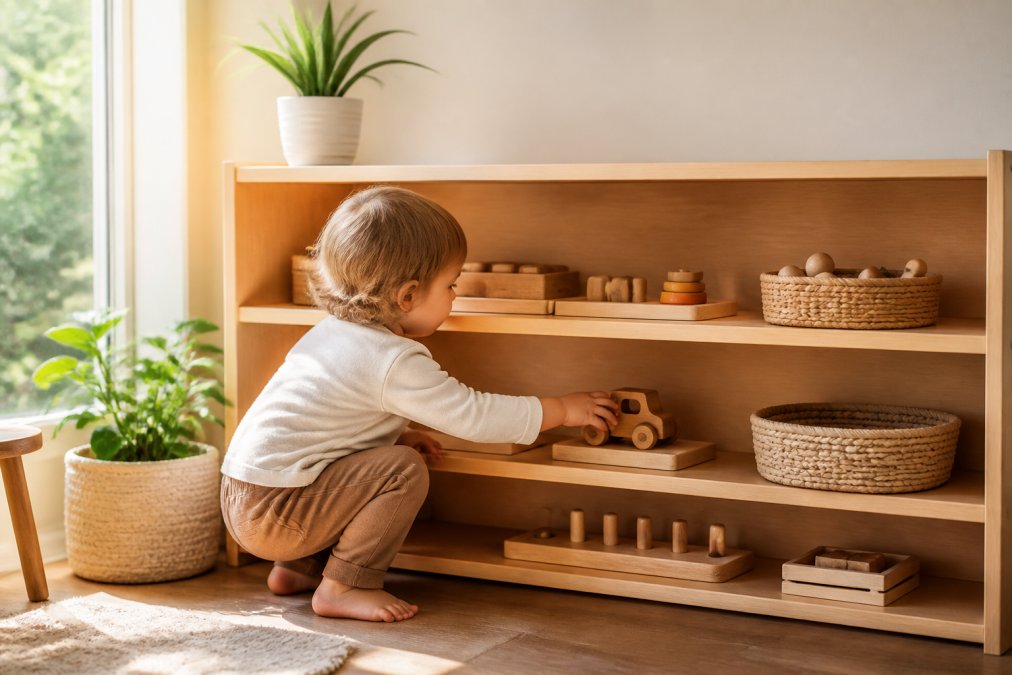
A Montessori shelf is a low, open unit with items at your child's eye level, so they can see every option and reach it without asking an adult. If your child needs you to hand them a toy, the shelf is too high.
| Age Band | Top Shelf Height | Tiers | What Belongs on It |
|---|---|---|---|
| 0-12 months | 8-12 inches (floor-level unit) | 1 | A few grasping toys, a basket of soft balls, one mirror at floor level |
| 12-24 months | 20-24 inches | 2 | One activity per tray: stacking, posting, a single puzzle |
| 2-3 years | 24-30 inches | 2-3 | Practical life trays, language objects, a small art caddy |
| 3-5 years | 30-36 inches | 3 | Broader choices: math manipulatives, cultural folders, chapter books |
Arrange items with intention:
- One activity per tray or basket, not a jumbled pile
- Heavier items on the bottom tier, lighter and more fragile items up top
- A clear left-to-right order that you keep consistent
- A plant, a small framed photo, or a natural object to add beauty
- Empty space between trays, so each activity reads as a separate invitation
Montessori Toy Rotation Guide for Busy Parents
A Montessori toy rotation guide works on one rule: keep only a handful of toys available, store the rest, and swap on a schedule, most families rotate every one to three weeks. The goal isn't novelty, it's depth. Fewer options mean your child plays longer with each one.
| Step | What You Do | How Often |
|---|---|---|
| 1. Observe | Watch which items sit untouched for a full week | Continuous |
| 2. Pull | Remove two or three neglected items from the shelf | Every 1-2 weeks |
| 3. Store | Place them out of sight in a labeled bin | Same day |
| 4. Swap | Bring out one or two stored items your child has outgrown in skill | Every 2-3 weeks |
| 5. Reset | Return everything to its marked spot on the shelf | Daily, with your child |
Montessori Activities for Toddlers That Build Independence
The best Montessori activities for toddlers mimic real work: pouring water, wiping a spill, buttoning a shirt, carrying a tray. Children this age want to do what you do, not a simplified version of it.
- Pouring: Two small pitchers and a tray. Expect spills for the first week.
- Transferring: A bowl of large dried beans and a spoon. Skip this if your child still mouths objects.
- Sponging: A small sponge and a shallow dish of water. This one absorbs toddlers for surprisingly long stretches.
- Dressing frames: Buttons, zippers, and snaps on a standalone board.
- Care of plants: A small watering can and one sturdy plant your child can reach.
Adapting These Activities for Neurodivergent Children
Most Montessori-at-home guides assume a neurotypical child who tolerates change and transitions easily. If your child is autistic, has ADHD, or has sensory processing differences, the same activities work, but the setup, pacing, and presentation need to change.
A few adaptations that practitioners commonly recommend:
- Reduce the shelf to two or three items, not five. A child with executive function challenges can be paralyzed by choice. Fewer options means less scanning and more starting.
- Keep the rotation schedule longer. Where a neurotypical toddler might rotate every two weeks, a child who relies on predictability may need four to six weeks with the same materials before a swap feels safe.
- Front-load sensory information. Before introducing a new activity, let the child touch the dry materials with no expectation of doing the task. Pouring dry rice before pouring water removes the stakes.
- Add a visual sequence card. A simple three-step picture strip taped to the tray (scoop, pour, wipe) replaces verbal instructions, which many children tune out under load.
- Build in a heavy-work option. Carrying a full watering can, pushing a loaded laundry basket, or wiping a table with pressure gives proprioceptive input that helps regulate attention.
- Protect the finish. A child who struggles with transitions may melt down when an activity ends. A two-minute warning and a designated "finished" basket can head that off.
Step-by-Step: How to Start Montessori at Home This Week
You can begin in seven days without buying a curriculum or taking a course. Here's the sequence:
- Day 1: Clear one corner. Pick a single low surface in a room you already use. Remove everything from it.
- Day 2: Choose five items. Select toys or household objects that meet the four filters above. Place them on the shelf, one per tray.
- Day 3: Lower the rest. Move a step stool to the sink and a low hook to the closet so your child can reach what they need without asking.
- Day 4: Watch, don't direct. Spend twenty minutes observing. Resist the urge to correct or suggest. Note what holds attention.
- Day 5: Add one practical life task. Pouring, sponging, or plant care. Show it once, slowly, then step back.
- Day 6: Rotate. Pull anything untouched for three days. Store it. Bring out one item from storage.
- Day 7: Set the routine. Keep the same shelf order and the same daily rhythm for the next two weeks before changing anything.
Common Mistakes When You Start Montessori at Home
The most common mistake is treating Montessori as a shopping list rather than a set of habits. Parents buy the wooden toys, arrange the shelf, then keep directing every minute of play. The materials are easy; the restraint is hard.
Watch for these:
- Correcting during play. If your child stacks the rings out of order, let it stand. Self-correction comes from the material, not from you.
- Filling the shelf. More than five or six items at once defeats the purpose.
- Buying ahead of readiness. A toy for a four-year-old will frustrate a two-year-old and end up broken.
- Skipping the practical life work. Fasteners and pouring look less impressive than puzzles, but they build more independence.
- Abandoning the routine after two weeks. Order takes time to show results.
Conclusion
The barrier to getting started is almost never money or space. It's the instinct to intervene, and that instinct is hard to unlearn. Set up one low shelf, keep five things on it, and let your child struggle productively with a zipper for ten minutes without your hands in the way. That habit matters more than any purchase.
Frequently Asked Questions
What is the best age to start Montessori at home?
You can begin Montessori principles from birth, but many parents find it easiest to start when their child is around 12 to 18 months old. At this stage, toddlers show clear interest in independence and purposeful work. For newborns, focus on a simple, calm sleep area and a few natural-material items. The key is matching your setup to your child's current developmental stage rather than waiting for a perfect age.
How do I set up a Montessori shelf on a tight budget?
You do not need expensive furniture. A low, sturdy bookshelf or even a wooden crate turned on its side works well. Rotate in a few open-ended items you already own, like wooden spoons, baskets, or board books. Thrift stores and yard sales often have natural-material toys at low prices. The goal is accessibility and order, not a perfect aesthetic. Start with what you have and add one or two quality pieces over time.
How does a Montessori toy rotation work for toddlers?
Toy rotation means keeping only a small number of toys accessible at once, usually 6 to 10 items on a shelf, and storing the rest out of sight. Every one to two weeks, swap a few items based on what your child is currently interested in or ready to practice. This keeps the environment fresh and prevents overwhelm. It also helps your child focus deeply on one activity instead of bouncing between too many choices.
Can I start Montessori at home without buying a full set of toys?
Yes. You can begin with everyday household items like measuring cups, sponges, and safe kitchen tools for practical life activities. A simple wooden busy board or a few natural-material toys can support fine motor skills without a large investment. Many parents start with one or two quality pieces, like a Montessori Busy Board, and add more as they see what their child gravitates toward. The philosophy is about observation and independence, not a specific product list.