

Why Choose Montessori for Toddlers: Benefits & Getting Started
Table of Contents
- Montessori Benefits for Toddlers: What Makes This Approach Different
- Social and Emotional Development Through Child-Centered Learning
- How to Start Montessori at Home with Your Toddler
- Is Montessori Right for Your Toddler? What to Consider
- A Thoughtful Gift That Grows With Your Grandchild
- Frequently Asked Questions
Last Updated: October 11, 2026
Montessori Benefits for Toddlers: What Makes This Approach Different
Montessori for toddlers offers a child-centered path rooted in hands-on exploration and self-directed learning.
The core idea is simple: toddlers learn best by doing. They touch real objects, solve problems, and make choices about what interests them, based on how young brains actually develop.
Research from the Institute of Education Sciences evaluated the Montessori preschool model and found that it supports children's kindergarten readiness skills and social-emotional outcomes. A more recent nationwide study covered by The 74 reported that public Montessori programs show more positive outcomes than other early education programs.
Independence and Self-Reliance
In a Montessori environment, children do real work: washing dishes, sweeping floors, caring for plants. These practical life activities build responsibility and genuine contribution to family life.
Hands-On, Experiential Learning
Montessori materials are designed with precision. A shape-sorting cube teaches spatial reasoning and problem-solving; beads on a string develop fine motor control. Each material has one clear purpose, allowing your toddler to master one skill before moving to the next.

Confidence, Curiosity, and Love of Learning
When children direct their own learning, they become curious explorers. A toddler who chooses their own activities works longer and with more focus, repeating tasks because they want to. This repetition builds genuine learning and a child who loves learning itself. Success fuels pride and curiosity about what else they can do.
Social and Emotional Development Through Child-Centered Learning
Multi-age classrooms allow toddlers to learn alongside older children, observing behaviors and developing empathy through helping younger peers. Children learn cooperation naturally, waiting, sharing materials, resolving conflicts, through real interaction. This social environment serves as a foundational setting for teaching empathy to toddlers, providing them with the daily practice necessary to understand the feelings of others while navigating their own developing relationships.
How to Start Montessori at Home with Your Toddler
Many families blend Montessori ideas into everyday routines at home. The key is setting up an environment that invites independence and understanding what's realistic at each stage.
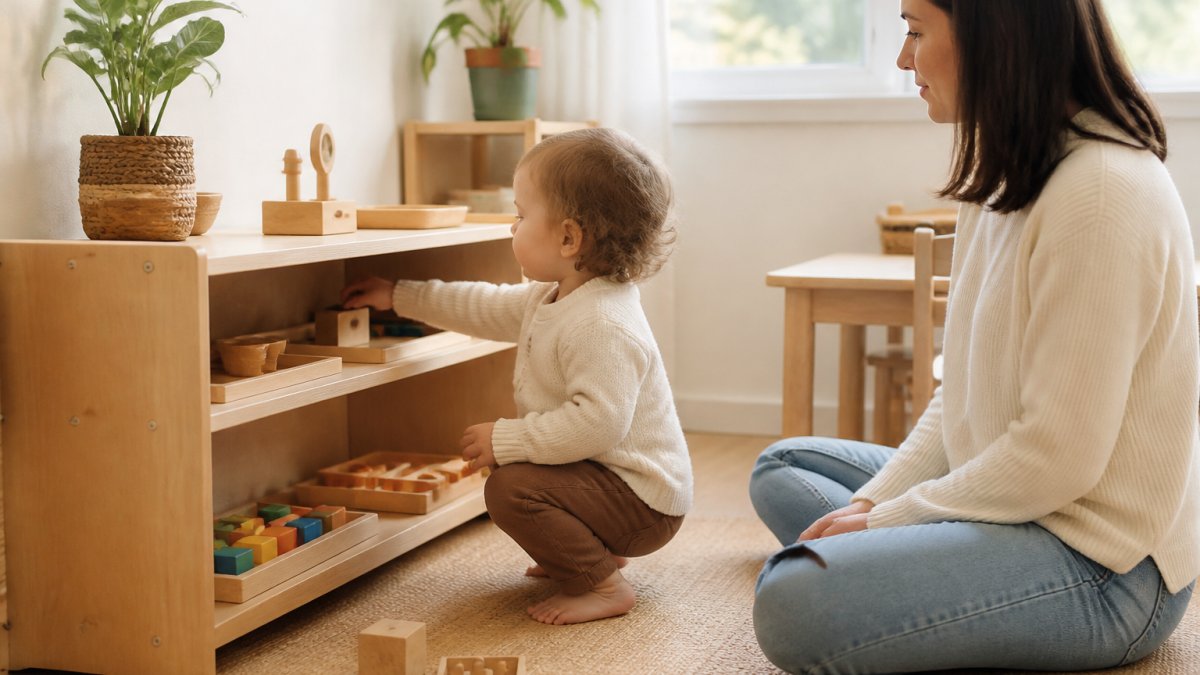
Setting Up a Prepared Montessori Toddler Environment
Lower shelves to your toddler's reach and use a small step stool for sink access. Organize materials in clear, open baskets so they can choose freely. Keep three to five activities available at a time; too many choices create confusion, not freedom.
Age-by-Age Montessori at Home: What to Expect
12-18 months: Focus on sensory exploration and simple practical life tasks.
- Realistic activities: Dropping objects into a container, touching different textures, exploring safe kitchen items
- What to expect: Very short focus (2-3 minutes), lots of repetition, frequent adult help
- Avoid: Small pieces, complex tasks, or expectations of "correct" use
18-24 months: Toddlers are more coordinated and can follow simple directions.
- Realistic activities: Pouring water between cups, sorting objects by color, wiping surfaces, stacking
- What to expect: Focus improves to 5-8 minutes; repetition and spills are constant
- Avoid: Pressure to do things "correctly"
24-36 months: Older toddlers show stronger coordination and multi-step ability.
- Realistic activities: Folding cloth, sweeping, caring for plants, sorting, simple cooking tasks
- What to expect: Focus stretches to 10-15 minutes; repetition and independence assertions are normal
- Avoid: Rushing or taking over
Choosing and Introducing Montessori Activities for Toddlers at Home
When introducing a new activity: (1) Demonstrate slowly and silently, letting them watch your hands. (2) Invite them to try and step back. (3) Let them practice without correction, spills are part of learning. (4) Expect repetition; this is how they internalize skills. (5) Rotate out activities when interest wanes.
Common challenges:
- Won't focus: Normal at 12-18 months. Shorten activities and be patient.
- Use materials "wrong": There's no wrong way to explore; stacking cups teaches spatial relationships.
- Wants constant help: Offer minimal guidance; resist taking over.
- Loses interest quickly: Rotate activities more frequently.
- Siblings or pets disrupt: Set up a contained area or accept a messier, less controlled space.
Practical Montessori Activities You Can Start Today
Water play (18+ months): Set up a low table with two cups and a pitcher. Pouring builds fine motor control and focus.
Sorting by color (18+ months): Put objects of different colors into baskets for sorting. Teaches categorization and color recognition.
Practical life tasks (18+ months): Wiping tables, sweeping crumbs, watering plants. Builds competence and contribution.
Sensory exploration (12+ months): Offer safe items with different textures, wooden spoons, soft cloth, smooth stones, brushes.
The Montessori Busy Board features real-world tasks like zipping, snapping, and lacing that develop hand coordination and problem-solving. It's portable enough for travel or quiet time at home.

Montessori at Home Doesn't Require Expensive Materials
Many of the best Montessori activities cost nothing. Wooden spoons, plastic containers, water, and cloth are all you need. The 6-in-1 Activity Cube combines multiple learning activities in one durable piece, making it efficient for families exploring the approach. But equally valuable are kitchen items, natural objects, and everyday household tasks.
The goal is not a perfect, curated space. It's an environment where your toddler can safely explore, make choices, and practice real skills. That can happen in any home.
Is Montessori Right for Your Toddler? What to Consider
Montessori can be transformative for many toddlers, but it's not universally the best fit. Understanding your child's needs and what to look for in a quality program matters more than the method itself.
Toddler Readiness and Temperament
Montessori works best for toddlers who:
- Enjoy exploration and making choices within boundaries
- Can focus on a single activity for 5-10 minutes (typical for ages 18-36 months)
- Respond well to gentle guidance rather than frequent verbal direction
- Are comfortable in group settings with mixed ages
Montessori may be less ideal if your toddler:
- Needs frequent adult reassurance or structured transitions between activities
- Prefers more explicit instruction and clear rules
- Becomes overwhelmed by too many choices, even when limited
- Has sensory sensitivities that make a busy classroom environment challenging
This isn't a judgment, it's about fit. Some children thrive with child-led discovery; others do better with a more teacher-directed, predictable routine.
What to Look for in a Quality Toddler Montessori Program
Not all programs calling themselves "Montessori" follow the method authentically. When evaluating a school or classroom, use this practical checklist:
Teacher Training & Credentials
- Lead teachers hold an AMI (Association Montessori Internationale) or AMS (American Montessori Society) credential, or are actively pursuing one
- Staff have training specific to the toddler age group (ages 18 months-3 years), not just general early childhood certification
- Teachers understand child development milestones and can explain how the classroom supports them
Classroom Environment & Materials
- Shelves are low and accessible; materials are real (not plastic replicas) and age-appropriate
- Activities focus on practical life (pouring, sorting, self-care) and sensorial exploration, not academics
- The room is calm and uncluttered, with 3-5 activities available at a time, not dozens
- Children can move freely and choose their own work
Ratios & Group Dynamics
- Teacher-to-child ratio is no more than 1:8 for toddlers (many quality programs maintain 1:6)
- The classroom includes a mix of ages (typically 18 months-3 years), allowing younger toddlers to observe and learn from older peers
- Transitions between activities are unhurried; children are not rushed
Observation & Individualization
- Teachers spend time observing rather than constantly directing
- Parents receive regular feedback on their child's progress, interests, and developmental readiness
- The program adjusts to individual pace; there's no expectation that all toddlers master the same skills at the same time
Safety & Practical Considerations
- Materials are regularly sanitized; the space is safe for mobile toddlers
- The program has clear policies on illness, transitions, and parent communication
- Ask how the program handles separation anxiety, which is normal at this age
Trade-Offs and Realistic Outcomes
What Montessori typically supports: Research from the Institute of Education Sciences and other studies show that quality Montessori programs correlate with stronger executive function, social-emotional skills, and kindergarten readiness. However, these outcomes depend heavily on program quality and consistency at home.
What Montessori does not guarantee:
- Academic acceleration. Montessori prioritizes depth and understanding over speed; your toddler may not be "ahead" in letter recognition or numbers compared to peers in other programs, and that's intentional.
- Perfect behavior or instant independence. Toddlers are still learning; they need guidance, patience, and time.
- A smooth transition to traditional schools. If your family later moves to a more structured, teacher-led classroom, your child will adapt, but the shift in expectations may take a few weeks.
- One-size-fits-all results. Outcomes depend on your child's temperament, the program's quality, and how consistently you reinforce the approach at home.
Honest limitations:
- Cost can be significant.
- Availability varies by location. Rural areas and some suburbs may have few or no authentic Montessori options.
- Group care isn't for every child. Some toddlers do better with one-on-one care or smaller family-based settings.
- Structure matters for some children. If your toddler needs predictable routines and clear boundaries to feel secure, a highly child-led environment may create anxiety rather than confidence.
Montessori at Home as an Alternative
If cost, access, or fit is a barrier, you can apply core Montessori principles at home without formal schooling. Many families use this hybrid approach: a traditional preschool or daycare for socialization and group care, plus Montessori-inspired routines and materials at home. This gives your toddler the benefits of choice, practical work, and respect for pace without the full financial or logistical commitment of a Montessori school.
A Thoughtful Gift That Grows With Your Grandchild
If you're a grandparent looking for a gift that truly matters, Montessori toys are worth considering. These aren't flashy or loud. They're quiet, beautiful, and built to last through multiple grandchildren.
A quality Montessori Shape Sorting Cube ($34.45) teaches shapes and colors through hands-on exploration. It sits on a shelf and invites play without batteries or screens. These toys become keepsakes.
The beauty of Montessori gifts is that they support what parents are already trying to do, raise capable, curious children. You're not fighting against the parenting approach; you're supporting it.
Starting Montessori for toddlers at home is simpler than you might think. Project Montessori's educator-approved toys are designed to support this journey, from the Busy Board that builds practical life skills to the Activity Cube that develops concentration and problem-solving.

| Activity Type | Best Age | Key Benefit | Example |
|---|---|---|---|
| Practical life | 12-36 months | Independence and coordination | Pouring, sorting, wiping |
| Sensorial exploration | 18-36 months | Focus and concentration | Texture boards, shape sorters |
| Fine motor work | 12-36 months | Hand strength and control | Lacing, threading, stacking |
| Real-world tasks | 18-36 months | Problem-solving and confidence | Fishing sets, busy boards |
Frequently Asked Questions
What are the main benefits of Montessori education for toddlers?
Montessori education fosters independence, self-motivation, and confidence in toddlers through child-led learning and hands-on activities. Toddlers develop fine motor skills, concentration, and problem-solving abilities in a prepared environment. Research from the Institute of Education Sciences shows Montessori preschool models support kindergarten readiness skills and social-emotional outcomes. A nationwide study reported more positive outcomes in public Montessori programs compared to other early education approaches.
How can I start Montessori at home with my toddler?
Begin by creating a prepared environment with low shelves, child-sized furniture, and accessible toys. Rotate a small selection of activities to maintain engagement. Introduce practical life activities like pouring, sorting, and self-care tasks. Observe your toddler's interests and follow their lead rather than directing every activity. Use real, natural materials whenever possible. The Montessori Busy Board and 6-in-1 Activity Cube are excellent starting points for developing fine motor skills and concentration at home.
Is Montessori suitable for every toddler?
Montessori is not necessarily the best option for every child or family. Success depends on your toddler's temperament, your family's values, and your ability to provide a prepared environment. Some toddlers thrive with child-led choice, while others need more structure. Consider your toddler's developmental readiness, attention span, and learning style. You can test the approach by introducing a few Montessori activities or materials before committing to a full program or school setting.
What materials and toys work best for Montessori learning at home?
Choose toys made from natural materials like wood, with simple, purposeful designs. Look for items that develop specific skills: the Montessori Shape Sorting Cube builds spatial awareness and fine motor control, the Montessori Catch & Count Fishing Set combines motor practice with early math, and the Montessori Busy Board teaches practical life skills like zipping, snapping, and lacing. Select materials appropriate for your toddler's age and developmental stage, rotating them regularly to sustain interest and challenge.