

Montessori Toys to Foster Creativity: A Parent's Guide
Last Updated: October 23, 2026
Quick Summary
Montessori toys foster creativity because they are open-ended, hands-on materials with no single correct outcome, so the child decides what to build or imagine. Look for natural materials, simple battery-free design, multiple ways to play, and a real skill behind the play.
- The Toy Association's 2026 report found 78% of parents want toys that build creativity and problem-solving.
- A toy with one correct outcome, like a single-solution shape sorter, is not Montessori-aligned.
- Keep three to five toys on a low shelf and rotate the selection every week or two.
- The Magnetic Wand Building Set costs $39.95 and has no instruction sheet or wrong answer.
- Describe what you see and ask open questions instead of praising the result or finishing the puzzle.
Table of Contents
- Why Montessori Toys Spark Creativity
- How to Choose Montessori Toys for Your Child
- Open-Ended Toys for Toddlers That Grow With Them
- Best Montessori Toys for 18 Month Olds
- Building a Creative Play Space at Home
- How to Encourage Creativity Without Directing Play
- Frequently Asked Questions
Why Montessori Toys Spark Creativity
The Toy Association's 2026 Toy & Play Trends report found that 78% of parents want more toys that help children develop creativity and problem-solving skills (Toy & Play Trends).
Montessori toys are play materials built around open-ended, hands-on exploration rather than a single scripted outcome. They favor natural materials, simple design, and real-life skill practice over flashing lights and pre-programmed responses. That design choice is the whole point.
A systematic review of indoor loose-parts play and cognitive development in children ages 0-6 examined exactly this kind of open-ended play, and a University of North Carolina article on creativity and toys points to classic blocks and construction sets as the toys that support improvisational, unscripted play.
Below, we'll show you how to spot a genuinely Montessori-aligned toy, which ones suit which stage, and how to set up a play space that keeps creativity alive without you running the show.
What Makes a Toy Montessori-Aligned
Four traits separate a real Montessori-aligned toy from one wearing the label as marketing. Natural materials, simple design with no batteries, open-ended use with no single correct answer, and a real skill behind the play. A toy that only does one thing when you press a button is not Montessori, no matter what the box says.
That last point matters for buyers. Plenty of toys borrow the word "Montessori" and change nothing else. If you want a deeper walkthrough, our guide on how to identify authentic Montessori toys covers the tells in detail.
How to Choose Montessori Toys for Your Child
Match the toy to the developmental stage, not the birthday. A toy that is too advanced frustrates; one that is too easy gets abandoned. Watch what your child is already trying to do, then pick the material that lets them practice it.
Ask three questions before buying:
- Can my child use this more than one way?
- Does it build a real skill, like grasping, sorting, or planning?
- Will it survive being dropped, chewed, and rebuilt?
Value matters too. A well-made wooden set that lasts years often costs less per year of use than three plastic toys that break. Buy a few pieces first, see what your child returns to, then add more.
Materials, Safety, and Simplicity
Safety comes first, especially in the first year, when everything goes in the mouth. Look for non-toxic finishes, sealed surfaces, and no small loose parts for children under three. Solid wood and quality fabric are easier to inspect than molded plastics with hidden seams.
Simplicity is a safety feature as much as a design choice. Fewer parts means fewer choking hazards and less overstimulation. For a fuller breakdown, our safe materials guide for baby toys goes deeper on what to check before you buy.
Open-Ended Toys for Toddlers That Grow With Them
Open-ended toys for toddlers are materials with no fixed endpoint: blocks, wands, balls, and loose parts a child can combine in endless ways. They grow with the child because the child supplies the challenge. A two-year-old stacks; a four-year-old builds a castle with a working gate.
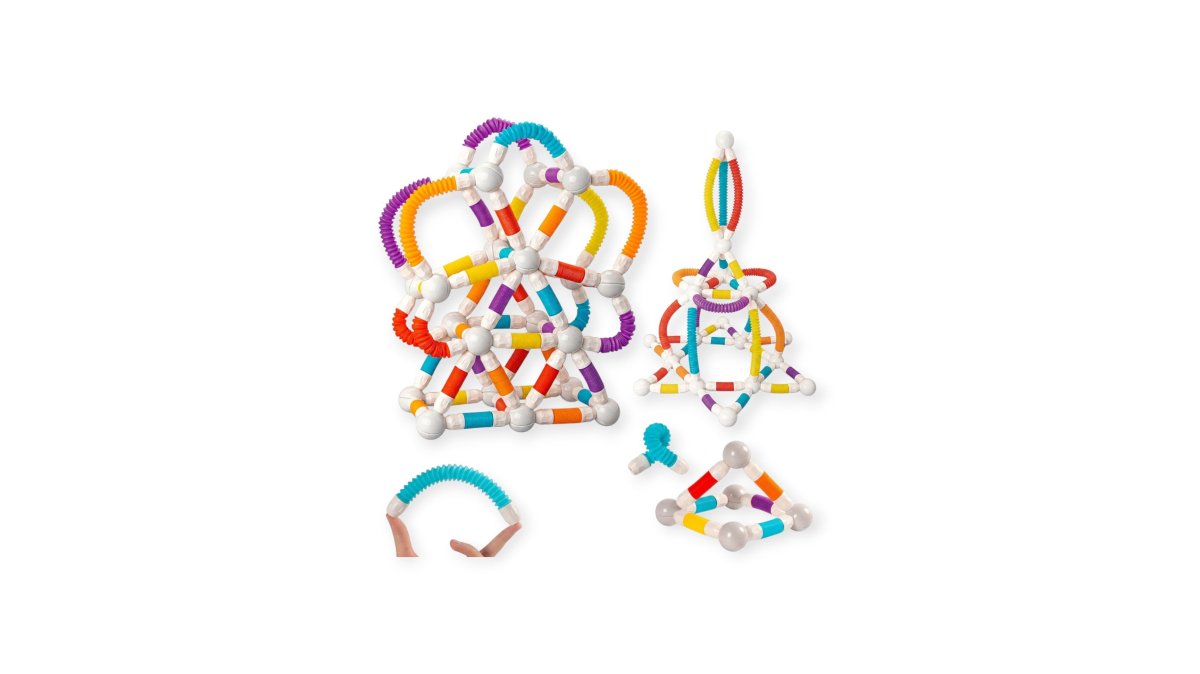
Our Montessori Magnetic Wand Building Set is a good example at $39.95. The color-coded wands extend from 8 cm to 18 cm and connect magnetically, so there is no instruction sheet and no wrong answer. Towers, patterns, and geometric shapes all come from the same set.

For a shoppable collection that grows with your toddler's stage, browse our Montessori toys for 2 year olds.
Best Montessori Toys for 18 Month Olds
At 18 months, the goal is grasping, stacking, filling, dumping, and simple pretend play. Toddlers this age are testing cause and effect constantly.
Readiness cues to watch for: your toddler carries objects from room to room, stacks two or three blocks before knocking them down, puts things into a container and dumps them out, and imitates what you do with a spoon or cloth. Those cues matter more than the birthday on the box. If your child is not there yet, a simpler grasping or posting toy is the better fit; if they have moved past stacking, look at the 2+ picks below.
Here is how we would match the stage to the material:
| Toy | Age | What it builds | Price |
|---|---|---|---|
| Felt Farm Play Board | 2+ | Storytelling, vocabulary, hand-eye coordination | $34.95 |
| Magnetic Dot Art Drawing Board | 3+ | Pen grip, focus, color recognition | $29.95 |
| 3D Tangram Puzzle Blocks | 3+ | Spatial thinking, logic, fine motor control | $49.95 |
| Magnetic Wand Building Set | 3+ | Creativity, problem-solving, spatial awareness | $39.95 |
The Montessori Felt Farm Play Board at $34.95 is the earliest fit here. Its 41 velcro-backed felt pieces on a 43 x 28 inch board let a toddler build and rebuild a farmyard scene, which is open-ended storytelling at its simplest.
Montessori Magnetic Dot Art Drawing Board →

A note on the 3+ items in that table: they are worth buying only if your child has stopped putting small parts in their mouth and can sit with a task for a few minutes.
Safety and supervision for this stage. Check every toy for loose or detachable parts, cracked wood, and peeling finish before each play session.
Toy rotation at this age. Keep three to five toys on a low shelf and store the rest. Swap the selection every week or two. A toddler who sees ten toys at once flits between them; a toddler who sees three plays longer with each, and the old toys feel new again after a break.
For a fuller list of stage-matched picks, see our guide to the best Montessori toys for 18-month-olds.
Building a Creative Play Space at Home
A creative play space needs less than most parents think: a low shelf, a few toys within reach, and room to move.
The rotation system, concretely. Most practitioners find that three to five toys out at a time is the sweet spot for a toddler. Store the rest out of sight, a closet shelf or a lidded bin works, and swap the selection every week or two. When you rotate, put the outgoing toys away rather than piling them on the shelf, and bring back one or two favorites alongside something new. The goal is focused play, not a constantly changing buffet. A child who sees ten toys at once often flits between them; a child who sees three plays longer with each, and old toys feel new again after a break.
Set up for independence. A low, open shelf at the child's height, a small table and chair sized to the child, and a clear floor area are the core.
Safety in the play space. Anchor any shelving to the wall, keep cords and curtains out of reach, and check toys for loose parts, cracked wood, and peeling finish before each session.
Buying criteria that matter. When you are choosing what goes on the shelf, weigh four things: durability (solid wood and quality fabric survive drops and chewing better than molded plastic), materials (non-toxic finishes and sealed surfaces are easier to inspect), versatility (a toy that can be used more than one way earns its shelf space), and price per year of use (a well-made wooden set that lasts years often costs less per year than three plastic toys that break). Buy a few pieces first, see what your child returns to, then add more.
Household objects as safe alternatives. You do not need to buy much to start.
Accessibility and different timelines. Children reach these stages on different schedules, and that is normal.
Our guide on how to rotate Montessori toys walks through a simple weekly system. The short version: keep three to five toys out, store the rest, and swap on a regular schedule.
How to Encourage Creativity Without Directing Play
The hardest part of Montessori parenting is stepping back. Creativity needs room to fail, and a child who is told the "right" way to build a tower never learns to test their own ideas. Your job is to set up the material and then get out of the way.
Try these:
- Describe what you see instead of praising the result: "You stacked four blocks."
- Ask open questions: "What happens if you put the big one on top?"
- Let the play be "wrong." A tower that falls is information, not a mistake.
- Resist the urge to finish the puzzle for them.
Repetition is not a problem to fix. A child who rebuilds the same tower twenty times is practicing, and that practice is where concentration and mastery come from. Screen-free, hands-on play like this is the whole reason we curate educator-approved toys built for independent exploration.

Frequently Asked Questions
What Montessori toys encourage creativity?
Open-ended toys do the most for creativity because there is no single right answer. Look for wooden blocks, tangram puzzles, magnetic building sets, and drawing boards that a child can use in many ways. The Montessori Magnetic Wand Building Set, for example, lets kids stretch and snap wands into towers or abstract shapes with no instruction sheet. The key is that the child decides what to build, not the toy.
How do Montessori toys support imaginative play?
Montessori toys leave room for the child to lead. A felt farm board with movable pieces lets a toddler invent stories about animals and crops, while a set of wooden blocks can become a house, a road, or a stack to knock down. Because these toys are simple and hands-on, children supply the imagination instead of following lights, sounds, or a scripted storyline.
How many toys should I offer at once?
A small, rotating selection works better than a full shelf. Offer a handful of toys at a time and swap them every week or two. This keeps attention fresh and avoids overstimulation. The Toy Association reports that 78% of parents want more toys that help children develop skills like creativity and problem-solving, and rotation helps each toy get the focus it deserves.
Are Montessori toys safe for babies and toddlers?
Safety depends on the toy and the age of the child. Check the recommended age on every product, look for non-toxic materials and rounded edges, and supervise play with small parts. The Montessori Felt Farm Play Board is listed for ages 2 and up, while many magnetic and drawing sets start at age 3. Always follow the manufacturer's age guidance and inspect toys for loose pieces before each use.
The real challenge is not finding toys. It is choosing a few that let your child lead, then resisting the urge to direct. Project Montessori curates educator-approved, Montessori-aligned toys designed for exactly that: independent play, open-ended creativity, and skill-building at every stage. Start with a single piece, watch what your child returns to, and build from there. Shop now and give your child playtime that grows with them.
