

Best Montessori Toys for 18-Month-Olds
Table of Contents
-
Best Montessori Toys for 18-Month-Olds: Our Top Picks
- 1. Montessori Shape Puzzle ($29.95)
- 2. Montessori Shape Sorting Cube ($34.45)
- 3. 6-in-1 Activity Cube ($54.45)
- 4. Montessori Busy Board ($34.45)
- 5. Montessori Sensory Sorting Cube ($39.45)
- 6. Montessori Busy Cube ($34.45)
- 7. Montessori Garden Shape Sorter ($49.95)
- 8. Montessori Animal Stacking Game ($34.45)
- Fine Motor Toys for 18-Month-Olds: Building Strength and Control
- Educational Toys for 18-Month-Olds That Support Cognitive Growth
- Independent Play Toys for Toddlers: Fostering Self-Directed Learning
- Montessori Gifts for Toddlers: A Thoughtful Investment in Development
- How to Choose Authentic Montessori-Aligned Toys
- Safety and Durability: What to Look For
- Frequently Asked Questions
Last Updated: October 10, 2026
Best Montessori Toys for 18-Month-Olds: Our Top Picks
At 18 months, your toddler is discovering cause and effect and refining hand movements. The best Montessori toys for 18 month olds support this stage with open-ended play that builds independence and confidence, pieces that grow with your child and encourage self-directed learning without screens or batteries.
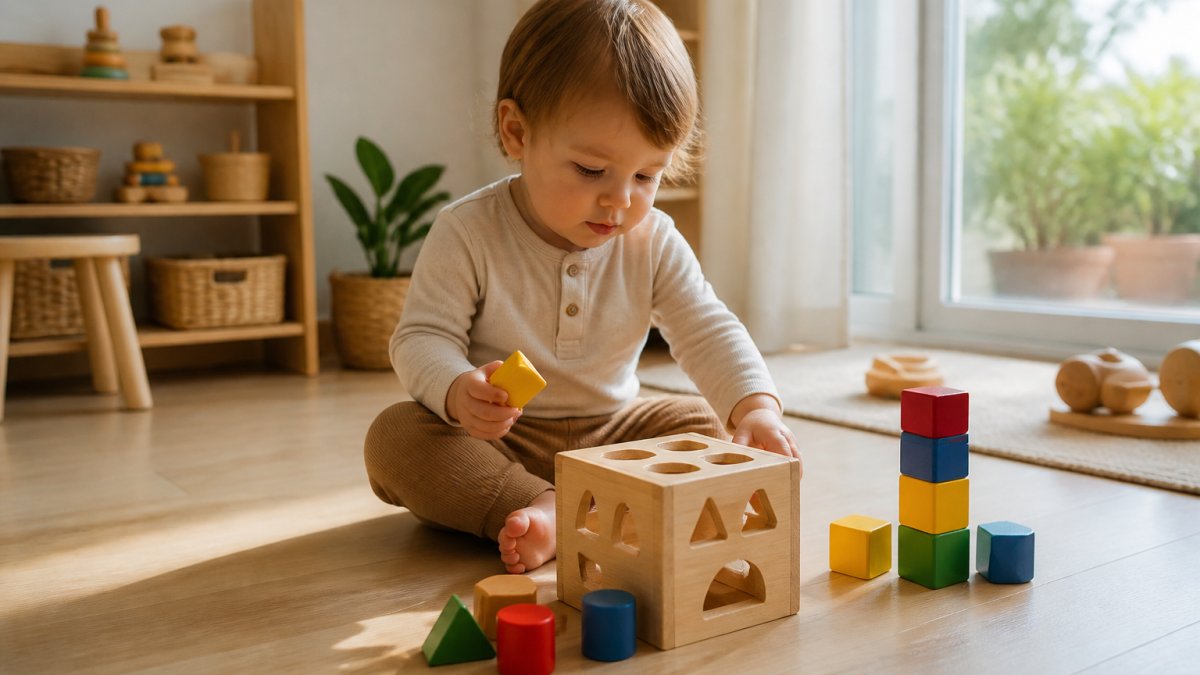
This guide covers eight toys that deliver real developmental value, supporting fine motor skills, problem-solving, and concentration. Whether you're a grandparent searching for a thoughtful gift or a parent investing in quality play materials, these recommendations balance durability, safety, and genuine learning potential.
1. Montessori Shape Puzzle ($29.95)
This solid wood puzzle introduces geometric thinking without frustration. Your child places simple shapes through corresponding holes, then retrieves them, a satisfying cycle that builds hand-eye coordination and shape recognition.
What makes it work: The pieces are chunky enough for small hands to grasp, and the satisfaction of dropping a shape through the correct slot keeps toddlers returning to it for weeks. Made from sustainably-forested wood with non-toxic paint, it's built to survive rough handling.
Best for: Toddlers just starting to understand that shapes have names and properties. This puzzle teaches spatial reasoning through repetition rather than frustration.
https://www.projectmontessori.com/products/montessori-shape-puzzles

2. Montessori Shape Sorting Cube ($34.45)
A cube with 12 wooden shapes that fit through corresponding holes on each side. Your toddler experiments with rotation, learns that shapes only fit certain ways, and practices problem-solving independently.
The real value: Unlike flat puzzles, this cube invites exploration from multiple angles. Your child discovers that the triangle won't fit the square hole, and learns why. It's cognitive work disguised as play.
Best for: 18-month-olds ready to move beyond single-hole puzzles. This one teaches spatial concepts and persistence without requiring adult help.
https://www.projectmontessori.com/products/montessori-shape-sorting-cube

3. 6-in-1 Activity Cube ($54.45)
Six sides, six activities: an animal pattern sorter, sliding number blocks, a sensory clock, and three more hands-on challenges. This is the toy that keeps working as your child grows from 18 months through age 4.
Why it's worth the investment: Each side teaches something different, colors, numbers, shapes, time concepts. Your toddler can focus on one activity or rotate between them. The animal patterns on one side introduce early learning through play.
Best for: Families wanting one versatile piece that grows with their child. The variety prevents boredom and supports multiple developmental skills at once.
https://www.projectmontessori.com/products/6-in-1-activity-cube

4. Montessori Busy Board ($34.45)
Eight different fasteners, zippers, buckles, snaps, shoelaces, mounted on a portable board. Your toddler practices real-life skills: zipping a jacket, buckling a shoe, tying laces.
The hidden benefit: These aren't abstract motor exercises. They're practical skills your child sees adults use daily. The repetition builds muscle memory and independence. The board is small enough to travel, making it ideal for plane rides or car trips when screen time isn't an option.
Best for: Parents wanting their toddler to practice dressing skills in a low-pressure environment. Grandparents will appreciate how it keeps little hands engaged during visits.
https://www.projectmontessori.com/products/kids-educational-board
5. Montessori Sensory Sorting Cube ($39.45)
Textured blocks and balls with different surfaces, smooth, bumpy, ridged, that your toddler places into a cube and retrieves. Six blocks and two balls offer variety without overwhelming.
What sets it apart: Sensory exploration is how 18-month-olds learn. Each texture feels different, stimulating fingers and developing sensory awareness. The BPA-free plastic is durable and easy to clean. Unlike wooden toys, plastic handles moisture better if your toddler mouths pieces (common at this age).
Best for: Sensory-seeking toddlers who need tactile input. The variety of textures keeps attention longer than uniform toys.
https://www.projectmontessori.com/products/montessori-sensory-sorting-cube
6. Montessori Busy Cube ($34.45)
A compact wooden cube with six interactive sides: a fingertip spiral, spring latch, rotating wheel, one-way switch, faucet switch, and rotating screw. Designed for travel, it's small enough for a diaper bag but engaging enough for extended play.
The advantage: Each mechanism teaches cause and effect. Turn the wheel, it spins. Push the switch, something moves. Your toddler discovers how the world works through safe, repeatable actions.
Best for: Families needing a portable, durable toy that teaches problem-solving. The compact size and secure construction mean nothing breaks off during travel.
https://www.projectmontessori.com/products/montessori-busy-cube
7. Montessori Garden Shape Sorter ($49.95)
A wooden rabbit with 8 carrots, 12 fruit pieces, and 10 worms to insert into matching holes. The garden theme makes it more imaginative than abstract shape sorters, your toddler "plants" and "harvests."
Why it works: The narrative hook (planting a garden) gives meaning to the sorting task. Your child isn't just matching shapes; they're feeding a rabbit or growing vegetables. Solid wood construction means it lasts through multiple children. The magnetic rabbit adds surprise and delight.
Best for: Toddlers who respond to storytelling and imaginative play. This toy combines learning with pretend play, keeping engagement high.
https://www.projectmontessori.com/products/montessori-garden-shape-sorter
8. Montessori Animal Stacking Game ($34.45)
Ten chunky wooden animal blocks in different shapes, giraffe, elephant, cow, sheep, crocodile, that stack in various ways. Difficulty cards (Levels 1-3) show different stacking challenges as your child grows.
The appeal: Animals are inherently interesting to toddlers. Stacking develops fine motor control and spatial reasoning. The difficulty progression means the toy doesn't get outgrown. Your child starts with simple stacking, then follows pattern cards for more complex challenges.
Best for: Toddlers who love animals and enjoy the repetitive satisfaction of stacking. The chunky blocks are safe and easy to grip.
https://www.projectmontessori.com/products/montessori-animal-stacking-game
| Toy | Price | Best For | Key Skill |
|---|---|---|---|
| Shape Puzzle | $29.95 | Shape recognition | Hand-eye coordination |
| Shape Sorting Cube | $34.45 | Spatial reasoning | Problem-solving |
| 6-in-1 Activity Cube | $54.45 | Versatile learning | Multiple skills |
| Busy Board | $34.45 | Life skills practice | Independence |
| Sensory Sorting Cube | $39.45 | Tactile exploration | Sensory awareness |
| Busy Cube | $34.45 | Travel & exploration | Cause and effect |
| Garden Shape Sorter | $49.95 | Imaginative play | Cognitive development |
| Animal Stacking Game | $34.45 | Motor control | Fine motor skills |
Fine Motor Toys for 18-Month-Olds: Building Strength and Control
Fine motor skills develop rapidly between 18 and 24 months. Toys requiring grasping, turning, inserting, and stacking build the muscle strength needed for later writing and self-care.
The best toys offer resistance without frustration, tight enough to challenge, loose enough to succeed. The toys above hit that balance by design.
Wooden toys offer better tactile feedback than plastic, teaching hand strength naturally. The busy board and garden sorter are particularly effective because they require sustained grip and controlled insertion.
Educational Toys for 18-Month-Olds That Support Cognitive Growth
Cognitive development at 18 months centers on cause and effect and early problem-solving. Your toddler is beginning to predict outcomes: "If I push this, what happens?"
The best educational toys create a feedback loop: your child acts, something happens, and they learn they caused it. The busy cube excels here with immediate cause and effect.
Color and shape recognition develop naturally through repetition with the activity cube and garden sorter, without flashcards or formal lessons.
Research from child development studies on play-based learning shows that toys requiring active problem-solving support stronger cognitive development than passive toys.
Independent Play Toys for Toddlers: Fostering Self-Directed Learning
Independence at 18 months means your child picks up a toy, explores it without help, and returns to it repeatedly, building confidence and concentration.
The toys recommended here support independent play: clear cause and effect, no "right" way to play, no adult instruction required. Your toddler explores alone, sorts shapes without demonstration, and stacks animals however they choose.
Open-ended toys hold attention longer because there's always something new to discover. A shape sorter can be played with for months.
Independent play also gives you uninterrupted time, 20-30 minutes of genuine engagement is valuable for both of you.
Montessori Gifts for Toddlers: A Thoughtful Investment in Development
If you're buying for a grandchild or friend's toddler, Montessori toys are gifts that matter, time-tested tools that support real development.
A Montessori gift is made from natural materials, invites exploration without batteries or screens, can be played with in multiple ways, and grows with the child.
A thoughtful gift respects the child's stage, toys that match current abilities while offering just enough challenge to keep them engaged.
Quality matters because cheap toys break and frustrate. Project Montessori toys are made from sustainably-sourced wood and non-toxic materials, built to last through multiple children.
How to Choose Authentic Montessori-Aligned Toys
Not every toy labeled "Montessori" actually supports Montessori principles. Here's how to evaluate genuine alignment.
Look for natural materials. Real Montessori toys are made from wood, cotton, metal, or ceramic.
Check for open-ended play. A Montessori toy has no single "correct" way to play.
Verify educator input. Genuine Montessori toys are designed by educators who understand child development.
Avoid batteries and screens. If it needs batteries or connects to an app, it's not Montessori.
Consider durability. Montessori toys are investments. They should withstand years of use and rough handling.
Safety and Durability: What to Look For
At 18 months, safety is non-negotiable. Toys must be non-toxic and free from choking hazards.
Construction quality. Quality toys have secure construction, smooth surfaces, and finishes that last through rough play.
Size and choking hazard. At this age, your toddler's mouth is still their primary tool for exploration.
Durability over time. Quality Montessori toys last through multiple children and years of daily use, making them worth the investment.
Research from toy safety standards and testing shows that toys meeting safety certifications significantly reduce injury risk.
Frequently Asked Questions
What are the best Montessori toys for an 18-month-old?
The best Montessori toys for 18-month-olds focus on hands-on learning and sensory exploration. Shape sorters, stacking toys, busy boards, and wooden puzzles are ideal because they develop fine motor skills, hand-eye coordination, and problem-solving abilities. At this age, children benefit from open-ended play toys made from natural materials like wood that encourage independent exploration and concentration.
How do fine motor toys for 18-month-olds support development?
Fine motor toys strengthen the small muscles in hands and fingers, essential for tasks like self-feeding and eventually writing. Shape sorters, stacking games, and busy boards with zippers and buttons require precision grasping and hand-eye coordination. These activities build the muscle control and dexterity your child needs to master everyday skills and develop confidence in independent play.
What makes a toy safe for an 18-month-old?
Safe toys for 18-month-olds have smooth edges, no small detachable parts that pose choking hazards, and are made from non-toxic materials. Look for toys certified for ages 1-4 and crafted from solid wood or BPA-free plastic. Montessori toys from Project Montessori are safety certified and made with sustainably sourced wood and non-toxic paint, ensuring your toddler plays with materials you can trust.
Should I rotate toys or offer them all at once?
Toy rotation is a Montessori principle that keeps play fresh and maintains your child's focus. Offering 5-7 toys at a time prevents overwhelm and helps toddlers develop deeper concentration. Rotating toys weekly or monthly keeps them feeling new and exciting, encouraging sustained engagement rather than the scattered attention that comes from too many options available simultaneously.
Are wooden Montessori toys worth the investment?
Yes, wooden Montessori toys are a worthwhile investment because they last through multiple children, withstand rough toddler play, and align with child-led learning principles. Unlike plastic toys, quality wooden toys from Project Montessori develop fine motor skills through realistic resistance and weight, encourage focused play, and grow with your child across several developmental stages.
Choosing toys for your 18-month-old is an investment in their development. The best Montessori toys for 18 month olds aren't the most expensive or the most colorful, they're the ones that invite exploration, build skills, and grow with your child. Project Montessori's curated collection supports independence, fine motor development, and cognitive growth through open-ended play. Shop now and give your toddler toys that matter.