

Montessori Toys for Independent Play: 9 Picks That Work
Table of Contents
- Montessori Toys for Independent Play: What Actually Keeps a Toddler Busy
- Quick Comparison: 9 Montessori Toys for Independent Play
- The Best Toys for Independent Play Toddlers Reach For First
- Montessori Toys for 18 Month Olds: Where to Start
- Independent Play Activities for Toddlers That Build Real Skills
- Montessori Toy Rotation: How Many Toys to Keep Out at Once
- Montessori Stick Drop Tower Game ($39.95)
- How to Choose Montessori Toys for Independent Play
- Frequently Asked Questions
Last Updated: October 14, 2026
Montessori Toys for Independent Play: What Actually Keeps a Toddler Busy
Montessori toys for independent play are designed so a child can pick them up, work out how they function, and stay absorbed without an adult directing every move.
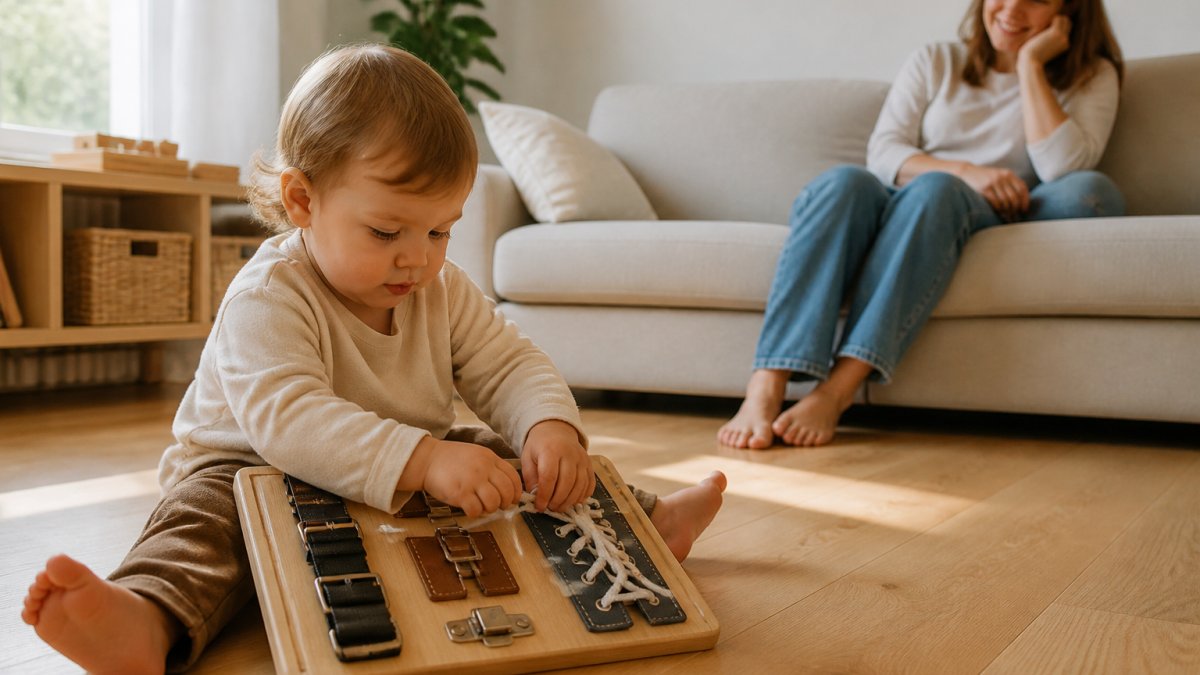
Most guides treat independent play as a personality trait. It isn't, it's a setup problem.
Below, we break down nine picks that reliably hold attention, plus how to rotate them so nothing goes stale.
The core principle comes from Maria Montessori's observation that young children prefer real, functional objects over pretend ones. The American Montessori Society's overview of the method explains that this preference for purposeful work is what drives a child's concentration.
Quick Comparison: 9 Montessori Toys for Independent Play
| Toy | Price | Best For | Key Skill |
|---|---|---|---|
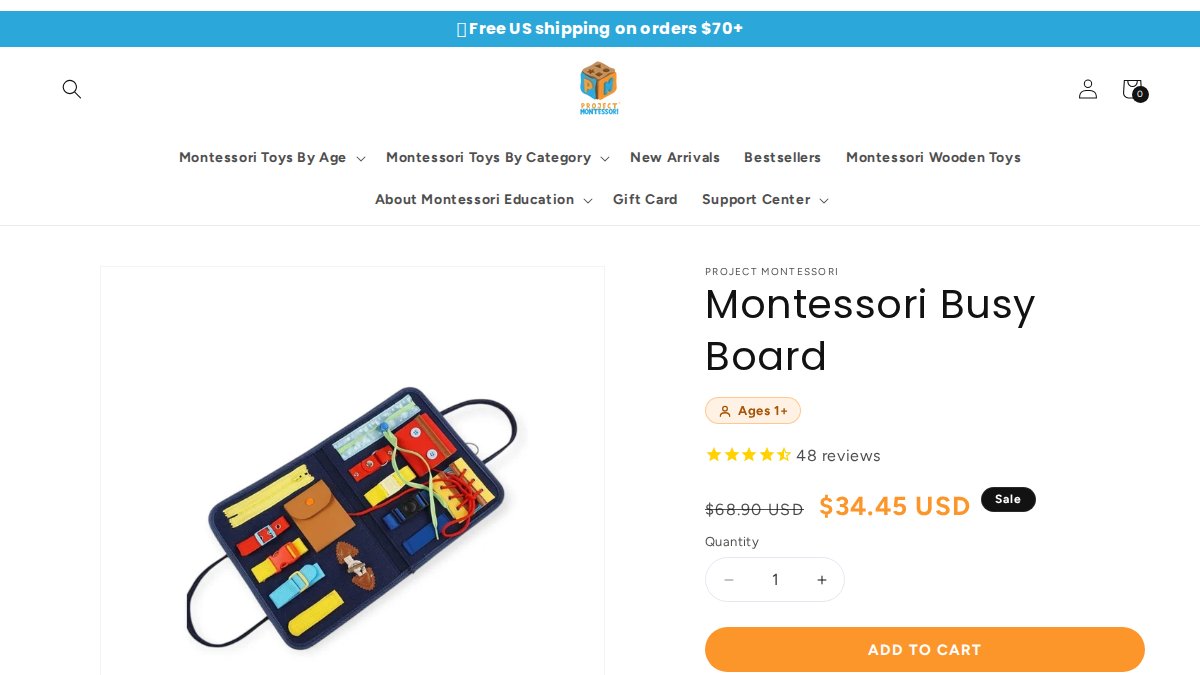
| Montessori Busy Board | $34.45 | Ages 1-4, travel | Practical life, focus |
| Montessori Shape Sorting Cube | $34.45 | Ages 3+ | Shape and color matching |
| 6-in-1 Activity Cube | $54.45 | Ages 1-4 | Multiple skills in one |
| Montessori Catch & Count Fishing Set | $39.95 | Ages 1+ | Counting, color sorting |
| Montessori Busy Cube | $34.45 | Ages 1+, travel | Fine motor, curiosity |
| Montessori Garden Shape Sorter | $49.95 | Ages 3+ | Problem-solving |
| Montessori Animal Stacking Game | $34.45 | Ages 3+ | Stacking, creativity |
| Montessori Bear Dress Up Game | $39.95 | Ages 3+ | Dressing, coordination |
| Montessori Stick Drop Tower Game | $39.95 | Ages 3+, family | Logic, patience |
The Best Toys for Independent Play Toddlers Reach For First
The best toys for independent play toddlers return to have a clear "start" and a satisfying "finish": a buckle that snaps, a shape that drops through its hole, a fish that sticks to the rod. That loop of effort and result keeps a child coming back.

Montessori Busy Board ($34.45)
Our top pick for the 1-4 crowd.
What works: The zipper and buckles are the standouts. They're genuinely hard for small hands at first, which is exactly the point.
Where it falls short: This is a flat board, not a cube.
It's also sized to slip into most bags, which makes it the toy we'd reach for on a plane or a long car ride instead of handing over a phone.
Montessori Shape Sorting Cube ($34.45)
Twelve wooden shapes, one cube, and a lot of trial and error.
What works: The self-correction loop. When a shape doesn't fit, the toy tells the child instantly and without judgment, the whole engine of independent play.
Where it falls short: It's a single-purpose toy. Once a child masters all twelve shapes, it loses some pull.
Crafted from natural wood with non-toxic paint and smooth edges, it survives being dropped, chewed, and stacked on.
6-in-1 Activity Cube ($54.45)
If you'd rather buy one thing than five, this is it.
What works: The variety. A child can switch tasks when focus dips, stretching a play session longer than a single-task toy would.
Where it falls short: It's the priciest pick here at $54.45, and it takes up more floor space than the flat boards. For a small apartment, that matters.
Montessori Toys for 18 Month Olds: Where to Start
For an 18-month-old, start with toys that need only one action to succeed. Catching, grasping, and dropping are the skills in play at this stage, so a toy that rewards a single motion holds attention far longer than one requiring a sequence. This is also where parents overspend: two or three toys that match their current abilities will keep them busier than ten that don't.
Montessori Catch & Count Fishing Set ($39.95)
The Catch & Count Fishing Set replaces fiddly magnets with hook-and-loop fastening, so a fish sticks with a gentle touch.
What works: Every catch becomes a counting exercise.
Where it falls short: The fabric fish are soft by design, which means they show wear faster than wood.
The pond mat folds into its own storage bag, so cleanup takes seconds, and a toy that's a pain to put away stops coming out.
Montessori Busy Cube ($34.45)
Six sides, six mechanisms: a fingertip spiral, spring latch, one-way switch, universal wheel, faucet switch, and rotating screw.
What works: Everything is attached. Nothing gets lost in a car seat or under an airplane seat, the failure mode of most travel toys.
Where it falls short: It contains small parts and carries a choking hazard notice, so it needs supervision with the youngest users.
Independent Play Activities for Toddlers That Build Real Skills
Independent play activities for toddlers work best when the toy has a built-in goal the child can see. Sorting, stacking, and fitting all give a clear target, and a clear target turns five minutes of fiddling into twenty minutes of focus.
Montessori Garden Shape Sorter ($49.95)
A wooden base, twelve fruit blocks, eight carrots, ten worms, and a magnetic rabbit.
What works: The planting-and-harvesting theme gives the play a narrative. Toddlers repeat an action far longer when it feels like a story rather than a drill.
Where it falls short: With more than thirty pieces, this one has the highest odds of a carrot going missing under the couch.
Montessori Animal Stacking Game ($34.45)
Ten chunky animal blocks, each with a simple outline of a giraffe, sheep, puppy, cow, crocodile, hippo, elephant, mouse, or rhino.
What works: The chunky blocks are easy for small hands to grip, and the leveled cards mean a three-year-old and a five-year-old can use the same set at different difficulties.
Where it falls short: Free stacking is the real draw here, and some children ignore the cards entirely. That's fine, but don't buy it expecting a structured curriculum.
Montessori Toy Rotation: How Many Toys to Keep Out at Once
Keep six to eight toys accessible at a time, and store the rest out of sight. A rotation cycle of roughly two to three weeks gives each toy enough novelty to hold attention again when it returns. The logic: a toddler with twenty toys visible is choosing constantly, which looks like boredom but is really overwhelm. A toddler with six toys plays with what's in front of them, and when you swap the set, the toys that come back feel new.
A practical rotation setup:
- Choose 6-8 toys that match your child's current skills
- Store the rest in a closed bin, out of sight
- Swap one or two toys every 2-3 weeks, not the whole set
- Watch for signs a toy is too easy (ignored) or too hard (frustration)
- Keep one travel-friendly toy in your bag at all times
Montessori Bear Dress Up Game ($39.95)
Dressing a wooden bear teaches the same skills as dressing a toddler: buttons, coordination, patience.
What works: It's a practical-life toy in the truest sense. The skills transfer directly to getting dressed in the morning.
Where it falls short: It's rated for ages 3 and up, so it's not a starting toy. An 18-month-old will mostly just chew the pieces.
Montessori Masterpieces: Sticks & Rings Builder ($34.45)
One hundred twenty sticks and rings, twenty double-sided guide cards, a wooden base, and a storage bag.
What works: The difficulty curve is genuinely well designed. A child starts with a basic shape and works up to letter formation, which lays groundwork for writing.
Where it falls short: One verified buyer noted it was too tricky for her three-year-old even with help.
Montessori Stick Drop Tower Game ($39.95)
The Stick Drop Tower Game is the one toy here built for more than one player.
What works: The tension is real, and it's genuinely funny. It builds patience and decision-making because every move has a visible consequence.
Where it falls short: It's a game, not a solo activity.
Made from premium beech wood with child-safe, non-toxic water-based paint, it comes with one tower, forty-two colored sticks, six balls, and a die.
How to Choose Montessori Toys for Independent Play
Choose toys that give immediate feedback, match your child's current skill level, and can be used without adult help.
A quick way to evaluate any toy before you buy:
| Question | Why It Matters |
|---|---|
| Can the child tell if they got it right? | Self-correction is what allows you to step back |
| Is it one action or a sequence? | Younger toddlers need single-action toys |
| Are the materials natural and safe? | Wood and non-toxic finishes hold up to daily use |
| Does it have one clear purpose? | Multi-purpose toys often do none of them well |
| Can it be stored and reset easily? | A toy that's a hassle to reset stops getting used |
For grandparents shopping for a gift, the same rules apply.
The hardest part of independent play isn't finding toys. It's resisting the urge to step in when your toddler struggles with a buckle for the third time. That struggle is the learning.
At Project Montessori, every toy in our catalog is chosen to make that struggle productive: educator-approved designs, natural wood and non-toxic finishes, and a focus on real skills over flashing lights. Start with the Montessori Busy Board for ages 1-4, or browse our full collection to build a rotation that fits your child's stage.
Frequently Asked Questions
What toys encourage independent play for toddlers?
Toys with a clear goal and a built-in error check work best. A shape sorter shows a child when a piece does not fit, so they correct it themselves instead of asking for help. Busy boards with buckles, zippers, and laces give short-attention toddlers something to master without an adult. Stacking games, pattern builders, and soft fishing sets with numbered cups all keep the activity in the child's hands. The common thread is that the toy responds to what the child does, not to what a parent says.
What makes a toy Montessori-aligned?
Three things matter most. The toy is made of natural material, usually wood, with a smooth finish and non-toxic paint. It teaches one skill at a time, like shape matching or lacing, rather than flashing lights and sounds at the child. And it is sized for small hands so a toddler can pick it up, turn it, and use it without adult help. The Catch & Count Fishing Set fits this pattern: fabric fish, a soft rod, and numbered cups that turn each catch into counting practice.
How many toys should I offer a toddler at once?
Six to eight items on an open shelf is a workable number for most toddlers. More than that and children tend to flit between toys instead of settling into one. A Montessori toy rotation helps here: keep the rest stored out of sight, then swap the shelf every one to two weeks. Most families find that a toy put away for two weeks feels new again when it comes back, which stretches the value of every piece you own.
How long can toddlers play independently?
It depends on age. An 18-month-old often manages five to ten minutes alone with a toy that interests them. By age three, many children reach 15 to 20 minutes, and some stretch longer with open-ended toys like the Sticks & Rings Builder. Build up in small steps: sit nearby without talking, then move a little further away. Rushing the process usually backfires, because a toddler who feels abandoned will follow you instead of returning to the toy.
Are open-ended toys better for independent play?
Open-ended toys tend to hold attention longer because there is no single correct outcome. A stacking game can be built into a tower, sorted by color, or lined up in a row, so the child decides what happens next. Closed toys with one right answer, like a puzzle, get solved once and then sit idle. A mix works well: one or two closed-goal toys for focus, plus open-ended pieces that a toddler can reinvent each time they play.