

Montessori Activities for 2 Year Olds: 7 Simple Setups
Table of Contents
- Why Montessori Activities Work So Well for 2-Year-Olds
- Montessori Practical Life Activities for Toddlers
- Montessori Sensory Activities for 2-Year-Olds
- Montessori Shelf Activities for Toddlers: Setting Up a Rotation
- Montessori Art Activities for Toddlers
- Safety and Supervision for Every Activity
- How to Observe Progress Without Turning Play Into Testing
- Conclusion
- Frequently Asked Questions
Last Updated: October 16, 2026
Why Montessori Activities Work So Well for 2-Year-Olds
Montessori activities for 2 year olds work because they turn everyday skills into real, hands-on work.
That is the core idea behind everything we do at Project Montessori: educator-approved toys that follow this approach, so learning happens through play instead of screens.
Two-year-olds are wired for independence and get frustrated when adults rush in to help. Montessori activities give them a safe way to try, repeat, and master a task alone.
Below are seven simple setups you can build at home, most from items you already own.
Montessori Practical Life Activities for Toddlers
Practical life activities are the backbone of the Montessori approach, using real everyday tasks to build independence and fine motor skills: pouring, spooning, wiping, and helping around the house.
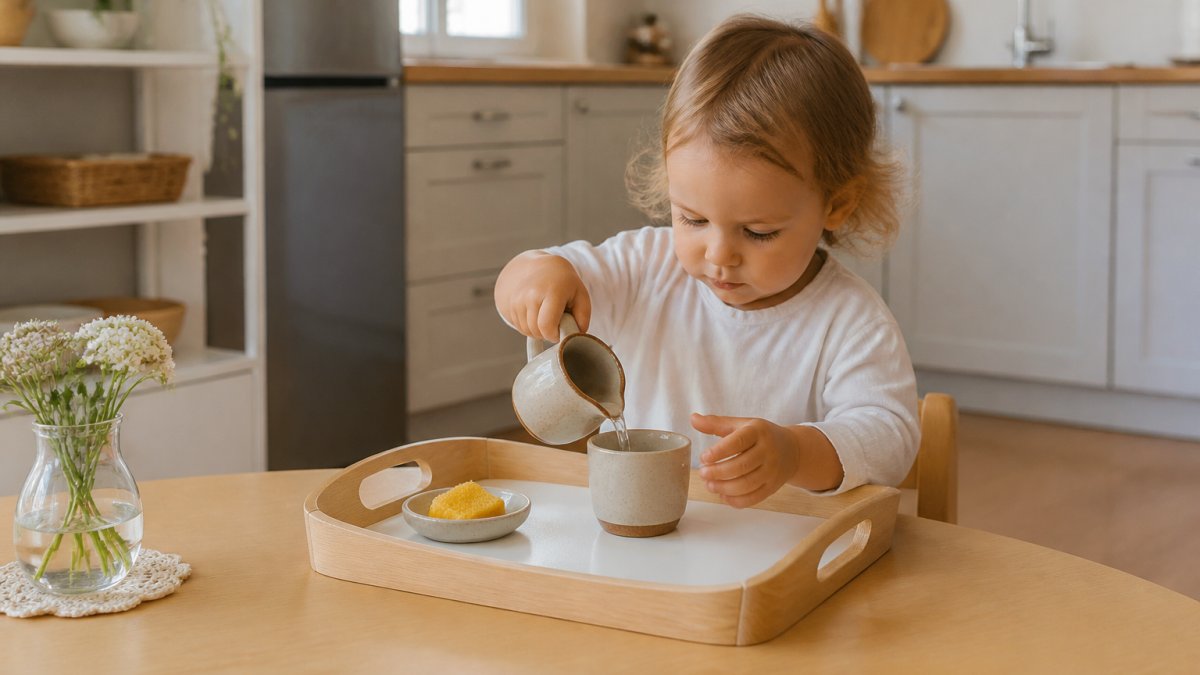
Pouring, Spooning, and Transferring Exercises
Start with a small pitcher and a cup on a tray.
These exercises build hand-eye coordination and the pincer grip they will later use to hold a pencil.
How to set it up so it actually works
A practical life tray has three parts: the material, the tool, and the cleanup cloth.
- Choose a tray with a raised lip. A rimmed baking sheet or a shallow wooden tray both work.
- Place the full container on the left and the empty container on the right. Left-to-right order matches the direction of reading and writing later.
- Add one tool: a small pitcher, a spoon, a scoop, or tongs.
- Fold a sponge or cloth and set it on the tray.
- Sit beside your child, not across from them. Do the task once, slowly, without talking. Then hand over the tool.
Household substitutions that work as well as store-bought sets
- Pitcher: a small creamer, a measuring cup with a handle, or a cleaned yogurt cup
- Dried transfer material: dry beans, large pasta, pom-poms, or cereal O's
- Scoop: a coffee scoop, a small measuring spoon, or a melon baller
- Tongs: kitchen tongs are usually too large; look for strawberry hullers or small ice tongs
- Tray: a rimmed baking sheet, a cake pan, or a wooden cutting board with a towel underneath
Adapting up or down
If your child dumps the material instead of transferring it, the task is too hard, use larger objects and a wider-mouth container.
Most practitioners find a 2-year-old needs two to four weeks with the same pouring setup before moving on.
Wiping Spills, Watering Plants, and Other Real Tasks
Real tasks matter more than pretend ones. A 2-year-old can wipe a spill, water a plant, or carry a small bowl to the sink.
Our Montessori Kids Cleaning Set gives toddlers a real broom, mop, and duster sized for their hands. It is built from solid beech wood, so it holds up to rough play.

Keep tasks small and repeat them daily. Repetition is how toddlers build mastery.
Three real tasks a 2-year-old can own
- Wiping a spill. Keep a small spray bottle of water and a folded cloth at child height. Show them how to spray once, wipe in circles, and drop the cloth in a laundry basket.
- Watering a plant. Use a small watering can with a narrow spout. Mark a line on the can so your child knows when to stop filling. Water one plant, not all of them.
- Setting the table. Start with one item: their own cup and plate. Place a small mat on the table to show where each item goes.
Cleanup is part of the activity
In Montessori, cleanup is not a punishment, it is the last step of the work.
Montessori Sensory Activities for 2-Year-Olds
Sensory activities help toddlers explore through touch, sight, and sound while sharpening concentration and problem-solving. Two simple setups cover most of what a 2-year-old needs.
Sorting by Color, Size, and Type
Sorting is a foundational Montessori activity. Give your child a bowl of mixed objects and a few empty containers, then ask them to sort by color, size, and type.
Start simple. Two colors is plenty for a young 2-year-old. Add more once they get the hang of it.
Our Montessori Shape & Color Matching Puzzle turns sorting into a game.

How to present a sorting tray
- Choose one attribute to sort by. Do not mix color and size in the same tray.
- Put 6 to 8 objects in a small bowl. More than that overwhelms a 2-year-old.
- Place two empty containers side by side, each with a color dot or a shape outline taped to the bottom.
- Pick up one object, say nothing, and place it in the correct container. Repeat with a second object.
- Hand the third object to your child. Let them place it. If they get it wrong, do not correct them. Just continue sorting the rest yourself.
Household materials that work
- Buttons, bottle caps, or jar lids in two colors
- Socks in two sizes
- Blocks in two shapes
- Fruit in two colors (apple and banana)
- Spoons and forks in two piles
Adapting up or down
If your child puts everything in one container, drop to one attribute and only four objects. If they sort quickly and correctly, add a third color or switch to sorting by size.
Puzzles and Matching Cards That Build Focus
Puzzles teach toddlers to slow down and solve a problem step by step.
A common mistake is offering puzzles that are too hard. If your child gives up fast, drop down a level.
A simple progression that works
- First: one-piece knob puzzles with a single shape per hole
- Next: two-piece puzzles with a clear picture match
- Then: four-piece puzzles with a frame
- Later: matching cards with identical pictures
- Last: matching cards with related pictures (a cow and a calf)
How to present a puzzle
Take the pieces out one at a time and set them to the right of the puzzle. Do not dump them.
Vocabulary without quizzing
Name the object as you place it, "Cow." "Red." "Circle." Do not ask "What is this?" That turns play into a test.
Safety notes for sensory play
- Check every object against a choke tube before offering it. If it fits inside a toilet paper roll, it is too small.
- Supervise water, sand, and rice bins at all times. A 2-year-old can inhale a small bead or swallow a pom-pom in seconds.
- Skip anything with loose magnets, button batteries, or sharp edges.
- Wash hands before and after sensory play, especially with food-based materials.
Montessori Shelf Activities for Toddlers: Setting Up a Rotation
A Montessori shelf is a low, open shelf your child can reach on their own, holding three to five activities at a time. This supports independence because your toddler picks what to work on without asking for help. Rotating these materials regularly keeps the environment engaging, especially when you need to incorporate screen-free indoor activities to maintain that sense of discovery during the colder months.
Here is how to build a rotation that works:
- Pick 3-5 activities that match your child's current skills
- Place each one on its own tray or in its own basket
- Put them at eye level on a low shelf
- Watch which ones get used and which sit untouched
- Swap out the ignored ones after a week or two
- Keep the rest stored and rotate them back later
The rotation keeps things fresh without overwhelming your child. Too many choices lead to mess and meltdowns. Fewer options lead to deeper focus.
Montessori Art Activities for Toddlers
Art gives 2-year-olds a way to build fine motor skills and express themselves without words. The setup matters as much as the supplies.
Keep it simple. Offer one material at a time: a chunky crayon and paper, or a small brush and a single color of paint. Put everything on a tray so your child can carry it to the table and clean up after.
Try these starter ideas:
- Scribbling with thick crayons on large paper
- Finger painting with washable paint
- Tearing and gluing scrap paper
- Stamping with sponges or corks
Skip the finished product. The process is the point. A 2-year-old is learning how the crayon feels, how the paint moves, and how their hand makes marks appear.
Safety and Supervision for Every Activity
Every activity on this list needs an adult nearby. Two-year-olds explore with their mouths, so small parts are a real risk. Check the age label on every toy before you buy it.
A few ground rules keep play safe:
- Stay in the same room during any water or pouring activity
- Choose non-toxic materials and smooth, rounded edges
- Skip anything with parts small enough to swallow
- Keep cleaning supplies and real tools out of reach when not in use
Our Montessori Busy Board is a good option for quiet, supervised play. It has shoelaces, a zipper, snaps, and 8 types of buckles, all attached to one board. Nothing comes loose, so there is nothing to lose or swallow. It is also small enough to pack for a car ride or flight.

How to Observe Progress Without Turning Play Into Testing
Watch, do not quiz. Sit nearby, stay quiet, and let your child work, you will learn more from five minutes of watching than from any checklist.
Look for these signs of progress:
- Longer focus on a single task
- Fewer spills or dropped pieces over time
- Repeating an activity without being asked
- Trying a harder version on their own
Keep a simple note on your phone: what your child picked and how long they stayed with it.
Never turn the activity into a test. If you ask "what color is this?" every few minutes, the play stops being play. Let your child lead.
For daily routines, our Montessori Visual Routine for Toddlers uses 70 illustrated cards to help kids follow their own schedule.
Conclusion
Setting up Montessori activities at home takes a few trays, a low shelf, and a little patience. The hard part is stepping back and letting your toddler work through the mess and mistakes on their own.
That is where Project Montessori can help. From the Busy Board to the Cleaning Set, each piece is made for small hands and years of use.
Shop now and give your 2-year-old the tools to do it themselves.
Frequently Asked Questions
Is 2 years old too early for Montessori activities?
No. Two-year-olds are at a natural age for Montessori activities because they want to do things themselves. At 24 to 30 months, toddlers can pour, sort, and wipe spills with simple setups. Keep activities short, offer one at a time, and let your child repeat as long as they stay interested.
What practical life activities can a 2-year-old do independently?
A 2-year-old can spoon dry beans, pour water from a small pitcher, wipe a spill with a cloth, water a plant, and put toys back on a shelf. Set each activity on a tray at their height, show the steps once, and let them try. Expect spills; they are part of learning.
How long should a Montessori activity last for a toddler?
Most 2-year-olds focus for 5 to 15 minutes per activity. Some will repeat a pouring or sorting task for much longer. Follow your child's lead. When they lose interest, put the activity away and offer it again another day rather than pushing them to finish.
How do I set up Montessori activities at home for a 2-year-old?
Use a low shelf with three to five activities, each on its own tray. Rotate items every week or two. Place real, child-sized tools like a small pitcher, sponge, and tongs within reach. Keep the space uncluttered so your child can choose and return items on their own.