

Kidodido Alternative for Montessori Home: 2026 Guide
Table of Contents
- What a Kidodido Alternative Needs to Get Right
- Montessori Toys vs Plastic Toys Benefits: What the Materials Change
- Five Kidodido Alternatives for the Montessori Home
- Best Montessori Furniture for Toddlers: What to Buy First
- Your Montessori Home Setup Checklist
- Safety, Longevity, and Resale Value
- Conclusion
- Frequently Asked Questions
Last Updated: October 9, 2026
What a Kidodido Alternative Needs to Get Right
If you're searching for a Kidodido alternative for your Montessori home, you want pieces that hold up, fit your space, and match how your child plays.
Most guides skip straight to product roundups. That's the wrong order: a toy that's too advanced gets ignored, and a climbing frame too big for your apartment becomes a hazard. Get the criteria right first, and buying gets easier.
The Five Criteria That Actually Matter
A Montessori home is a prepared environment where every object is child-sized, purposeful, and reachable without adult help. That definition filters out a lot of gear marketed as "Montessori" without the substance. Here's what we check before anything earns a spot in our catalog:
- Child-sized proportions. Handles, seats, and shelves built for small bodies, not scaled-down adult furniture.
- Open-ended function. A toy that does one thing gets abandoned. A toy a child can approach five different ways gets returned to for years.
- Natural, non-toxic materials. Solid wood with a safe finish, not particleboard wrapped in a printed veneer.
Montessori Toys vs Plastic Toys Benefits: What the Materials Change
The Montessori toys vs plastic toys benefits question comes down to feedback. Wood gives a child weight, temperature, and resistance; plastic gives a beep and a light. A wooden peg that won't seat until it's turned the right way teaches patience and problem-solving, while a plastic button that plays a song regardless of how it's pressed teaches nothing about cause and effect.
Where Plastic Still Works
We're not absolutists about this. Plastic earns its keep in a few specific situations:
- Bath and water play, where wood would swell and crack
- Outdoor sand and mud, where you don't want to worry about a finish
- Travel backups, where weight and cost matter more than longevity
The mistake is filling a playroom with plastic because it's cheap, then wondering why your child cycles through toys in a week. Rotation works better than volume, and best when the materials are worth returning to.
Five Kidodido Alternatives for the Montessori Home
1. Montessori Busy Board ($34.45), Our pick for the first practical life material. Sized for 1-4 year olds and flexible enough for most bags, it's the piece we recommend for car rides and flights. Montessori Busy Board

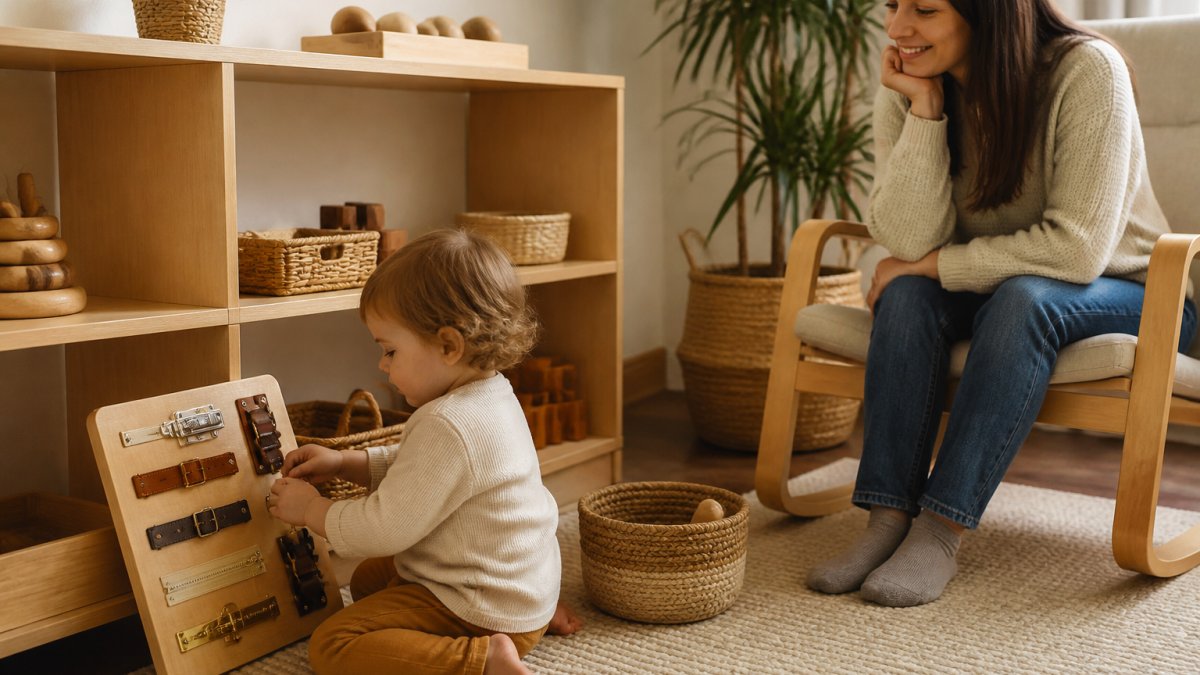
**2. Buy this version if you want one item that stays interesting longer. Montessori Busy Board - Upgraded Edition

**3. Contains small parts; recommended for ages 3 and up. Montessori Busy Cube

4. 6-in-1 Activity Cube ($54.45), The heaviest-hitting option for 1-4 year olds. This one stays on the shelf rather than traveling. 6-in-1 Activity Cube
**5. At 6.8 inches long it fits in a backpack, and it takes two AA batteries for the light function. Montessori Busy Board Truck
How the Five Compare
| Item | Price | Age Range | Best For | Travel-Friendly |
|---|---|---|---|---|
| Busy Board | $34.45 | 1-4 years | First practical life material | Yes |
| Busy Board - Upgraded Edition | $39.95 | 3+ years | Long-term engagement | Yes |
| Busy Cube | $34.45 | 3+ years | Car seats and diaper bags | Yes |
| 6-in-1 Activity Cube | $54.45 | 1-4 years | Home shelf centerpiece | No |
| Busy Board Truck | $49.95 | 2-5 years | Tool play and mechanics | Yes |
Best Montessori Furniture for Toddlers: What to Buy First
The best Montessori furniture for toddlers is the piece that removes an adult from the equation. A weaning table your child can climb into alone. A floor bed they can get out of without calling you.
Buy in this order:
- A floor bed or low cot. It's the single biggest independence win, and it's usually the first purchase parents make. A mattress on a slatted frame at floor height works; you don't need a specialty bed.
- A weaning table and chair. Child-sized seating turns mealtimes into self-directed routines. The seat height should let your child's feet rest flat on the floor.
- A low open shelf. Rotate 4-6 items at a time. Fewer choices, deeper play. Two tiers is plenty for a toddler.
- A wooden climbing triangle or arch. Builds gross motor skills and gives kids a safe outlet for climbing urges indoors.
What most guides miss is that furniture and toys aren't separate categories in a Montessori home. A shelf is a toy organizer and a lesson in order.
Fitting a Montessori Home Into a Small Space
Most Montessori furniture guides assume a spare room. Most families don't have one. In a corner of a living room or a shared bedroom, the same principles apply, you just have to be more deliberate about vertical space and rotation.
- Go vertical before you go wide. A wall-mounted low shelf takes up zero floor area and still puts every item at your child's eye level. Anchor it into studs; a shelf that tips is worse than no shelf.
- Choose a folding climbing arch over a fixed triangle. It stores flat behind a door or under a bed, and it does the same gross-motor work. A Pikler-style triangle that folds is the single best small-space gross-motor buy.
- Use a floor bed instead of a crib plus a bed. One piece replaces two, and it frees the wall space a crib would have occupied.
A common pattern in small homes is one corner doing three jobs: sleep, work, and movement. That's fine, as long as each job has a defined spot and your child can move between them without asking for help.
Blending Montessori Pieces Into a Regular Living Room
You don't have to convert a room into a classroom. Wooden Montessori furniture reads as warm and neutral, so it blends into standard decor far more easily than primary-colored plastic. A few practical moves:
- Match wood tones where you can. A light birch shelf next to a dark walnut coffee table looks accidental; two similar tones look intentional.
- Keep the low shelf against a wall your child already uses, not in a separate zone. Proximity is what makes it get used.
- Skip the cartoon-character storage bins. Baskets and open trays keep the room looking like a room while still being child-accessible.
Your Montessori Home Setup Checklist
Use this to audit a room before you buy anything else. The goal: a space your child can operate without you hovering.
- Every toy is at your child's eye level and reachable without help
- Shelves hold 4-6 items maximum, rotated every week or two
- One defined movement area with a mat or rug for climbing and rolling
Small-Space Adjustments
You don't need a dedicated playroom. A single corner works if you use vertical space and rotate ruthlessly: mount a low shelf on the wall instead of a freestanding unit, choose a folding climbing arch over a fixed triangle, and store out-of-rotation toys in a closed bin your child can't see, swapping them in weekly. The clutter-free look isn't aesthetic preference; it's what lets a child focus on one material at a time.
Safety, Longevity, and Resale Value
Safety certifications are the part buyers skim past, and the part that separates a piece you'll hand down from one you'll throw out. Here's what the markings on the box actually mean.
What the Certifications Actually Cover
- CPC (Children's Product Certificate). This is the document a U.S. manufacturer or importer must issue for children's products, backed by third-party lab testing. It certifies the product meets the applicable federal rules, most relevantly, lead content limits, phthalate limits, and small-parts requirements for the stated age range. If a seller can't produce a CPC on request, that's a red flag.
- ASTM F963. This is the mandatory federal toy safety standard in the U.S. It covers mechanical hazards (sharp edges, points, small parts), flammability, and heavy metals. When a listing says "meets ASTM F963," it means the toy passed the same baseline the CPC is built on.
- EN71. The European toy safety standard. EN71-1 covers mechanical and physical properties, EN71-2 covers flammability, and EN71-3 covers migration of certain elements (heavy metals). Many manufacturers meet it alongside U.S. requirements because they sell in both markets.
A quick way to read a listing: CPC and ASTM F963 mean the product is legal to sell for children in the U.S.; EN71 means it also cleared European limits; BSCI says something about the factory.
How to Inspect Wooden Climbing Gear Before You Trust It
Certifications cover the product as shipped. Your job is to check it after assembly and again every few months, because wooden gear loosens with use.
- Wiggle every joint. Grab the frame and try to rock it. Any movement at a connection point means the hardware needs tightening or the joint is failing.
- Check for splinters and cracks along the grain. Run a cloth over every edge. A snag means it needs sanding before it goes back into rotation.
- Confirm the finish is intact. A worn finish on a piece a toddler mouths is the point where you stop using it until it's refinished with a child-safe product.
Longevity and Resale Value
Longevity works in two directions. A solid wood piece with a non-toxic finish survives rough play, so you buy once instead of three times, and it holds resale value in a way plastic never does.
What drives resale value on wooden Montessori gear:
- Solid wood, not veneer or particleboard. Buyers can tell, and veneer chips at the corners within a year of toddler use.
- Intact original hardware. Missing bolts and stripped screws kill resale faster than cosmetic wear.
- A refinishable finish. A piece finished with oil or wax can be sanded and re-oiled; a heavily lacquered piece is harder to bring back.
That math changes the buying decision. A busy board that survives two children costs less over its life than three plastic alternatives that crack in a year.
Families who want to test Montessori materials without committing to a full collection. Start with one busy board, then add as you see what your child returns to.
Conclusion
Setting up a Montessori home can feel like a puzzle with too many pieces, especially when you're buying for a child whose interests change every few months. You don't have to solve it all at once.
Project Montessori carries educator-approved toys rooted in the Montessori philosophy, designed to build independence, creativity, and problem-solving through hands-on play. Our curated selection spans developmental stages, so you can add pieces as your child grows rather than replacing a whole shelf.
Frequently Asked Questions
Is Project Montessori a good alternative for home learning tools?
It is worth comparing against your shortlist. The catalog covers practical life and sensory categories: the Montessori Busy Board for ages 1-4, the Upgraded Edition for ages 3 and up, the Busy Cube for ages 3 and up, the 6-in-1 Activity Cube for ages 1-4, and the Busy Board Truck for ages 2-5. That range lets you build a Montessori home setup one piece at a time instead of committing to a full collection up front.
What should I look for when buying Montessori-aligned toys?
Four things decide most purchases. First, one clear skill per toy, such as buckles or a zipper, so your child can focus and master it. Second, a size their hands can manage without help. Third, a non-toxic finish, since these items go in mouths. Fourth, a construction that survives daily use. A toy that checks all four earns its shelf space; a toy that checks none becomes clutter.
Are there affordable alternatives to boutique Montessori climbing furniture?
Yes, and the practical move is to spend on the items your child touches every day rather than on large statement pieces. A busy board at $34.45 or a busy cube at $34.45 delivers daily fine motor practice for a fraction of what a climbing frame costs. Add a floor bed and a low shelf when budget allows, and treat the climbing triangle as a later purchase.
How do I set up a Montessori-inspired play area on a budget?
Start with one low, open shelf at your child's height so they can reach and return items themselves. Keep only a handful of toys out at a time and rotate the rest, which keeps the space clutter-free without buying more. Add a child-sized table and chair for snack and craft time. Then introduce one skill-building toy, such as a busy board, and build from there as you see what holds attention.
How do I choose high-quality wooden toys for a Montessori home?
Check the material, the finish, and the joinery. Solid wood with smooth rounded edges and no sharp corners holds up better than particle board. A non-toxic finish matters because toddlers mouth their toys. Look for securely attached parts, since loose pieces are a choking risk. The Montessori Busy Board Truck, for example, lists BSCI, CE, CPC, and EN71 safety certifications and includes child-safe screwdriver, wrench, and hex tools.