

Best Magnetic Building Sets for Creative Play Reviewed
Last Updated: November 4, 2026
Quick Summary
The best magnetic building sets for creative play combine strong magnets, sealed smooth edges, and enough pieces to build something real. Our top pick is the 60-piece Montessori Magnetic Building Blocks at $79.95, while the Travel Magnetic Tiles at $34.45 are the best budget entry point.
- Snap two tiles together and lift to test magnet strength before buying.
- Run a thumbnail along every rim to check for sealed, smooth edges.
- Respect the ages 3 and up rating and keep small parts from younger siblings.
- Buy within one family of tiles, since compatibility across brands is inconsistent.
- A set rebuilt three times in an afternoon passes the return-to-play test.
Table of Contents
- How We Tested These Magnetic Building Sets
- Best Magnetic Tiles and Sets Compared at a Glance
- Magnet Strength, Structural Stability, and Build Quality
- Magna-Tiles vs. Connetix Tiles: What the Compatibility Question Really Means
- Magnetic Tiles for Toddlers: Age Suitability and Safety Details
- Magnetic Tile Building Ideas for Open-Ended Play
- Long-Term Value, Expansion Costs, Storage, and Portability
- Choosing the Right Set for Your Child's Play Style
- Frequently Asked Questions
How We Tested These Magnetic Building Sets
The best magnetic building sets for creative play earn that label through magnet strength, edge safety, and how long a child stays engaged.
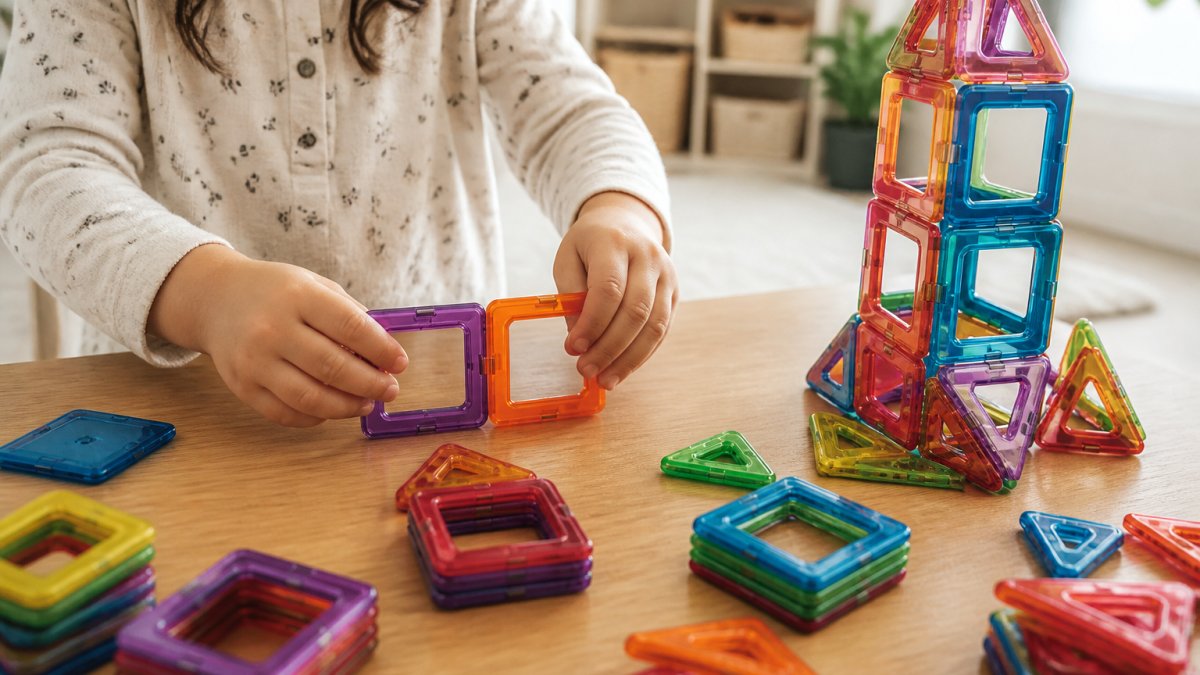
We evaluate five things: magnet strength and grip, build quality and edge finish, age suitability and small-part safety, piece count relative to price, and storage, cleanup, and portability.
Magnet strength and connection grip. Snap two square tiles together along one edge and lift by the top tile; a strong connection holds the lower tile horizontally without sagging. Build a four-tile vertical stack and press gently on the top piece, it should resist a light nudge. Flip one tile and try to connect it to the same edge: if it repels, the set uses fixed polarity, which limits how freely a child can attach pieces in any orientation.
Build quality and edge finish. Run a thumbnail along every rim; a sealed, smooth edge should feel continuous, with no lip, gap, or rough seam.
Age suitability and small-part safety. Confirm the manufacturer's age label and cross-check it against the smallest piece in the set.
Piece count relative to price. Divide the price by the number of usable pieces, not the total in the box; decorative or duplicate pieces inflate the count.
Storage, cleanup, and portability. Time how long it takes to gather every piece back into its container.
The return-to-play test. This is the one no spec sheet captures.
Best Magnetic Tiles and Sets Compared at a Glance
Here is the short answer for shoppers in a hurry. The Montessori Magnetic Building Blocks (60 pcs) at $79.95 is our top pick for open-ended creative play, because 60 pieces is enough to build something real without overwhelming a young builder. The Montessori Travel Magnetic Tiles at $34.45 is the best budget entry point and the easiest to store.
| Set | Pieces | Price | Best For | Standout Detail |
|---|---|---|---|---|
| Magnetic Building Blocks | 60 | $79.95 | All-around creative play | Carrying bag included |
| Travel Magnetic Tiles | Not listed | $34.45 | Travel and small spaces | Zippered travel case |
| Magnetic Builder Blocks | 40 | $44.95 | Castle and themed builds | Food-grade ABS plastic |
| Glow Magnetic Tiles | 49 / 75 / 110 | $69.95 | Marble runs and engineering | Light-up pieces and marbles |
| Magnetic Building Sticks | 30 | $44.95 | Geometric shapes | Sticks plus metal balls |
| Magnetic Wand Building Set | 26 / 45 / 86 / 138 | $39.95 | Fine motor practice | Telescopic wands |
| Christmas Magnetic Blocks | 105 / 150 / 610 | $49.95 | Seasonal gifts | Holiday-themed tiles |
| Fort Building Kit | 100 | $59.95 | Big collaborative builds | Rods and ball connectors |
You can browse the full range of Montessori Magnetic Toys to see every set side by side.
Magnet Strength, Structural Stability, and Build Quality
Magnet strength is the single spec that decides whether a set frustrates a child or delights them. Weak magnets mean towers that collapse on contact; strong magnets let a four-year-old add a roof without knocking down the walls.
The Montessori Magnetic Builder Blocks are listed as food-grade ABS plastic with strong magnets and smooth, rounded edges. The Montessori Christmas Magnetic Blocks are made of high-quality ABS plastic and strong magnets. The Montessori Magnetic Building Sticks are made of high-quality ABS plastic and permanent magnets that connect and disconnect easily.
Build quality shows up in the details. Rounded edges and a smooth surface matter more than piece count. Run a finger along every edge before you buy.
Magna-Tiles vs. Connetix Tiles: What the Compatibility Question Really Means
Shoppers ask about Magna-Tiles vs. Connetix Tiles constantly, and the real question underneath is simpler: will new pieces work with the tiles already in the toy bin? Compatibility across brands is inconsistent, because tile sizes, magnet placement, and polarity vary from maker to maker. Two sets that look identical on the shelf can refuse to snap together.
The practical answer is to buy within one family of tiles and expand there. The Montessori Christmas Magnetic Blocks are listed as compatible with other magnetic building tiles.
Before you mix brands, test one connection. Snap a single tile from each set together and lift. If the join holds under its own weight, the sets will build together. If it slips, keep them in separate bins.
Magnetic Tiles for Toddlers: Age Suitability and Safety Details
Magnetic tiles for toddlers need one non-negotiable feature: no small parts that fit in a mouth.
For a toddler approaching three, start with larger tiles and fewer pieces. The Montessori Travel Magnetic Tiles include a zippered travel case that keeps pieces contained.
Montessori Magnetic Building Blocks (60 pcs) →
Watch out: a magnetic tile that cracks can release small magnets, so inspect tiles for damage and retire any piece with a split rim.
Age labels are a starting point, not a guarantee.
How to inspect a tile before and after purchase. Press the rim between thumb and forefinger and look for any gap where the two halves meet. Flex the tile gently; a sealed tile should not creak or open. Shake it near your ear, a rattle suggests a loose magnet inside.
Age bands in practice. Under 3, avoid magnetic tiles entirely unless the set is specifically designed with fully sealed, oversized pieces and no small accessories.
Material disclosures. Look for a child-safe material and check whether the manufacturer discloses its material information. Checking materials and odors is one part of choosing a safe play experience, and screen-free toy options can help keep creative play engaging beyond magnetic building sets.
Practical setup for a toddler household. Keep a single lidded bin for magnetic pieces, inspect the bin monthly, and store any set with small accessories on a high shelf.
Magnetic Tile Building Ideas for Open-Ended Play
Open-ended play means the set has no single right answer, and magnetic tiles are built for exactly that. Here are magnetic tile building ideas that work with almost any set:
- Build a tall tower, then knock it down and rebuild with a wider base.
- Design a castle with a working drawbridge that opens and closes.
- Make a garage for toy cars, then test whether each car fits.
- Create a marble run by adding chutes and slides to a tower frame. The Montessori Glow Magnetic Tiles include marble-run chutes, slides, and glowing balls for this kind of build.
- Sort tiles by color and shape, then build a pattern.
- Build a "house" with one window and one door, then move the door.
If you want more structured inspiration, our guide to Montessori toys that foster creativity covers how building play supports imaginative thinking. For a set with a novel building element, look at the glow magnetic tiles.

Long-Term Value, Expansion Costs, Storage, and Portability
Long-term value comes down to price per piece and how easily a set expands. A larger set usually costs less per tile than a small one, so buying one mid-size set beats buying three tiny ones. Our Building Blocks at $79.95 for 60 pieces and the Builder Blocks at $44.95 for 40 pieces sit at different points on that curve; the right one depends on how much building space you have.
Storage decides whether a set gets used. Loose tiles end up at the bottom of a bin; a case or bag keeps them in rotation. The Montessori Magnetic Building Blocks include a carrying bag, the Montessori Travel Magnetic Tiles include a zippered travel case, and the Montessori Fort Building Kit comes with a storage bag.
Portability matters for grandparents and road trips. The Montessori Travel Magnetic Tiles are the set we would pack for a flight, because everything has a place and packs up in seconds.

Choosing the Right Set for Your Child's Play Style
Match the set to how your child actually plays, not to the biggest piece count. A builder who loves towers wants tiles. A child who loves patterns and shapes wants sticks and balls. A child who wants to hide inside something wants a fort.
- The tower builder: Magnetic Building Blocks, 60 pieces, $79.95.
- The pattern maker: Magnetic Building Sticks, 30 pieces, $44.95.
- The storyteller: Magnetic Builder Blocks, 40 pieces, $44.95, with a castle theme.
- The engineer: Glow Magnetic Tiles, from $69.95, with chutes and a marble run.
- The toddler on the move: Travel Magnetic Tiles, $34.45.
- The grandparent buying a gift: Christmas Magnetic Blocks from $49.95, or the Fort Building Kit at $59.95.
If you are still deciding, browse the full Montessori building toys collection and compare piece counts and themes directly.
The hardest part of buying magnetic tiles is not finding a set, it is picking one your child will still reach for in six months. Start with a set that matches their play style, check the age rating, and expand within the same family of tiles. Project Montessori carries educator-approved magnetic sets built around open-ended, screen-free play, from the 60-piece Building Blocks to the marble-run Glow Magnetic Tiles. Get started with Project Montessori and give a child a toy that gets rebuilt, not forgotten.
Frequently Asked Questions
What should I look for when choosing magnetic tiles for a child?
Start with the age rating, since most magnetic building sets are labeled for ages 3 and up because of small magnets and, in some sets, marbles. Check the magnet strength by building a tall tower and giving it a gentle nudge; pieces that hold through a two-foot structure are doing their job. Look at edge finish (smooth and rounded, not sharp), whether shapes are compatible with other tiles you own, and what storage comes in the box. Piece count matters less than whether the shapes let a child actually build something.
Are magnetic building sets compatible across brands?
Often, but not always. Many tile sets use similar magnet placement and tile sizing, so pieces from different brands sometimes snap together, but compatibility is not guaranteed and varies by brand and by tile shape. Before mixing sets, test one tile from each brand together. If you are building a collection over time, buy within one system first, then add a second brand only after you have checked that the pieces connect. Sets that are described as compatible with other magnetic building tiles are the safest place to start.
What age is appropriate for magnetic building sets?
Most magnetic building sets are rated for ages 3 and up. Sets that include marbles or small parts carry the same 3+ rating and should be kept away from younger siblings, since those pieces are a choking hazard. For a toddler under 3, choose larger-piece options and always supervise. For a 3- to 8-year-old, the rating on the box is the guide, and the real question becomes which set matches how your child likes to play: towers and houses, marble runs, or stretch-and-snap wands.
What are some good magnetic construction sets for kids who get bored quickly?
Sets with a moving part hold attention longest. A marble-run tile set gives kids something to test and rebuild, so the play has a result they can watch. Telescopic wand sets work well for kids who like to freestyle rather than follow a design, because there is no instruction sheet and no wrong build. For a child who likes pretend play, a themed tile set with castle or holiday pieces gives the building a story. Rotating two or three set types usually beats buying one bigger set.
How many pieces do I need to start with?
A 40- to 60-piece set is enough for one child to build a house, a tower, or a small castle, and it is the right size to test whether the toy gets used. Under about 30 pieces, most kids run out of parts before a build feels finished. If your child takes to it, add an expansion set rather than replacing the first one, and keep the pieces in one bin so the collection grows together. Storage bags and travel cases make cleanup part of the play instead of a chore.
