

Top Bella Luna Toys Alternative Brands for Natural Play
Table of Contents
- Why Families Look for Bella Luna Toys Alternatives
- How to Evaluate Natural Toy Brands
- Wooden Toy Brands That Prioritize Sustainability
- Waldorf Dolls and Doll Play Options
- Play Silks for Children and Sensory Play
- Montessori Toy Brands for Independent Learning
- Comparing Top Alternatives by Age and Play Style
- Where to Buy and What to Expect
- Frequently Asked Questions
Last Updated: October 13, 2026
Why Families Look for Bella Luna Toys Alternatives
Searching for a Bella Luna Toys alternative usually starts with one question: where else can you find natural, screen-free toys that hold a child's attention?
The natural toy category has never been broader.
Below, we break down how to evaluate any natural toy brand, then compare the categories that matter most: wooden toys, dolls, play silks, and Montessori learning tools.
How to Evaluate Natural Toy Brands
A natural toy brand earns its reputation on three things: what the toy is made of, how it is tested, and whether it survives real play.
Start with a simple test: check the product page for a material list, recommended age range, and any safety certification named in plain language. If a brand can't say what the wood is finished with or how the fabric is attached, that's your answer.
Materials and Safety Standards
Natural materials matter most in the first three years, when toys spend the most time in mouths and hands.
In the United States, children's toys fall under federal safety rules enforced by the Consumer Product Safety Commission, including limits on lead and phthalates and requirements for small-part warnings. A brand that names its testing standards is telling you it expects to be checked.
Price Ranges and Value
Natural toys cost more than mass-market plastic, and the gap is real.
You're paying for durability, safer finishes, and hand-me-down value. A well-made wooden toy frequently outlasts two or three cheap replacements, which changes the math over a childhood.
Our advice: buy fewer, better pieces and rotate them. A small shelf of quality toys gets more use than a full bin of forgettable ones.
Wooden Toy Brands That Prioritize Sustainability
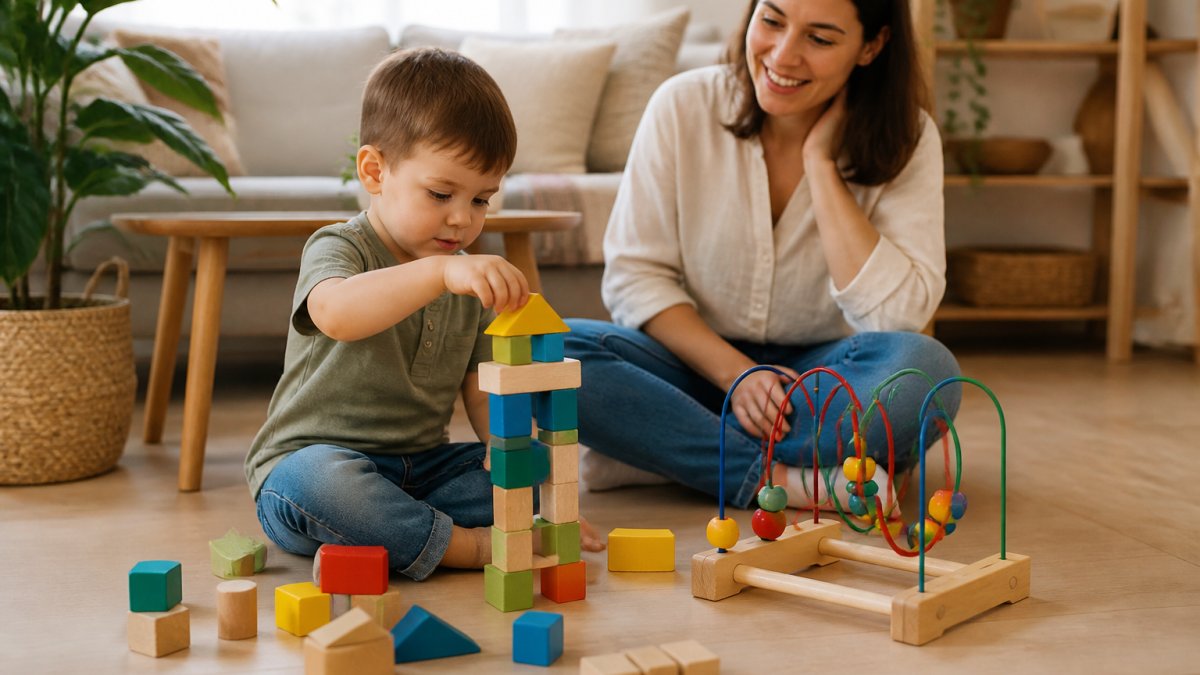
Sustainability claims range from meaningful to decorative. The strongest wooden toy brands name their wood source, finish, and packaging on the product page, not just in a mission statement.
Here's how the leading approaches differ:
| Approach | What It Means | Best For |
|---|---|---|
| FSC-certified wood | Wood traced to responsibly managed forests | Buyers who want verified sourcing |
| Non-toxic water-based paint | Safer finish for mouthing toddlers | Ages 0-3 |
| Recycled or plastic-free packaging | Lower waste on arrival | Gift-givers |
| Solid hardwood construction | Survives drops and chewing | Long-term value |
How to Read a Wooden Toy Listing
Most shoppers scan the photos and skip the specs, where the useful information lives. Check these before adding anything to a cart:
- Wood species. Hard maple, beech, and rubberwood are dense and hold up to teething. Pine and particleboard dent, splinter, or delaminate.
- Finish. Look for water-based, plant-based, or unfinished wood. A vague "non-toxic" claim without a named finish is a yellow flag.
- Joinery. Dowels, screws, and interlocking cuts outlast glue-only assembly, especially on toys that get dropped.
- Edges. Rounded, sanded edges matter more than any label for children under three.
What "Sustainable" Doesn't Tell You
"Sustainable" and "durable" aren't the same claim. A toy can be responsibly sourced and still fall apart in a month, or use FSC-certified wood finished with a coating you'd rather your toddler didn't mouth.
A practical test: pick up the toy. If it feels light for its size, smells strongly of solvent, or the joints flex under gentle pressure, the sustainability label isn't doing much work.
A Note for Gift-Givers
If you're buying a wooden toy as a gift, durability matters most. Parents remember the toys that survived three children and the ones that didn't survive a single holiday. A solid hardwood piece with a simple finish beats a larger set with thinner construction.
Project Montessori's wooden pieces, including the 6-in-1 Activity Cube, are made from solid wood with non-toxic paint and recyclable packaging.

Waldorf Dolls and Doll Play Options
Dolls do quiet, important work: they let children rehearse care, conversation, and conflict before they meet those things in real life.
Waldorf dolls use natural fibers, soft wool stuffing, and simple, neutral faces. That minimalism is intentional: fewer fixed features leave more room for a child's imagination to fill in the expression.
When comparing doll options, look at:
- Stuffing: wool and cotton hold shape better than synthetic fill
- Features: simple faces invite projection, detailed faces direct play
- Size: smaller dolls suit toddlers; larger ones suit older children
- Clothing: removable outfits extend play but add small parts
For doll play without a full Waldorf purchase, plush animal sets are a gentler entry point. Project Montessori's Barnyard Cuddly Animals ($39.95) gives younger children six soft animals and a carry-along barn, supporting the same nurturing play at an age when a traditional doll may be too advanced.
Play Silks for Children and Sensory Play
Play silks are squares of lightweight, dye-free fabric children use as capes, rivers, tents, and blankets. They cost little, pack flat, and get used more than almost any other toy on the shelf.
The appeal is open-endedness: with no correct answer, a four-year-old and a nine-year-old can both find something to do with it. That flexibility is why silks show up in so many natural toy collections.
Pair silks with tactile toys and you get a full sensory play setup. Project Montessori's Montessori Sensory Book ($29.95) uses peel-and-paste pieces to build matching and sorting skills, and it grows with a child from age two through five.

Montessori Toy Brands for Independent Learning
If you're shopping for a grandchild, you don't need a full explanation of the Montessori method, just which toys a child will actually use, which ones parents will thank you for, and how to pick something that fits the child you're buying for.
The short version: Montessori-inspired toys are designed so a child can figure them out without an adult hovering, fewer buttons, no batteries, and a clear "right answer" the child discovers alone.
What Makes a Good Gift in This Category
A few qualities separate a toy that gets used for years from one that gets shelved by January:
- Self-correcting. The toy tells the child when they've got it right, a puzzle piece that only fits one way, a buckle that clicks, a shape that drops through its matching hole.
- Open-ended. No single correct outcome, so the toy grows with the child instead of being outgrown.
- Hands-on. Real materials, wood, fabric, metal fasteners, rather than screens or lights.
- Age-appropriate challenge. Slightly ahead of the child's current skill, not far ahead.
Picking by Age
| Age | What They're Working On | Gift That Fits |
|---|---|---|
| 1-2 years | Grasping, sorting, cause and effect | Wooden activity toys with chunky pieces |
| 2-3 years | Imitation, fine motor practice | Practical-life boards with buckles and laces |
| 3-5 years | Building, storytelling, puzzles | Open-ended construction and magnetic tiles |
| 4-6 years | Matching, early literacy, rules | Structured learning books and puzzle sets |
A common mistake is buying for the child's current age and not the next six months. Toys slightly ahead of a child get used longer than toys they've already mastered, and a gift that's still interesting in a year is a better gift.
A Few Pieces That Fit the Approach
- Montessori Busy Board: laces, zippers, snaps, and multiple buckle types for ages 1-4
- Montessori Busy Board Truck: screwdriver, wrench, and key play for ages 2-5
- Montessori Magnetic Story Puzzle Books: magnetic pieces and themed puzzles per book
- Montessori Sensory Book: peel-and-paste pieces that build matching and sorting skills from age two through five
- Montessori Travel Magnetic Tiles: pack into a zippered case and turn any waiting room into a building site
The throughline is self-correction: a child can tell when a buckle isn't fastened or a puzzle piece doesn't fit, and that feedback loop builds patience without an adult stepping in.
If You're Not Sure
If you're testing the approach before committing, buy one or two pieces rather than a full collection. A single busy board tells you more about whether your grandchild responds to it than any product page will, and leaves room for the parents to add later.
Comparing Top Alternatives by Age and Play Style
The right brand depends less on reputation than on your child's age and how they play.
| Age | Play Style | Best Fit | Example |
|---|---|---|---|
| 6-18 months | Mouthing, grasping, sound | Soft sensory sets | Barnyard Cuddly Animals |
| 1-2 years | Sorting, stacking, cause and effect | Wooden activity toys | 6-in-1 Activity Cube |
| 2-3 years | Imitation, fine motor practice | Practical life boards | Busy Board Truck |
| 3-5 years | Building, storytelling, puzzles | Open-ended construction | Travel Magnetic Tiles |
| 4-6 years | Rules, matching, early literacy | Structured learning books | Sensory Book |
Where to Buy and What to Expect
Availability is the practical reason many families shop more than one brand: natural toy makers run small production batches, so popular items sell out and restock slowly.
A few things to check before you order from any brand:
- Return window and whether it covers opened toys
- Shipping time against your gift deadline
- Whether replacement parts are sold separately
- Age range printed on the listing, not just the marketing copy
- Whether the toy ships assembled or needs setup
Project Montessori ships directly from our own store, offers a 30-day money-back guarantee, and lists the recommended age range on every product page. If you're buying a gift, order with a little buffer, especially around the holidays.
For grandparents in particular: a single well-chosen piece beats a pile of small ones. A busy board or magnetic tile set gives a child something to return to for years, the kind of gift parents actually thank you for.

Frequently Asked Questions
Are Bella Luna Toys non-toxic?
Bella Luna Toys states that its products are made from natural materials and non-toxic finishes. When evaluating any natural toy brand, look for certifications like FSC-certified wood and water-based, non-toxic paints. Project Montessori toys, for example, use sustainably forested wood and non-toxic paint, and the 6-in-1 Activity Cube is manufactured at an award-winning factory with 100% recyclable packaging.
What are some good alternatives to Bella Luna Toys?
Several brands offer Waldorf-inspired and Montessori-aligned toys. Project Montessori is a strong alternative, with educator-approved toys like the Montessori Busy Board ($34.45) and the 6-in-1 Activity Cube ($54.45). Other options include wooden toy brands that focus on open-ended play and natural materials. When comparing, look at material sourcing, safety certifications, and age range to find the best fit for your child.
How do I choose safe wooden toys for children?
Check for non-toxic finishes, smooth edges, and age-appropriate design. Look for certifications like FSC-certified wood, and avoid toys with small parts for children under 3. Project Montessori's Montessori Busy Board Truck meets BSCI, CE, CPC, and EN71 safety standards, and is designed for ages 2-5 with rounded edges and child-safe tools. Always inspect toys for loose parts before play.
What is the difference between Montessori and Waldorf toys?
Montessori toys emphasize real-life skills, independence, and self-correction, often with a focus on fine motor tasks like buckles and zippers. Waldorf toys lean toward imaginative, open-ended play with natural materials like dolls and play silks. Both avoid screens and plastic. Project Montessori offers Montessori-aligned toys like the Montessori Sensory Book ($29.95), which builds fine motor skills through matching and sorting.
Can I buy just a few pieces to test a Montessori toy brand?
Yes. Many brands, including Project Montessori, sell individual items so you can try before committing to a full collection. Start with a bestseller like the Montessori Busy Board ($34.45) or the Montessori Travel Magnetic Tiles ($34.45) to see how your child engages. This lets you assess material quality, durability, and play value without a large upfront investment.
Finding natural toys that hold up to real play takes more research than it should. Project Montessori exists to shorten that search. Our educator-approved toys, from the Montessori Busy Board to the 6-in-1 Activity Cube, are rooted in the Montessori philosophy and built to support independence, creativity, and skill-building at every stage. Shop now and give a child something worth growing with.