

Bannor Toys vs Montessori Generation: 2026 Comparison
Table of Contents
- Bannor Toys vs Montessori Generation: How the Two Brands Differ
- Side-by-Side Comparison: Materials, Safety, and Age Range
- Montessori Toys vs Plastic Toys Benefits: Why Material Choice Matters
- Best Montessori Toy Brands for Toddlers: What to Look For
- Sustainability and Material Sourcing: What Each Brand Does
- Longevity and Resale Value: Which Toys Hold Up
- Where Each Brand Wins: A Use-Case Breakdown
- Verdict: Choosing Between Bannor Toys and Montessori Generation
- Frequently Asked Questions
Last Updated: October 4, 2026
Bannor Toys vs Montessori Generation: How the Two Brands Differ
The global Montessori toys market was valued at USD 3.5 billion in 2025, and it is projected to grow from USD 3.8 billion in 2026 to USD 6.2 billion by 2034 (Intel Market Research Montessori toys market forecast). This guide from Project Montessori breaks down how the two brands actually differ.

Here is the short version. Bannor Toys is a small-batch, family-owned wooden toy maker. Montessori Generation is a content-led retailer that built its audience around Montessori education. They compete for the same shopper but win on different things.
Bannor Toys is an Iowa-based, family-owned manufacturer that produces wooden Montessori-aligned toys in small batches, with a focus on dual-use learning tools. Montessori Generation is a Montessori-focused retailer and content publisher that earns roughly 145,798 monthly visits, according to BrandSearch traffic data for Montessori Generation.
Below, we compare materials, safety, age range, sustainability, and resale value, then tell you which brand fits which family.
Side-by-Side Comparison: Materials, Safety, and Age Range
Both brands sit in the wooden toy category, but they approach manufacturing differently. Bannor Toys manufactures its own small-batch wooden toys domestically. Montessori Generation curates and sells Montessori-aligned products under its own brand umbrella.
| Factor | Bannor Toys | Montessori Generation |
|---|---|---|
| Business model | Small-batch domestic manufacturer | Curated retail brand across many suppliers |
| Primary material | Solid hardwood (maple, cherry, walnut) | Wood plus mixed materials, varies by SKU |
| Finish | Non-toxic, water-based dyes and natural oils | Varies by supplier; check each listing |
| Safety standard | Consumer Product Safety Improvement Act (CPSIA) compliant; ASTM F963 toy safety testing | CPSIA compliant; ASTM F963 testing varies by product |
| Age range | Infant through preschool | Infant through preschool |
| Catalog depth | Narrow, deep, a few dozen core SKUs | Broad, shallow, hundreds of SKUs across categories |
| Best for | Buyers who want a maker story and material transparency | Buyers who want one cart across multiple developmental stages |
What the Materials Difference Actually Means
Bannor Toys builds around solid hardwood, maple, cherry, and walnut are the common species in its line, which means grain direction, density, and weight are consistent from piece to piece. Montessori Generation's catalog spans many suppliers, so a single order can mix solid wood, plywood, and painted composite depending on which SKU you pick. That is not a knock on the brand; it is a structural consequence of curating instead of manufacturing.
Safety: What to Actually Verify
Both brands operate under the same federal floor. The Consumer Product Safety Improvement Act (CPSIA) sets lead and phthalate limits for children's products sold in the United States, and ASTM F963 is the voluntary toy safety standard that most reputable makers test against. The difference is documentation. A domestic small-batch manufacturer typically publishes its testing posture on a single page because it controls the whole line.
Age Range: Read the Band, Not the Label
Both brands cover infant through preschool, but the useful comparison is at the band level. Infant and young toddler pieces (roughly 6 to 18 months) should be large enough to eliminate choking risk and simple enough to mouth safely. Research indexed by the National Institutes of Health shows that children's engagement with toys is moderated by age, with measurable differences when a toy matches a child's developmental stage versus when it is intended for a younger or older child.
The Head-to-Head Verdict
If material transparency and a single accountable maker matter to you, Bannor Toys is the stronger pick, you can trace the wood, the finish, and the testing posture without cross-referencing suppliers. If you need to cover three developmental stages in one order and you are willing to read each product page carefully, Montessori Generation's catalog breadth wins. Neither is a compromise; they are optimized for different shoppers.
Montessori Toys vs Plastic Toys Benefits: Why Material Choice Matters
The montessori toys vs plastic toys benefits argument is not about snobbery. It is about what each material lets a child do.
Wood gives tactile feedback that plastic cannot. For sensory development and fine motor skills, that difference matters because the child's hand learns from the resistance.
Plastic toys often do the work for the child. Press a button, get a sound.
Durability favors wood as well. A solid wood puzzle survives being dropped, chewed, and handed down.
Best Montessori Toy Brands for Toddlers: What to Look For
When you are evaluating the best montessori toy brands for toddlers, four things separate real Montessori products from marketing.
- Solid wood, not composite. Look for real wood construction rather than particleboard with a veneer.
- Non-toxic finishes. Water-based paints and natural oils are the standard to look for.
- Age-appropriate challenge. A toy should be hard enough to hold attention but not so hard it frustrates.
The last point is where a lot of brands fail. One widely shared critique of the category argues that not all products marketed as Montessori provide genuine educational value, with some criticized as overpriced or built for entertainment rather than purposeful engagement (Montessori toy buying critique).
Project Montessori Picks Worth Starting With
If you want to test the approach before committing to a full shelf, start with two or three pieces.
The Project Montessori Animal Puzzles 6 PACK is a solid starting point.
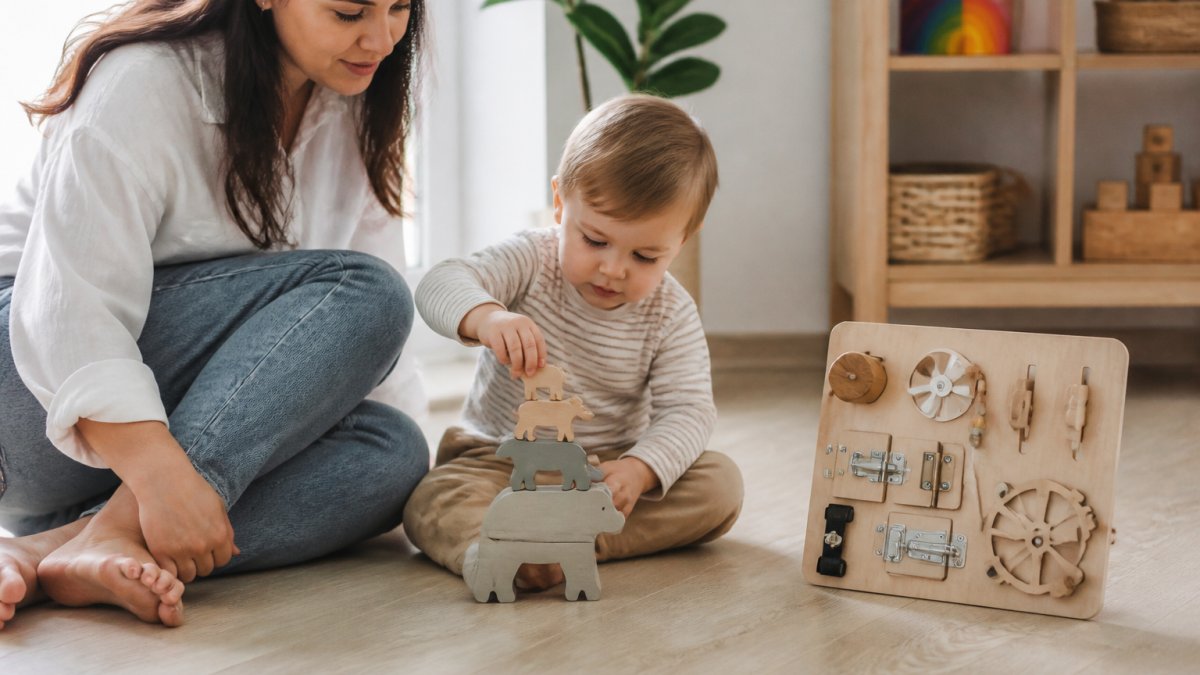
For toddlers who need to keep their hands busy, the Montessori Busy Board covers shoelaces, a zipper, a snap pocket, and eight types of buckles.

The Montessori Busy Cube offers six interactive sides, including a fingertip spiral, spring latch, one-way switch, and rotating screw, in a 6.1 x 4.5 x 5.5 inch wooden body.
Sustainability and Material Sourcing: What Each Brand Does
Most articles in this category stop at 'look for sustainable wood.' That advice is useless at the point of purchase because it does not tell you what to check or where the two brands actually diverge. Here is the technical version.
Wood Species and Why It Matters
Hardwood density determines how a toy ages. Maple is the hardest common toy wood, it resists dents, holds a crisp edge on puzzle pieces, and takes a water-based dye evenly. Cherry is softer, warms to a deeper color over years, and shows handling marks sooner. Walnut is dense and dark, often used for contrast pieces. Rubberwood and beech are common in imported Montessori lines: beech is hard and fine-grained, rubberwood is softer and cheaper.
Project Montessori™ Animal Puzzles 6 PACK →
Finishes: The Part Most Buyers Skip
Finish is where a toy's safety and longevity are actually decided. Water-based dyes and natural oils (beeswax, linseed, tung) cure into the wood and do not chip the way a thick lacquer can. Painted surfaces on cheaper toys can flake at edges and joints after months of chewing. When you compare two listings, the finish line is more informative than the material line.
Certifications Worth Looking For
Three labels do real work in this category. FSC (Forest Stewardship Council) certification means the wood came from a responsibly managed forest. GREENGUARD Gold certifies low chemical emissions, relevant for painted and finished wood products used indoors. CPSIA compliance is the federal floor for children's products in the United States and is not optional. A brand that publishes all three is telling you something; a brand that publishes none is telling you something too.
How the Two Brands Compare on Sourcing
Bannor Toys manufactures in small batches domestically, which shortens the supply chain and makes species and finish claims easier to verify. Montessori Generation sources across a broader catalog, which means sourcing practices vary product by product, some SKUs will be FSC-certified solid wood, others will not. That is the honest trade-off: a maker gives you consistency, a curator gives you range, and range always means variance.
The Three-Question Sourcing Check
Before you buy from either brand, answer three questions from the product page alone:
- What species is the wood? If the page says only 'wood,' assume it is a soft or composite material until proven otherwise.
- What is the finish? Named coatings (water-based dye, beeswax, linseed oil) beat the phrase 'non-toxic.'
- Is there a certification? FSC, GREENGUARD Gold, or a stated CPSIA/ASTM F963 testing claim.
If a listing answers all three, it is a serious product. If it answers none, the price is the only thing you are comparing.
Longevity and Resale Value: Which Toys Hold Up
Solid wood toys hold their value better than plastic, and that gap is widening.
Three factors drive it. First, wood does not yellow or become brittle the way some plastics do.
This is where the category's economics get interesting. Kid-free households purchased more than 50% of all toys sold in the first half of 2026, according to New York Post report on toy buying demographics.
The practical takeaway: a wooden toy that costs more upfront often costs less per year of use. A plastic toy that breaks in eighteen months rarely does.
Where Each Brand Wins: A Use-Case Breakdown
Neither brand wins everything. Here is how we would split it.
Choose Bannor Toys if you want a small-batch, family-made product and you care about knowing the maker.
Choose Montessori Generation if you want a wide catalog and strong educational content alongside the products.
Choose Project Montessori if you want educator-approved toys curated specifically around independence, creativity, and developmental stages, without sorting through a sprawling catalog to find them.
Verdict: Choosing Between Bannor Toys and Montessori Generation
For most families, the decision comes down to catalog breadth versus maker story. Bannor Toys wins on small-batch domestic manufacturing. Montessori Generation wins on catalog size and educational content.
If you want a curated middle path, Project Montessori sits between them. Each toy is chosen to support a specific developmental stage, such as the Project Montessori Animal Puzzles 6 PACK for 1 to 4-year-olds or the Project Montessori™ Creative Board for ages 3 and up.

Frequently Asked Questions
What are the key differences between Montessori toys and regular toys?
Montessori-aligned toys are built around self-directed activity and open-ended play, so a child decides how to use them rather than following a preset script. They tend to be made from wood and other natural materials with tactile feedback, and they isolate one skill at a time, such as a shape puzzle or a set of buckles. Regular toys often add lights, sounds, or fixed outcomes that do the thinking for the child.
Are Bannor Toys made in the United States?
Bannor Toys is a small-batch, family-owned manufacturer based in Iowa that focuses on wooden Montessori-aligned toys, according to the brand's own published information. That domestic, small-batch model is one reason its output is limited compared with larger importers, and it is a real factor if buying American-made matters to you. Montessori Generation, by contrast, operates as an online retailer and content destination rather than running its own manufacturing line.
What are the benefits of wooden toys over plastic alternatives?
Wood gives children tactile feedback and natural textures that plastic cannot replicate, which supports sensory development during hands-on learning. Solid wood also survives drops, chewing, and years of rough toddler engagement far better than hollow plastic, so it holds resale value and can pass between siblings. Finishes matter as much as the material: look for non-toxic paint and safety certification. Project Montessori puzzles, for example, are made from solid wood with non-toxic paint and are safety certified for ages 1 to 4.
How do I choose the right Montessori-aligned toys for my toddler?
Match the toy to your child's current developmental milestones rather than their age on paper. Children's engagement with toys is moderated by age, with measurable differences when a toy fits the child versus one meant for younger or older kids (National Institutes of Health, 2020). Start with one or two pieces that isolate a single skill, such as a busy board for fine motor skills or a shape puzzle for spatial awareness, and watch whether your child returns to it independently. Add more only when the first toy stops being a challenge.
What qualifies a toy as Montessori?
A genuine Montessori toy supports self-directed activity, has a clear single purpose, and lets a child correct their own mistakes without an adult stepping in. It is usually made from natural materials with a minimalist design and gimmick-free construction, so the child focuses on the task rather than the noise. Not every product marketed as Montessori meets that bar; some are criticized for being overpriced or for offering entertainment instead of purposeful engagement (YouTube, 2026). Checking materials, safety certification, and whether the toy has one clear job is the fastest filter.
Sorting through Montessori brands takes time you would rather spend with your child. Project Montessori curates educator-approved, Montessori-rooted toys that promote independence, creativity, and problem-solving at every stage, with a 30-day money-back guarantee on every order. Get started with Project Montessori and give your toddler a head start.