

Are Montessori Toys Worth the Price? A 2026 Review
Table of Contents
- Are Montessori Toys Worth the Price? The Honest Breakdown
- Quick Comparison: What You Get at Each Price Point
- How to Identify Authentic Montessori Toys
- Benefits of Montessori Toys for Child Development
- Montessori Toys for Toddlers on a Budget
- The Hidden Costs Nobody Talks About
- Verdict: When Montessori Toys Are Worth the Investment
- Frequently Asked Questions
Last Updated: October 2, 2026
Are Montessori Toys Worth the Price? The Honest Breakdown
The global Montessori toys market hit an estimated $9.96 billion in 2026, up from $9.15 billion the year before, according to 360iResearch Montessori Toys Market Report. That growth tells you parents are buying in. It doesn't tell you whether you should.
Here's the honest answer: Montessori toys worth the money when they last through multiple developmental stages, hold a child's attention without a screen, and get used daily for years.
This guide from Project Montessori breaks down what you actually get at each price point, how to spot authentic Montessori design, and where the hidden costs live.
The 7 sections below cover real prices, real materials, and the questions most buyers ask too late.
Quick Comparison: What You Get at Each Price Point
Price alone tells you very little. What matters is cost per year of active use. A $34 board used daily for three years costs about a dollar a month. A $12 plastic toy abandoned in six weeks costs more.
Here's how Project Montessori's own lineup breaks down by age and function:
| Product | Price | Age Range | Primary Skill | Best For |
|---|---|---|---|---|
| Montessori Busy Board | $34.45 | 1-4 years | Fine motor, focus | First Montessori toy |
| Montessori Busy Cube | $34.45 | Under 1 year | Sensory, cognition | Travel and infants |
| Montessori Screwdriver Tool Board | $44.45 | 3+ years | Practical life skills | Hands-on learners |
| Switch & Light Activity Board | $44.45 | 1-3 years | Cause and effect | Screen-free quiet time |
| Wooden Number Train Set | $49.95 | 1-3 years | Early counting | Gift buyers |
| Rainbow Wooden Bowling Set | $59.95 | 3+ years | Coordination | Active indoor play |
| Wooden Bug Catcher Kit | $64.45 | 2+ years | Outdoor discovery | Nature-curious kids |
| STEM Snap Circuit Kit | $84.45 | 5-12 years | Engineering basics | Older siblings |
How to Identify Authentic Montessori Toys
Authentic Montessori toys share three traits: they're made from natural materials, they isolate one skill per activity, and they let a child correct their own mistakes without adult help. If a toy needs you to explain it, it isn't Montessori.

The problem is that "Montessori" is not a protected term. Any brand can print it on a box. So you have to check the design itself.
Real markers to look for:
- Single-skill focus. A busy board with shoelaces, zippers, and buckles teaches fastening. It doesn't also flash lights and play music.
- Self-correction built in. A screw that only fits one way, a puzzle piece that only seats in the right spot. The toy tells the child when they're wrong.
- Natural, non-toxic materials. Solid wood with water-based or non-toxic finishes, not particleboard with a plastic veneer.
- No batteries, no screens. With one exception: cause-and-effect boards where a switch lights an LED, which teach real mechanics.
A ScienceBasedParenting community discussion on developmental toy research noted that infants playing with electronic toys vocalized less and got fewer responses from parents than infants playing with traditional toys. The toy changes the parent's behavior too.
Benefits of Montessori Toys for Child Development
The strongest argument for Montessori design isn't philosophical. It's practical. These toys train concentration, fine motor control, and independent problem-solving because they're built to be used without an adult narrating the experience.
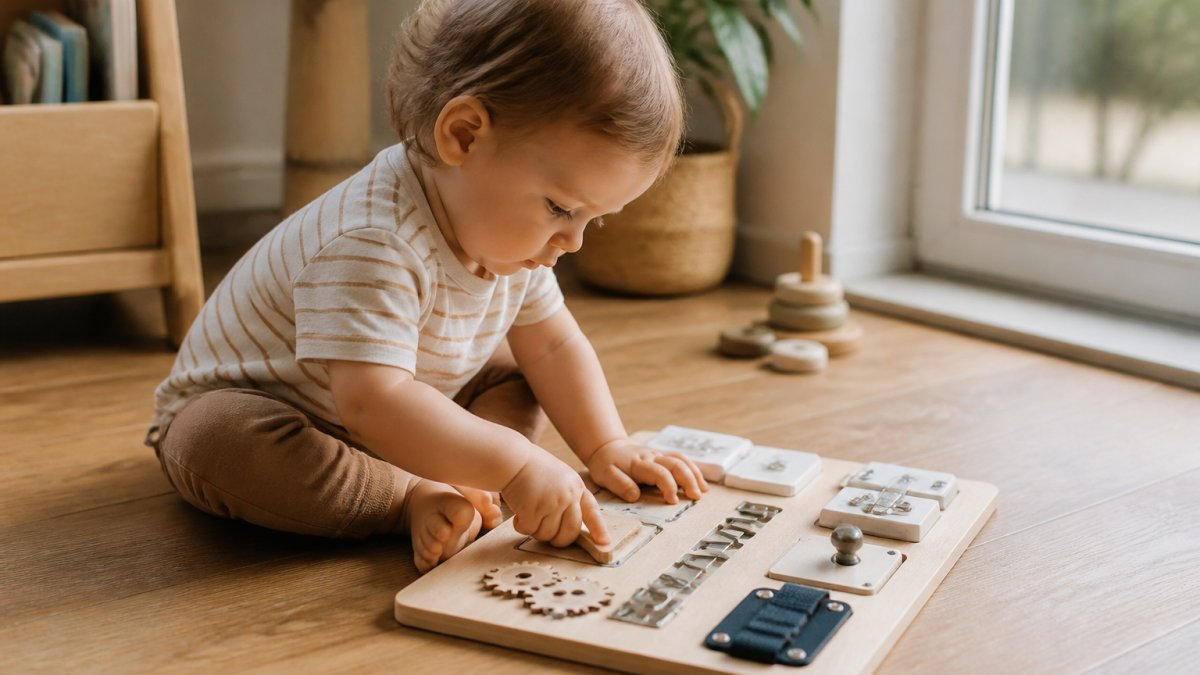
A busy board with eight buckle types keeps a short-attention-span toddler occupied because each buckle is a small, solvable problem. The Screwdriver Tool Board goes further: 14 screws in 7 styles, plus a wrench, a lock with 2 keys, and a dual-purpose screwdriver. A child figures out how a tool works by using it, not by watching you demonstrate.

That's the mechanism behind child-led discovery. The toy creates the conditions; the child does the work.
Cognitive science vs. the "Montessori" label
Here's where most buying guides stop short. They repeat the same benefits list without asking which of those benefits are actually supported by child development research and which are marketing copy dressed up as pedagogy.
The research-backed mechanisms are narrower than the marketing suggests:
- Repetition with variation. A single-skill toy lets a child repeat an action until it's mastered, then the toy offers a slightly harder version. This is the pattern behind motor-skill consolidation. A busy board with eight different buckles is eight repetitions of the same underlying motion with escalating difficulty.
- Error detection without adult correction. When a puzzle piece only seats one way, the child's own action produces the feedback. Researchers who study early learning describe this as reducing dependence on adult cues, which is what builds persistence.
- Reduced passive stimulation. A ScienceBasedParenting community discussion on developmental toy research noted that infants playing with electronic toys vocalized less and got fewer responses from parents than infants playing with traditional toys. The toy changes the parent's behavior too, which is the part the "Montessori" label never mentions.
What the label does not reliably deliver: any specific neurological outcome tied to the word "Montessori." The term isn't protected, and no regulator verifies it.
The durability argument, with numbers
Beyond motor skills, the research points to durability as the real value driver.
What most guides miss: the value isn't in the toy. It's in the number of developmental stages one toy spans. A $34.45 busy board serving ages 1 through 4 replaces three or four single-stage toys. That's the ROI calculation that matters, and it's the one the label never puts on the box.
Montessori Toys for Toddlers on a Budget
You can start the Montessori approach for under $40, and you should. Buying one piece and watching how your toddler actually plays with it tells you more than any review.
Here's an order to consider for a budget-conscious first purchase:
- Start with one busy board or busy cube ($34.45). These cover the widest age range and the most skills per dollar.
- Add a practical-life board once your child turns 3 ($44.45). Screws, locks, and wrenches hold attention longer than abstract puzzles at this age.
- Skip the collection bundles until you've confirmed engagement. A bored toddler with ten toys is worse off than an engaged toddler with two.
- Watch for rotation, not replacement. Rotating three toys weekly keeps them feeling new. This is the single cheapest upgrade to any playroom.
The Montessori Busy Cube is built for travel: 6.1 x 4.5 x 5.5 inches, all parts securely attached. Parents report it surviving plane rides and car trips that would destroy a plastic alternative. It contains small parts, so supervise around children under 3.
The subscription trend in this category, where curated toys arrive by developmental stage, is growing, according to Playroom Collective industry notes on natural materials. But subscriptions lock you into a monthly cost before you know what your child gravitates toward. Buy one piece first.
The Hidden Costs Nobody Talks About
The sticker price is not the real cost. Four expenses catch buyers off guard, and none of them appear on a product page.
1. The engagement gamble. Some Montessori-branded toys look beautiful in photos and fail to hold a child's interest in practice, leading to wasted spending, as noted in parenting review commentary on Montessori toy value. Aesthetics sell the toy to the parent. Only the child decides whether it gets used.
2. Maintenance and storage. Wood needs care. The Busy Cube should be wiped with mild detergent and a damp cloth, never immersed, since water swells the wood and peels the paint.
3. The comparison trap. Premium learning towers can run upwards of $350, per Today's Parent coverage of Montessori furniture pricing. Once you've seen those numbers, a $44.45 board feels cheap by comparison, and it's easy to overbuy.
4. The resale and lifespan calculation. This is the angle almost no buying guide covers, and it's the one that changes the math most.
Age-specific ROI: which toys hold value across stages
Not every Montessori toy earns its price back. The ones that do share a pattern: they span multiple developmental stages, so the same object gets used differently at 1, at 2, and at 3.
| Toy type | Stages spanned | Typical active-use years | Resale outlook |
|---|---|---|---|
| Busy board (buckles, zippers) | 1-4 years | 3+ | Strong, solid wood, no batteries to fail |
| Busy cube (sensory) | Under 1 to 2 | 1-2 | Moderate, smaller window |
| Screwdriver/tool board | 3+ years | 2-3 | Strong, real tools, real beech wood |
| Number train | 1-3 years | 2 | Moderate, pieces get lost |
| Bowling set | 3+ years | 2-3 | Moderate, bulky to ship |
| Snap circuit kit | 5-12 years | 4+ | Strong, highest stage span in the catalog |
The pattern: toys that isolate one skill but scale in difficulty hold value longest. Toys that are a single fixed activity, a shape sorter, a one-trick puzzle, are the "one-hit wonders." They're fine as gifts, but they don't earn back their price the way a multi-stage board does.
The resale math
Solid wood holds value in a way plastic doesn't. A beech wood tool board that survives two children can be resold, handed down, or donated in working condition. Plastic toys rarely survive the first child, let alone the second.
That resale floor is the hidden asset. It means the effective cost of a wooden toy is the purchase price minus what you recover, which is a number plastic can't match.
For grandparents buying a gift: a multi-stage wooden toy is the safer bet than a single-activity one. It stays in use longer, survives to a younger sibling, and holds enough value to feel like a real gift rather than a temporary distraction.
Verdict: When Montessori Toys Are Worth the Investment
They are not worth it if you're buying a full collection before your child has shown interest, or if you're paying a premium for the label rather than the design.
The math favors Montessori design on lifespan alone. A $34.45 busy board used three years costs roughly $1 per month.
Project Montessori's catalog reflects this logic. The Montessori Busy Board at $34.45 spans ages 1-4 with shoelaces, zippers, snap pockets, and 8 buckle types.
For grandparents, the Wooden Number Train Set at $49.95 turns counting into a game a 1-year-old can play alone, and the Rainbow Wooden Bowling Set at $59.95 gives kids an hour of screen-free activity they set up themselves.

Frequently Asked Questions
What defines a Montessori toy?
A Montessori toy is designed for child-led discovery rather than passive entertainment. It typically has one clear educational purpose, uses natural materials like wood, and encourages open-ended play. Look for toys that build fine motor skills, concentration, and independent play without batteries, flashing lights, or predetermined outcomes. The toy should match a child's current developmental stage and allow them to repeat an activity until they master it on their own.
Are Montessori toys worth the investment compared to plastic alternatives?
Montessori toys often cost more upfront, but the price-to-value ratio shifts over time. A wooden busy board at $34.45 can serve a child from age 1 to 4, while a $15 plastic toy may break or lose appeal in months. Parents are recognizing that durable construction and developmental span matter more than the initial price tag. Fewer, better toys often cost less over a childhood than constant replacements.
How do you identify authentic Montessori toys?
Authentic Montessori toys share specific traits: they are made from natural materials like wood, have a single clear educational purpose, and encourage hands-on exploration without screens or batteries. Check for non-toxic finishes, smooth edges, and realistic child-sized tools. A genuine Montessori toy lets a child work independently, makes self-correction possible, and respects the child's concentration. If a toy does the entertaining for the child instead of the other way around, it is not Montessori-aligned.
Do Montessori toys actually last longer than conventional toys?
Solid wood construction and non-toxic finishes mean Montessori toys hold up to rough play far better than thin plastic alternatives. A beech wood tool board or a wooden bowling set can survive years of daily use and still be passed down to siblings. While wooden Montessori toys cost more upfront, their durability and ability to adapt across developmental stages prevent the frequent replacement cycle that cheaper plastic toys require.
What are the long-term developmental benefits of Montessori-style play?
Montessori-aligned play builds fine motor skills, hand-eye coordination, problem-solving, and concentration. Montessori toys encourage practical life skills, independent play, and cognitive development that carries into school readiness. The benefits compound because the toys grow with the child, offering new challenges at each developmental milestone rather than becoming obsolete after a few months.
The real challenge isn't choosing a toy. It's finding one that survives your child's attention span long enough to justify the price. Project Montessori builds educator-approved, solid wood toys designed for independent play across multiple developmental stages, with a 30-day money-back guarantee if the fit isn't right. Start with a single piece, watch how your child plays, and let the toy prove its value before you buy the next one.