

Montessori Toys for Newborn Development: A Stage Guide
Table of Contents
- Why Montessori Toys Matter for Newborn Development
- Montessori Visual Stimulation for Newborns: Birth to 3 Months
- Sensory Exploration and Motor Development: 3 to 6 Months
- Montessori Newborn Sensory Activities: 6 to 12 Months
- How to Rotate Toys for Newborns: Keeping Play Fresh
- Natural Materials and Safe Design Principles
- Building Your Newborn's Montessori Toy Collection
- Conclusion
- Frequently Asked Questions
Last Updated: September 29, 2026
Why Montessori Toys Matter for Newborn Development
Newborns don't need much, but what they do need matters enormously. A baby's brain is building neural connections at a staggering rate during the first year, and the toys surrounding them play a direct role in that development. Research indicates that toys are most effective for development when they align with a child's specific stage of development and emerging abilities, according to the University of New England's developmental research. At Project Montessori, we've found that intentional toy selection during these early months creates a foundation for independent learning, motor skill development, and sensory awareness that lasts far beyond infancy.
Montessori-aligned play emphasizes calm, purposeful materials that match what a baby's developing brain is ready to process: high-contrast patterns for newborns aged 0-3 months, textured objects for babies beginning to grasp, and simple wooden toys that invite repetition.
Toys aligned with developmental stages support cognitive growth, fine motor development, and the neural pathways that underpin learning itself.
Montessori Visual Stimulation for Newborns: Birth to 3 Months
High-Contrast Patterns and Early Vision
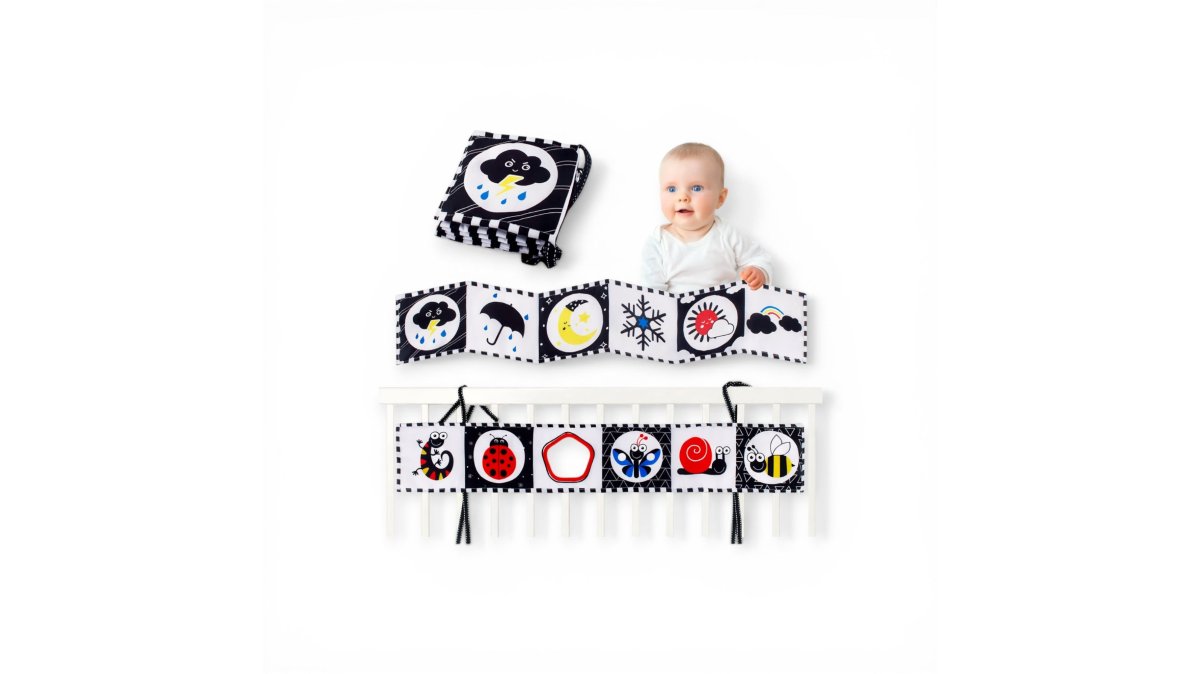
A newborn's vision is limited at birth, focusing best at 8-12 inches. They cannot perceive color but can see stark contrasts: black against white, bold geometric patterns, and simple shapes.
This is not a limitation to work around. It's an invitation to support visual development intentionally. High-contrast toys and patterns activate the developing retina and optic nerve during a critical window. According to the National Association for the Education of Young Children (NAEYC), toys for young children must be safe and specifically matched to their developmental stages to support learning. During tummy time, when babies are building neck and shoulder strength, high-contrast materials keep their eyes engaged and their heads lifted longer, naturally strengthening the muscles they need.
The Montessori Baby Sensory Book delivers exactly this with eleven black-and-white patterns, a baby-safe mirror, and hidden crinkle paper. It ties to cribs or strollers for travel. For grandparents seeking a meaningful first gift, this book signals thoughtfulness, you're supporting your grandchild's earliest learning.
Mirrors and Self-Recognition
Around 2-3 months, babies begin to notice their own reflections. The mirror becomes a point of visual fascination and discovery.

A baby-safe mirror provides a new visual target that encourages reaching and head turning while creating moments of connection between parent and baby.
The Montessori Baby Discovery Mirror combines high-contrast patterns with a soft, safe mirror and unfolds to 33 inches for extended visual interest. The crinkle fabric adds tactile and auditory elements, and it's durable for daily use and portable for travel.

Sensory Exploration and Motor Development: 3 to 6 Months
Between 3 and 6 months, babies transition from observers to explorers, beginning to grasp and understand that their movements create effects in the world.
Sensory toys during this window should invite touching, grasping, and mouthing. Texture matters now, soft, crinkly, smooth, bumpy. Babies learn through their mouths during this stage, so every toy must be completely safe for chewing and mouthing.
Montessori Newborn Sensory Activities: 6 to 12 Months
Grasping, Reaching, and Hand-Eye Coordination
By 6 months, babies reach deliberately, grasp with intention, and transfer objects from hand to hand. This is the stage for toys that reward reaching, grasping, and manipulation.
Object Permanence and Cause-and-Effect Play
Around 8 months, babies begin to understand that objects continue to exist even when hidden from view, object permanence, foundational to all future learning.
Montessori Baby Discovery Mirror →
How to Rotate Toys for Newborns: Keeping Play Fresh
Here's how to implement it practically:
Step 1: Curate your collection. Gather all toys your baby has. Assess each one against the developmental stage. Keep only toys that match your baby's current abilities and interests. Store the rest in a closed bin.
| Rotation Interval | Active Toys | Storage Toys | Parent Benefit |
|---|---|---|---|
| Every 2 weeks | 4-6 toys | 8-12 toys | Maintains novelty without purchasing constantly |
| Every 3 weeks | 5-7 toys | 10-15 toys | Slightly more variety, easier to manage |
| Every 4 weeks | 6-8 toys | 12-20 toys | More toys available, requires larger storage |
Natural Materials and Safe Design Principles
The shift toward natural materials in infant toys is rooted in both safety and developmental philosophy.
When selecting toys, look for:
- Untreated or naturally finished wood. No plastic coatings, no varnish that might chip.
- Organic cotton or natural fabrics. Soft, breathable, safe for mouthing.
- No small parts. Everything must be large enough that it cannot be swallowed.
- No toxic dyes or finishes. If it smells chemical, it's not safe for a baby who will mouth it.
- Washable construction. Babies are messy. Toys need to withstand washing.
Building Your Newborn's Montessori Toy Collection
You don't need to buy everything at once. In fact, you shouldn't. A thoughtful Montessori collection grows gradually, matched to your baby's developmental stage.
Conclusion
Newborn development happens fast. In the first year alone, babies progress from reflexive movements to intentional grasping, from blurry vision to focused visual tracking, from passive observers to active explorers. The toys surrounding them during this window matter more than most parents realize.
Frequently Asked Questions
What are the best montessori toys for newborns in the first three months?
For newborns aged 0-3 months, focus on high-contrast visual stimulation and gentle sensory exploration. The Montessori Baby Discovery Mirror and Montessori Baby Sensory Book feature bold black-and-white patterns designed for developing eyesight, plus soft mirrors for early self-recognition. These align with research showing that newborns respond best to simple, intentional toys that match their visual and tactile readiness. Pair these with soft crinkle toys like the Montessori Sensory Caterpillar to introduce gentle auditory development through safe, natural sounds.
How do montessori sensory activities support newborn brain development?
Montessori newborn sensory activities engage multiple developmental pathways at once. High-contrast patterns activate visual tracking and focus, building neural connections in the visual cortex. Textured materials, crinkle fabrics, soft surfaces, safe mirrors, stimulate tactile pathways and encourage reaching, which strengthens fine motor skills and hand-eye coordination. Toys matched to a child's specific developmental stage support cognitive growth more effectively than generic age-labeled toys. Repetitive sensory play builds neurological pathways essential for later learning.
When should I introduce different montessori toys as my baby grows?
Introduce toys in alignment with your baby's emerging abilities, not just their age. Birth to 3 months: high-contrast visuals and gentle sounds. Three to 6 months: add grasping toys like soft balls and rattles as hand strength develops. Six to 12 months: introduce toys supporting object permanence, cause-and-effect play, and hand-eye coordination. The Montessori Sensory Wonder Ball works from 6 months onward, supporting the transition from simple sensory exploration to more intentional, problem-solving play. Rotate toys every 1-2 weeks to maintain engagement and prevent overstimulation.
Are natural materials really better than plastic for newborn toys?
Natural materials like wood, cotton, and untreated fabric offer distinct developmental and safety advantages. They provide varied tactile feedback, warmth, texture, weight, that plastic cannot replicate, supporting richer sensory exploration and fine motor skill development. Natural materials also reduce exposure to synthetic chemicals, addressing a primary parental concern about toy safety. That said, the most important factor is that toys are intentionally designed to match your baby's developmental stage, whether natural or not.
Can I make DIY montessori toys at home, or should I buy curated sets?
Many effective Montessori sensory activities use everyday household items, high-contrast scarves, wooden spoons, safe kitchen containers, without requiring expensive curated sets. However, purpose-built toys like the Montessori Baby Development Toy and Montessori Baby Sensory Book combine multiple developmental features (high contrast, safe mirrors, varied textures, auditory elements) in one thoughtfully engineered product. For first-time parents uncertain about what truly supports development, curated collections remove guesswork and ensure safety standards are met. You can also blend both approaches: use DIY items for exploration while introducing targeted sensory toys for specific developmental milestones.
What makes a toy Montessori-aligned versus just any sensory toy?
Montessori-aligned toys follow specific design principles: they support one clear developmental skill, use simple and intentional design without excess decoration, encourage open-ended and child-led exploration, and respect the child's developmental readiness. A true Montessori toy invites repetition and mastery rather than passive entertainment. For example, a high-contrast book supports visual development and tummy time strength; a wooden ring stacker teaches sequential thinking and hand-eye coordination. Generic sensory toys may stimulate the senses but lack this intentional developmental framework. When evaluating toys, ask: Does this support a specific skill my child is ready for right now?
How often should I rotate toys, and why does it matter for newborn development?
Rotate toys every 1-2 weeks to maintain engagement and prevent overstimulation. When a toy is always available, babies stop noticing it; rotation keeps play fresh and encourages sustained focus. This practice also supports intentional learning by allowing you to introduce toys aligned with your baby's current developmental stage, then reintroduce them later when new skills emerge. Rotation reduces clutter in the nursery environment, supporting the Montessori principle of calm, purposeful spaces. For newborns, this means moving one sensory toy to storage while bringing out another, allowing your baby to rediscover it with fresh attention weeks later.