

How to Identify Authentic Montessori Toys: 2026 Guide
Table of Contents
- Why So Many Toys Get Labeled Montessori (and Why It Matters)
- Montessori Toy Characteristics: The 7-Point Authenticity Checklist
- How to Choose Montessori Toys by Age
- Montessori Toy Safety Standards: What Certifications to Check
- Marketing vs. Reality: How to Filter Out Fake Montessori Toys
- Authentic Montessori Toys in Practice: What to Look For on a Product Page
- Conclusion: Build a Playroom That Earns the Name
- Frequently Asked Questions
Last Updated: September 28, 2026
Why So Many Toys Get Labeled Montessori (and Why It Matters)
The Montessori learning toys market was valued at $4.2 billion in 2025 and is projected to reach $8.1 billion by 2034, growing at 7.5% per year (Dataintelo Montessori Learning Toys Market Report). That growth explains why so many products now carry the label. It does not explain why so few earn it.
Here is the uncomfortable truth: the word "Montessori" is not trademarked. Anyone can print it on a box. That means learning how to identify authentic Montessori toys comes down to reading design, not labels.
At Project Montessori, we built our catalog around that distinction. This guide gives you a practical filter: seven characteristics to check, an age-by-age reference, and the safety marks that actually matter.

The stakes are real. A toy marketed as Montessori but designed as passive entertainment teaches a child to wait to be entertained. A genuine material teaches a child to work things out alone.
Montessori Toy Characteristics: The 7-Point Authenticity Checklist
Authentic Montessori toys share seven traits: a control of error, isolation of quality, natural materials, no batteries, open-ended use, realistic scale, and simple design. If a product misses three or more, the label is marketing.
Use this checklist before you buy:
- Control of error built into the design
- Isolates one skill at a time
- Made from wood, metal, cotton, or wool
- No batteries, lights, or sounds
- Open-ended (many ways to play)
- Realistic size and weight for small hands
- Plain, uncluttered surface
A peer-reviewed review of the Montessori evidence base confirms that genuine materials follow a defined pedagogical approach, not a color scheme. Generic wooden blocks with a pastel finish are not the same thing.
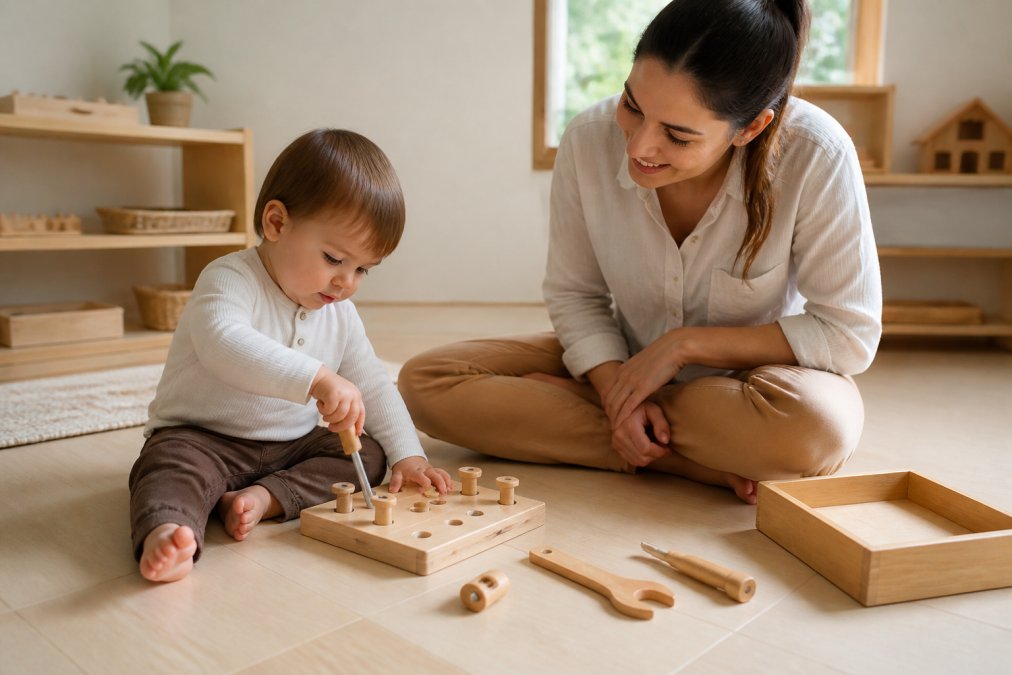
Control of Error: The Feature Marketing Copy Never Mentions
Control of error is a design feature that lets a child spot and fix their own mistake without an adult stepping in. A knob that only fits one hole. A puzzle piece that will not sit flush if it is turned the wrong way.
That feedback loop builds independence and concentration. It also removes you from the referee role.
The Project Montessori Screwdriver Tool Board shows this clearly. Each of the 14 screws matches one driver or wrench, so a wrong tool simply will not turn the screw. The board corrects the child. You do not have to.
Isolation of Quality and Simple Design
Isolation of quality means the toy highlights one property at a time. A color-matching set varies only color. A size-sorting set varies only size.
This is why authentic materials look plain. Every extra feature splits a child's attention. Minimalist design is not a style choice here; it is the point.
How to Choose Montessori Toys by Age
Match the toy to the developmental stage, not the birthday. A toy that is too easy bores a child. One that is too hard frustrates them and kills intrinsic motivation. The Montessori approach calls this the sensitive period: a window when a child is primed to absorb a specific skill, and a material that arrives outside that window either gets ignored or gets misused.
The practical test is to watch what the child already tries to do unprompted. A toddler who insists on buckling their own shoe straps is signaling readiness for practical-life materials. A preschooler who sorts snacks by color is signaling readiness for classification work. Buy for the behavior you already see, not the age on the box.
Montessori Screwdriver Tool Board →
For infants, focus on contrast, texture, and safe mouthing. For toddlers, prioritize fine motor skills and practical life tasks. For preschoolers, look for problem-solving and early numeracy.
A Quick Age-by-Age Reference
| Age | Best Toy Type | Skill Built | What to Look For |
|---|---|---|---|
| 0-12 months | Contrast cards, grasping rings | Visual tracking, grip | High-contrast patterns, lightweight wood or food-grade silicone, no detachable parts |
| 1-2 years | Switch boards, stacking sets | Cause and effect, fine motor | One action per feature, chunky knobs sized for a full-hand grasp, no batteries required for the core play |
| 2-3 years | Tool boards, shape sorters | Problem-solving, focus | A built-in control of error so the child can self-correct, realistic tool shapes |
| 3-4 years | Practical life, puzzles | Independence, sequencing | Real tasks (pouring, fastening, transferring), pieces that fit only one correct way |
| 4-6 years | Numeracy, language sets | Early math, literacy | Concrete-to-abstract progression, sandpaper numerals or letters, countable objects |
The Mismatch Signals to Watch For
A toy is too hard if the child abandons it within a minute, asks an adult to finish it, or uses it in a way that damages the pieces. A toy is too easy if the child completes it once and never returns. Both are worth noting, because the fix is usually to move one stage up or down rather than to buy more.
This is also where the authenticity question and the age question intersect.
Montessori Toy Safety Standards: What Certifications to Check
Check for ASTM F963 compliance and Proposition 65 labeling. These are two marks that tell you a toy has been tested for mechanical hazards and heavy metals.
- ASTM F963 is the consumer safety specification for toy safety. It covers mechanical and physical properties (sharp edges, small parts, pinch points), flammability, and certain chemical limits.
- Proposition 65 is a state-level warning requirement. It does not certify a product as safe; it requires a warning label when a product exposes a user to listed chemicals above a set threshold. A product with no warning is not automatically clean, and a product with a warning is not automatically dangerous. It is a disclosure rule, not a pass/fail stamp.
What Else to Verify on the Listing
- Non-toxic finishes stated by name (water-based, food-grade, or plant-based oil), not implied by the word "natural"
- Smooth, rounded edges with no splinters or exposed fasteners
- No small parts on items marked for under-3s, per the small-parts cylinder test
- Solid wood, not particleboard or MDF that chips and exposes adhesive
- Third-party lab reports available on request, not just a logo on the box
Why Safety and Authenticity Are the Same Question
This is the angle most buying guides skip: safety testing and Montessori authenticity are not two separate checklists. They are the same design philosophy viewed from two directions.
Marketing vs. Reality: How to Filter Out Fake Montessori Toys
The fastest filter is the battery test. Authentic materials avoid electronics because flashing lights and sounds pull a child out of focused, open-ended exploration.
Watch for these red flags:
- The word "Montessori" appears but no learning objective does
- The listing leads with entertainment, not skill
- Dozens of features crammed into one item
- Plastic parts dressed up as "educational"
- No mention of materials, age range, or safety testing
Authentic Montessori Toys in Practice: What to Look For on a Product Page
Open any product page and scan for four things in this order: materials, age range, skill list, and safety marks. If all four are present and specific, you are likely looking at a genuine material.
Conclusion: Build a Playroom That Earns the Name
The real challenge is not finding toys. It is filtering out the ones that borrowed the name without the design behind it.
Frequently Asked Questions
Do authentic Montessori toys have to be made of wood?
Wood is common because it gives a realistic tactile experience and holds up to years of use, but it is not the only authentic material. Genuine materials also include cotton, wool, cork, and metal. What matters is that the material supports real sensory learning and durability. A metal lock or a cotton lacing frame can be just as authentic as a wooden puzzle. Plastic is not automatically disqualifying, but it is rarely chosen for authentic materials because it offers little tactile variety.
What is the biggest giveaway that a toy is not really Montessori?
Batteries, flashing lights, and pre-scripted play are the clearest signals. Authentic Montessori toys avoid electronic components because they distract from focused, open-ended exploration. If a toy only works one way, does the playing for the child, or rewards button-pressing with noise and lights, it is unlikely to meet the Montessori toy characteristics that matter. Look instead for a single clear skill, a way for the child to self-correct, and materials that feel real in the hand.
Are Montessori toys safe, and what certifications should I check?
Check the product page for a non-toxic finish, smooth sanded edges, and no small parts for children under three. Note that the Montessori name itself is not trademarked, so safety claims are not verified by any Montessori body. You have to read the listing. If a brand will not state its materials and testing, treat that as a warning sign and keep looking.
How do I spot a toy that truly encourages independent play?
Look for one clear purpose and a built-in way for the child to check their own work, which is called control of error. A shape sorter that only fits the correct shape, or a screw board where the screw either threads or does not, lets a child notice and fix mistakes without an adult stepping in. That self-correction is what builds concentration and intrinsic motivation. Toys that need a parent to explain every step, or that have no right answer at all, tend to lose a child's attention faster.