

Non-Toxic Educational Toys for Infants: 10 Best Picks
Table of Contents
- Why Non-Toxic Educational Toys Matter for Infant Development
- Educational Toys for Babies 0-6 Months: Sensory Foundations
- Educational Toys for Babies 6-12 Months: Motor Skills and Exploration
- Safe Wooden Toys for Infants: Materials That Matter
- PVC-Free Baby Toys: Understanding Material Safety
-
10 Best Non-Toxic Educational Toys for Infants
- 1. Montessori Sensory Caterpillar: High-Contrast Play for Newborns
- 2. Montessori Baby Discovery Mirror: Visual Development in Motion
- 3. Montessori Baby Sensory Book: Tummy Time Engagement
- 4. Montessori Wooden Rattles (4 Pack): Hand-Eye Coordination
- 5. Montessori Sensory Wonder Ball: Diverse Textures for Exploration
- 6. 3D Animal Tails Cloth Book: Memory and Touch
- 7. Montessori Barnyard Cuddly Animals: Multi-Sensory Play Set
- 8. Montessori Busy Cube: Problem-Solving for Older Infants
- 9. Carrots Harvest Box: Sorting and Size Recognition
- 10. Montessori Baby Development Toy: Color and Sound Discovery
- How to Evaluate Safety Claims and Certifications
- Cleaning and Maintenance for Long-Term Safety
- Frequently Asked Questions
Last Updated: October 18, 2026
Why Non-Toxic Educational Toys Matter for Infant Development
Non-toxic educational toys for infants support developmental growth during the most critical window for learning and sensory exploration, protecting your child's health while fueling curiosity.
Infants learn through their senses, reaching, grasping, mouthing, and manipulating everything within reach.
At Project Montessori, we've curated a collection rooted in the Montessori philosophy that prioritizes both safety and learning, with each toy chosen to support specific milestones.
Educational Toys for Babies 0-6 Months: Sensory Foundations
The first six months are all about sensory awakening: vision is still developing, hearing is adjusting, and touch is the primary way of understanding the world. Toys for this age focus on high-contrast visuals, gentle sounds, and safe textures.
High-Contrast Visual Stimulation
Newborn vision develops rapidly but starts limited.
The American Academy of Pediatrics notes that visual development happens in stages, with newborns preferring stark contrasts before progressing to color recognition. High-contrast books and toys align perfectly with this natural progression.
Toys like the Montessori Baby Sensory Book use black-and-white patterns designed for newborn vision, based on how infant eyes develop.
Gentle Textures and Safe Grasping
Touch is how infants first explore the world. At this stage, toys should have no hard edges, no small parts, and materials safe for mouthing.
Plush toys with crinkle elements, like the Montessori Sensory Caterpillar, combine visual, tactile, and auditory stimulation, engaging multiple senses to build neural connections.

Educational Toys for Babies 6-12 Months: Motor Skills and Exploration
By six months, babies have better hand control and are beginning to understand cause and effect. Toys at this stage should encourage grasping, reaching, and exploration while showing that their actions create outcomes.
Rattles and Reaching Toys
Rattles are a classic for good reason: reaching and grasping teaches babies their body can control their environment, and shaking one to hear the sound teaches cause and effect.
The Montessori Wooden Rattles (4 Pack) offer variety in weight, texture, and sound, keeping exploration fresh.

Cause-and-Effect Play
Between 6 and 12 months, babies begin to understand that their actions produce results.
The Montessori Sensory Wonder Ball introduces diverse textures and responds to a baby's touch and movement, with varied surfaces that encourage continued exploration.
Safe Wooden Toys for Infants: Materials That Matter
Wood is a natural, durable material used for generations. When sourced responsibly and finished with non-toxic coatings, wooden toys offer safety, longevity, and a sensory experience different from plastic, without off-gassing chemicals.
The key to safe wooden toys is the finish. Water-based paints and natural oils are non-toxic alternatives to conventional varnishes and stains.
Wooden toys also tend to be heavier than plastic, and their weight and warmth engage the senses differently.
PVC-Free Baby Toys: Understanding Material Safety
PVC-free toys use alternatives like polyester, silicone, or natural rubber, which don't require phthalates for flexibility.
When evaluating toys, look for explicit labeling: "PVC-free," "phthalate-free," and "BPA-free." Products from Project Montessori are selected specifically to meet these safety standards.
Consumer Product Safety Commission guidelines on toy safety outline standards for toy materials and chemical exposure.
10 Best Non-Toxic Educational Toys for Infants
1. Montessori Sensory Caterpillar: High-Contrast Play for Newborns
It grows with your baby: high-contrast panels engage newborns during tummy time, while older infants enjoy the varied textures and mirror. Machine washable and built for daily use.
Best for: Newborns through 6 months, especially during tummy time Price: $39.95 Key features: High-contrast patterns, baby-safe mirror, crinkle and rattle elements, machine washable
2. Montessori Baby Discovery Mirror: Visual Development in Motion
The Montessori Baby Discovery Mirror unfolds into 33 inches of high-contrast discovery.
The fold-out design is portable and versatile: tie it to a crib, stroller, or car seat, and the extended length gives babies plenty of visual material to explore during tummy time.
Best for: Newborns through 6 months, travel and tummy time Price: $29.95 Key features: 33-inch fold-out design, high-contrast patterns, baby-safe mirror, crinkle fabric, portable ties
3. Montessori Baby Sensory Book: Tummy Time Engagement
The Montessori Baby Sensory Book combines high-contrast patterns with crinkle paper and a baby-safe mirror.
Designed for tummy time, it turns floor time into focused play that strengthens neck and arm muscles. The soft, non-toxic polyester construction is safe for mouthing, and the book is hand washable.
Best for: Newborns through 6 months, especially tummy time Price: $29.95 Key features: 11 black-and-white patterns, crinkle paper, baby-safe mirror, red flag flip, hand washable
4. Montessori Wooden Rattles (4 Pack): Hand-Eye Coordination
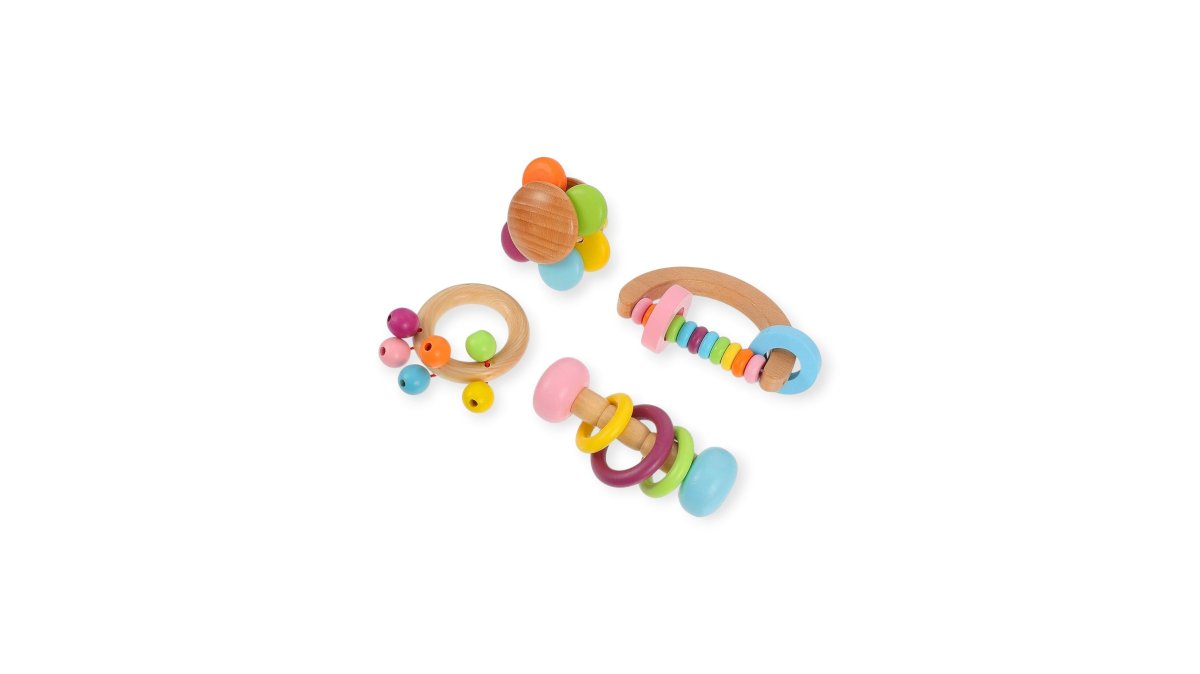
The Montessori Wooden Rattles come as a set of four, each with different weights, textures, and sounds, giving babies multiple opportunities to practice grasping and reaching.
Each rattle responds differently to a baby's touch, supporting cognitive development as babies learn that different objects behave differently.
Best for: 6 months and older Price: $39.95 Key features: 4 different rattles, wooden construction, non-toxic finish, varied textures and sounds
5. Montessori Sensory Wonder Ball: Diverse Textures for Exploration
The Montessori Sensory Wonder Ball offers multiple textures, shapes, and sensory experiences in one toy.
Montessori Wooden Rattles (4 Pack) →
It grows with your baby: younger infants enjoy the varied textures and gentle responses, while older infants use it to practice grasping and manipulation.
Best for: 6 months and older Price: $54.45 Key features: Diverse textures, soft construction, safe for mouthing, encourages exploration
6. 3D Animal Tails Cloth Book: Memory and Touch
The 3D Animal Tails Cloth Book combines touch-and-feel exploration with early memory development.
The book measures 19 by 15 centimeters, sized perfectly for little hands. A handle strap allows it to hang in a crib or travel with you.
Best for: 6 months through 12 months Price: $34.45 Key features: 3D animal tails, touch-and-feel design, sound paper, portable handle, washable
7. Montessori Barnyard Cuddly Animals: Multi-Sensory Play Set
The Montessori Barnyard Cuddly Animals set includes six plush animals with varied textures and soft, crinkly, and rattling elements, plus a soft barn with a mirror and carry handle.
It grows with your baby: younger infants enjoy the varied textures and gentle sounds, while older infants practice grasping and coordination filling and emptying the barn.
Best for: 6 months through 3 years Price: $39.95 Key features: 6 plush animals, soft barn with mirror, varied textures and sounds, portable carry handle
8. Montessori Busy Cube: Problem-Solving for Older Infants
The Montessori Busy Cube offers six interactive sides: fingertip spiral, spring latch, one-way switch, universal wheel, faucet switch, and rotating screw.
The Montessori Busy Cube is made from high-quality, non-toxic materials and carefully handcrafted with smooth surfaces and no sharp edges, ensuring your child's safety.
Best for: 9 months and older Price: $34.45 Key features: 6 interactive sides, wooden construction, non-toxic materials, travel-friendly size, durable design
9. Carrots Harvest Box: Sorting and Size Recognition
The Carrots Harvest Box teaches size recognition and sorting through repetitive play. Each wooden carrot has its own hole, and only the right size fits.
Solid wood construction with non-toxic finish and smooth edges makes this toy safe and durable. The chunky carrots are sized for little hands.
Best for: 12 months and older Price: $39.95 Key features: Wooden construction, non-toxic finish, size-sorting play, smooth edges, durable design
10. Montessori Baby Development Toy: Color and Sound Discovery
The Montessori Baby Development Toy replicates the joy of pulling tissues from a box.
Crafted from non-toxic, skin-friendly, and odorless materials, the Montessori Baby Development Toy is safe for curious babies who love to explore with their mouths.
Best for: 12 months and older, especially for travel Price: $34.95 Key features: 8 colorful scarves, 3 crinkle papers, non-toxic materials, reinforced stitching, portable and washable
How to Evaluate Safety Claims and Certifications
Not all toy labels tell the complete story. Understanding what safety claims actually mean helps you make confident choices.
Non-toxic means the materials and finishes don't contain substances known to be harmful at expected exposure levels.
Look for toys that carry third-party testing certifications. Project Montessori toys are selected based on these safety standards, ensuring you're getting toys that meet rigorous safety requirements.
International toy safety standards overview provides detailed information about testing and certification standards for toys.
Cleaning and Maintenance for Long-Term Safety
Keeping toys clean isn't just about hygiene, it's part of maintaining their safety.
Most soft toys and cloth books are machine washable or hand washable.
Inspect toys regularly for wear.
| Toy Type | Cleaning Method | Frequency | Inspection Points |
|---|---|---|---|
| Cloth/plush toys | Machine wash or hand wash | Weekly or after heavy use | Seams, tears, loose threads |
| Wooden toys | Spot clean with damp cloth | Monthly | Cracks, splinters, finish integrity |
| Sensory books | Hand wash or spot clean | Weekly | Binding, pages, attached elements |
| Plastic toys | Wipe with damp cloth | Weekly | Cracks, discoloration, loose parts |
Proper maintenance keeps toys safe and extends their usability.
Choosing non-toxic educational toys for infants means investing in both safety and development.
Shop now and discover toys that support your child's natural development while keeping their health protected.
Frequently Asked Questions
What makes non-toxic educational toys different from regular baby toys?
Non-toxic educational toys are crafted from materials free of harmful chemicals like BPA, PVC, phthalates, and heavy metals. They're designed with developmental stages in mind, offering sensory stimulation and skill-building through textures, sounds, and interactive features. Educational toys encourage reaching, grasping, cause-and-effect thinking, and visual tracking, while regular toys may focus only on entertainment. Non-toxic options also use natural finishes and safe materials so babies can safely mouth and explore without chemical exposure.
Are wooden toys safe for infants to chew and mouth?
Yes, when properly made. Safe wooden toys for infants use non-toxic, water-based finishes and smooth, splinter-free construction. They are durable enough to withstand mouthing and chewing. Always check that wooden toys have no loose parts, sharp edges, or peeling paint. Montessori wooden toys are typically finished with food-safe coatings and tested to ensure they remain safe during normal teething and exploration behavior.
How do I know if a baby toy is PVC-free and actually safe?
Look for product labels stating 'PVC-free,' 'BPA-free,' and 'phthalate-free.' Check the materials list for natural alternatives like wood, organic cotton, or silicone. Reputable brands provide safety certifications and test results. Avoid toys with strong chemical odors, which often signal off-gassing from harmful materials. Read customer reviews mentioning durability and safety. Project Montessori toys clearly state their non-toxic materials and safe finishes, making it easy to verify what you're purchasing.
What developmental benefits should I expect from educational toys for babies 0-12 months?
From 0-6 months, babies develop visual tracking, hand-eye coordination, and sensory awareness through high-contrast patterns, gentle rattles, and varied textures. From 6-12 months, toys support reaching, grasping, cause-and-effect learning, and problem-solving. Educational toys encourage fine motor skill development, cognitive growth, and curiosity. Montessori-inspired toys specifically support independent exploration and self-directed learning, helping babies progress at their own pace while building confidence and concentration.
Can I mix non-toxic toys from different brands, or should I stick to one collection?
You can absolutely mix toys from different brands. What matters is that each toy meets safety standards and suits your baby's developmental stage. Many parents combine Project Montessori toys with other non-toxic options to create a well-rounded play environment. The key is ensuring all toys are free of harmful chemicals, age-appropriate, and free of small parts or choking hazards. Variety actually enriches sensory play and keeps babies engaged across different types of learning.