

Montessori Toys vs Plastic Toy Sets: Which Wins?
Table of Contents
- Montessori Toys vs Plastic Toy Sets: The Core Difference
- What Makes a Toy Montessori?
- Wooden Toys vs Plastic Toys for Toddlers: An Honest Comparison
- Open-Ended Toys for Toddlers: Where Each Type Delivers
- Safety, Cleaning, and Total Cost of Ownership
- Montessori Toys for Different Ages: A Stage-by-Stage Guide
- Building a Balanced Toy Collection That Works for Your Family
- Frequently Asked Questions
Last Updated: October 17, 2026
Montessori Toys vs Plastic Toy Sets: The Core Difference
The real difference between montessori toys vs plastic toy sets isn't wood versus plastic. It's how much work each one asks of your child.
A Montessori-aligned toy is a simple, open-ended material that gives a child one clear job and lets them repeat it until they've mastered it.
That distinction matters most in the toddler years, when attention is short and the drive for independence is enormous.
Neither category is a monolith: some plastic sets are genuinely open-ended, and some wooden toys are decorative junk. Judge individual toys, not material labels.
What Makes a Toy Montessori?
A toy qualifies as Montessori when it supports independent, hands-on learning rather than passive entertainment. The clearest marker is whether a child can pick it up, use it correctly, and put it back without adult help.
We look for five things:
- One skill per material. A stacking ring set teaches size order. It doesn't also flash lights.
- Self-correcting design. The tower falls if the blocks are wrong. The child sees the error without being told.
- Real materials and real weight. Wood, cotton, metal. These give honest feedback through the hands.
- Nothing to fix. No batteries, no screens, no sounds the toy makes on its own.
- A place to belong. Materials live on a low shelf in a small rotation, so a toddler can choose and return them.
Notice what's missing: the word "wooden." It's a strong signal, not a requirement. The test is function, not material.
Wooden Toys vs Plastic Toys for Toddlers: An Honest Comparison
Wooden toys win on feedback, lifespan, and calm. Plastic wins on price, cleaning, and variety. The right answer depends on how your child plays and how much upkeep you can tolerate.
| Factor | Wooden toys | Plastic toy sets |
|---|---|---|
| Feel and feedback | Weighty, warm, honest resistance | Light, slick, sometimes hollow |
| Weight | Heavier; a dropped block stings | Light; safer for throwing stages |
| Noise level | Quiet | Often loud, sometimes noisy toys with sound chips |
| Cleaning | Wipe clean; avoid soaking | Rinse or wipe; most are dishwasher-friendly |
| Durability | High; repairable dents and scuffs | High impact resistance, but cracks and fades |
| Product lifespan | Years; often passed down | Months to a couple of years |
| Purchase price | Higher upfront | Lower upfront |
| Eco-friendly materials | Often FSC-certified or reclaimed | Usually virgin plastic, rarely recyclable |
| Best for | Focused, repeat-play toddlers | High-energy play, travel, mixed collections |
The trade-off is real: wooden toys cost more upfront and need more care, while plastic toys are cheap, tough, and easy to sanitize.
Open-Ended Toys for Toddlers: Where Each Type Delivers
Open-ended play is where a toy can be used a hundred different ways, the category where the gap between good and bad is widest.
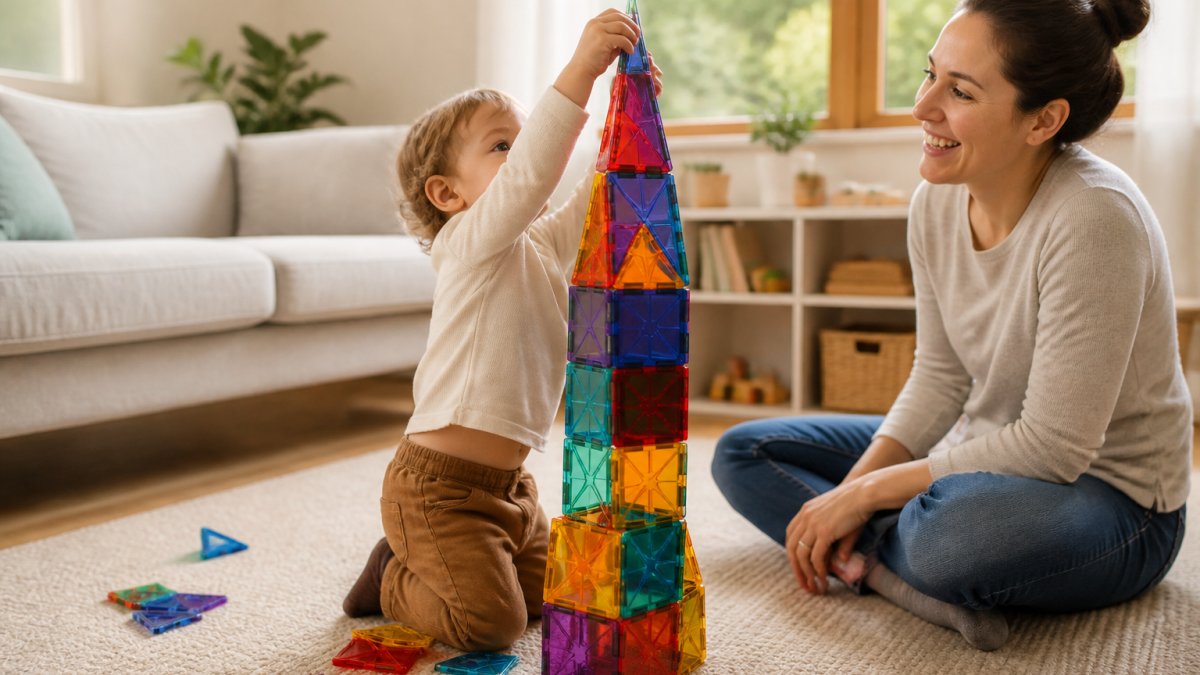
Here's a like-for-like test, three common toddler activities, and how each toy type handles them:
Activity 1: Building a tower. Wooden blocks give satisfying weight and a real crash. Plastic bricks snap and hold, which lets a toddler build higher. Both work. Wooden blocks teach balance; plastic bricks teach connection.
Activity 2: Pretend play. A plastic farm set with molded animals is instantly recognizable. A set of wooden figures and a plain barn needs the child to supply the story.
Activity 3: Cause and effect. A battery-driven toy with buttons delivers a predictable reward. A set of magnetic building sticks lets a child discover the reward themselves. The first is easier; the second builds problem-solving.

Our own magnetic building sets sit in the second camp. The Montessori Magnetic Building Blocks (60 pcs) at $79.95 let a toddler build flat shapes, then towers, then whatever they invent next. The Montessori Glow Magnetic Tiles at $69.95 add a marble run, so the same set keeps working as your child's engineering thinking grows.

Safety, Cleaning, and Total Cost of Ownership
Safety, cleaning, and long-term cost are the three reasons families reach for plastic, so each deserves a straight answer.
Safety: what the label actually tells you
In the U.S., toys are governed by the Consumer Product Safety Commission (CPSC), with ASTM F963 as the mandatory toy standard, alongside rules on lead, phthalates, and small parts. A compliant toy carries an age grading and the manufacturer's or importer's contact information.
What that means in practice:
- Small parts. The small-parts rule applies to toys for children under three (Small Parts Ban and Choking Hazard Labeling). If a piece fits inside a small-parts cylinder, it is a choking hazard for that age group. Magnets and marbles are the classic offenders in open-ended sets, which is why most magnetic building sets are labeled 3 and up.
- Magnets specifically. High-powered small magnets that come loose can attract each other across intestinal walls and cause serious injury if swallowed (Magnets). Check that magnets are fully encased and cannot be pried out.
- Finishes. Lead is banned in paint and surface coatings on children's toys. A reputable wooden brand will state compliance and name its finish, often water-based. A strong chemical smell out of the box is a reason to return, not to air out.
- Breakage. Plastic cracks into shards; wood splinters and can expose a loose screw or dowel. Inspect both monthly and retire anything with a sharp edge or wobbly joint.
Neither material is inherently safer, a well-made plastic set and a well-made wooden set can both meet the same standard. The differentiator is brand transparency and age match.

Cleaning: material-specific, not one-size-fits-all
Plastic wins on convenience, but the advice is more specific than 'rinse it.'
Montessori Magnetic Building Blocks (60 pcs) →
- Hard plastic (ABS, polypropylene): wipe with a damp cloth and mild soap, or rinse. Many sets survive a dishwasher top rack, but heat can warp thin pieces and degrade decals, so check the manufacturer's instructions first.
- Wood, sealed: wipe with a damp cloth and mild soap, then dry immediately. Do not soak, and do not put wood in the dishwasher. Standing water raises the grain, warps panels, and can loosen glued joints.
- Wood, unfinished: a light wipe is usually all it needs. Avoid harsh cleaners, which can strip the surface.
- Fabric and plush components: follow the care tag; most are surface-wash or machine-wash cold.
During flu season, plastic's ability to be fully washed and sanitized is a genuine advantage. Wood avoids the crevices around molded seams but demands faster drying.
Total cost of ownership: the math that matters
Sticker price is the least useful number. What matters is cost per year of use, which depends on durability, repairability, resale, and replacement.
- Durability. Wood holds its structure for years and can be sanded or re-glued. Plastic resists impact but fades, cracks at stress points, and loses decals.
- Repairability. A loose wooden joint can often be fixed with wood glue. A cracked plastic housing usually cannot.
- Resale and hand-me-downs. Quality wooden sets hold resale value and pass between siblings and cousins. Plastic sets rarely resell and are often discarded.
- Replacement. A plastic set that breaks in a year and is replaced twice can cost more over five years than one wooden set bought once.
The honest caveat: for a single child who will outgrow a toy in a season, plastic can be cheaper. For siblings, cousins, or a future second child, wooden usually wins on long-term value.
Montessori Toys for Different Ages: A Stage-by-Stage Guide
The right toy changes with the child, and the age label is only a starting point.
0-6 months: sensory input, not entertainment. High-contrast images, a grasping ring, a soft ball, a lightweight rattle.
6-12 months: filling, dumping, and posting. A first stacking cup, a simple posting box, a container of safe household objects.
12-18 months: one job, done independently. A shape sorter, a first push toy, chunky wooden blocks.
2-3 years: construction and practical life. Open-ended construction, art materials, child-sized practical tools like a pitcher or a spreading knife. This is where magnetic tiles and building sticks earn their keep, because the same set supports flat designs, towers, and simple machines.
3-5 years: planning and following through. Complex construction sets, early counting materials, imaginative play props.
A note for gift buyers: skip the age label and ask what the child already does well.
Building a Balanced Toy Collection That Works for Your Family
A balanced collection beats a pure one. Most families end up with a mix, and that's fine as long as it's intentional.
Here's how we'd do it:
- Pick a small core of open-ended materials. Blocks, tiles, or building sticks. These do the heavy lifting.
- Add a few plastic sets for high-energy play. Vehicles, bath toys, and travel toys earn their place.
- Rotate, don't pile up. Keep a small selection out and store the rest. A toy rotation resets attention without buying anything.
- Give every toy a home. A low shelf or labeled bin makes cleanup part of the play.
- Audit twice a year. Pull out anything broken, outgrown, or ignored. Toy clutter is the enemy of concentration.
If you're testing the approach before committing, start with one piece. The Montessori Magnetic Building Sticks at $44.95 are a low-risk entry point, and the Kids Flexible Race Track Set at $59.95 covers the vehicle-loving child.
The hardest part of choosing between Montessori toys and plastic toy sets isn't the comparison. It's the clutter that builds when you buy both without a plan.
Frequently Asked Questions
What is the difference between Montessori toys and regular toys?
Montessori toys are designed for a single clear purpose and let a child lead the play, while most regular toys come with a preset script, flashing lights, or a fixed outcome. A Montessori toy might be a set of magnetic building blocks a child arranges however they like. A regular plastic toy set often has one button and one result. The difference is not the material alone. It is whether the toy asks the child to think, test, and adjust, or simply watches the toy perform.
Are Montessori toys always made of wood?
No. Wood is common because it lasts and feels good in small hands, but plenty of Montessori-aligned toys are plastic. What matters is the design: open-ended, simple, and built for repeated use. Magnetic building sticks, for example, are made of high-quality ABS plastic and still support the hands-on, child-led play Montessori classrooms favor. Judge a toy by what a child can do with it, not by the material label on the box.
Are plastic toys bad for child development?
Plastic itself is not the problem. A plastic toy that does one thing at the push of a button gives a child little to figure out, and that is where the developmental value drops. A plastic toy that can be built, rebuilt, and tested keeps the same benefits as wood. Look at the play pattern first: does the child plan, try, fail, and adjust? If yes, the material is a secondary concern.
Can plastic toys fit the Montessori approach?
Yes, when they are open-ended and simple. Battery-driven gadgets that entertain a child passively sit outside the approach, but plastic construction sets that a child assembles and rebuilds fit right in. The Montessori test is whether the toy invites independent play and hands-on learning. A plastic magnetic tile set that becomes a marble run one day and a tower the next passes that test.
How do I choose toys that encourage open-ended play?
Pick toys with no single correct outcome. Blocks, magnetic tiles, flexible track sets, and stacking pieces all let a child decide what to build and how. Avoid toys where one button produces one result. Also watch for toys that grow with your child: a track set a 3-year-old snaps together can become a complex bridge layout for a 6-year-old. Fewer, more flexible toys usually beat a big pile of single-purpose ones.