

Montessori Toy Starter Kit Review: What's Worth It
Table of Contents
- What a Montessori Toy Starter Kit Actually Contains
- How to Spot Authentic Montessori Toys vs. Montessori-Marketed
- Montessori Toys by Age: Matching the Kit to Your Child
- The Best Montessori Toys for Toddlers in a Starter Kit
- Safety, Materials, and Durability: What to Verify Before Buying
- Are Montessori Toys Worth It? A Value Breakdown
- Who Each Starter Kit Suits Best
- Frequently Asked Questions
Last Updated: October 8, 2026
What a Montessori Toy Starter Kit Actually Contains
A Montessori toy starter kit is a curated set of hands-on learning materials grouped by a child's developmental stage, usually built around wood, natural textures, and open-ended play. The global Montessori toys market reached an estimated $9.96 billion in 2026, up from $9.15 billion in 2025, according to Project Montessori's 2026 review citing 360iResearch.
This review breaks down what belongs in a starter kit, how to tell real Montessori materials from toys that just borrow the name, and which kits fit which child, plus the safety details worth verifying before you buy.
The Four Material Categories That Matter
Authentic starter kits organize around four material groups, not a random pile of toys:
- Sensorial materials that isolate one quality at a time, like texture, weight, or color
- Practical life tools such as buckles, laces, and pouring cups that build real-world skills
- Language and number materials that introduce patterns, sequencing, and early counting
If a kit skips practical life or sensorial work entirely, it's a toy bundle wearing a Montessori label.
How to Spot Authentic Montessori Toys vs. Montessori-Marketed
Authentic Montessori toys share three traits: natural materials, a single isolated skill, and child-led play rather than a preset outcome. Montessori-marketed toys often miss all three.
The distinction isn't cosmetic. One 2026 guide to choosing Montessori toys from HABA USA emphasizes open-ended blocks and hands-on learning as the core markers, while The Good Trade's 2026 toddler roundup points to responsibly chosen materials and open-ended collections.
Here's a quick filter:
| Signal | Authentic Montessori Toy | Montessori-Marketed Toy |
|---|---|---|
| Material | Solid wood, natural fibers | Plastic with wood-look finish |
| Purpose | One skill, child-led | Multiple gimmicks, battery-driven |
| Outcome | Open-ended play | Fixed result or score |
| Longevity | Durable across siblings | Breaks within months |
Montessori Toys by Age: Matching the Kit to Your Child
The right starter kit matches your child's developmental stage, not their birthday alone. A toy that challenges a 3-year-old will frustrate a 1-year-old, and one built for a baby will bore a preschooler within a week. The practical test: watch your child with a toy for ten minutes. Master it instantly and walk away? Too easy. Hand it back or throw it?
First Year: Sensory Exploration and Cause-and-Effect
In the first year, development moves fast enough that a single kit rarely covers the whole span.
Around 4 to 8 months, babies work on grasping, mouthing, and tracking motion.
Around 9 to 14 months, the focus shifts to pincer grasp, stacking, and purposeful release.
The Montessori 1-2 Years Busy Bundle ($99.95) is built for this window, with pieces sized for small hands and designed around independent exploration.

Toddler Years: Fine Motor Skills and Practical Life
Once a child can sit and reach deliberately, practical life tools take over. Buckles, zippers, and laces turn daily routines into fine motor practice, and the toys mirror what the child sees adults doing, which is what holds attention at this age.
A useful way to think about the toddler window is by skill, not by month:
- Grasp and release: posting coins into a slot, dropping clothespins into a jar, threading large beads onto a cord
- Fastening: large buttons, snaps, hook-and-loop strips, and eventually zippers and buckles
- Pouring and transferring: small pitchers, scoops, and tongs moving dry beans or water between containers
A child still mouthing everything is not ready for the smallest pieces here, regardless of age. That's a supervision question, not a kit question.
The Montessori 2-3 Years Essentials Bundle ($99.95) targets this stage directly.
Preschool Years: Language, Number, and Longer Attention
By three to five, the materials shift again. Practical life work continues, but language and number materials take on more weight: sandpaper letters, movable alphabets, counting rods, and sequencing cards. Open-ended construction pieces, blocks, planks, interlocking shapes, get used for longer, more elaborate projects rather than quick stacks.
The Montessori 3-5 Years Pre-School Bundle ($99.95) extends the same approach into preschool years.
A Note for Grandparents and Gift-Givers
If you are buying a gift rather than outfitting a classroom, you do not need to match the kit to a precise developmental window. A versatile piece that spans a wide age range, like the 6-in-1 Activity Cube, which covers ages 1 to 4, is the safer choice, because it stays useful as the child grows and does not depend on you knowing their exact stage.
The Best Montessori Toys for Toddlers in a Starter Kit
The best Montessori toys for toddlers in a starter kit are durable wooden pieces that build fine motor skills and reward repeated use.
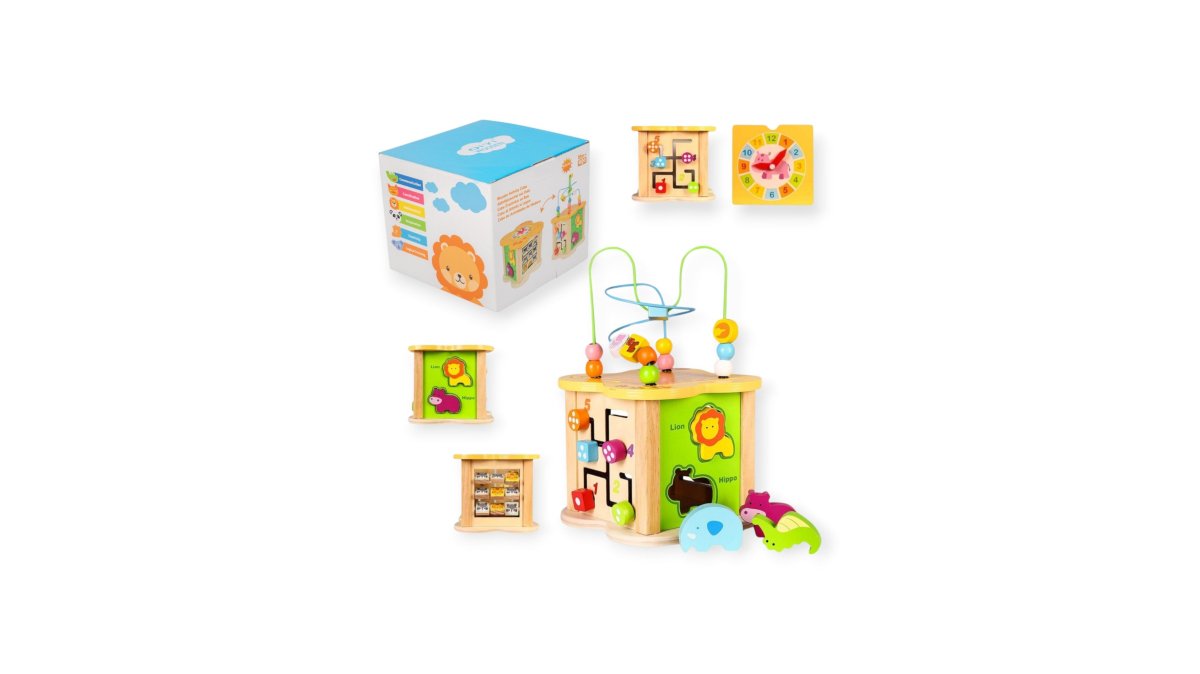
The 6-in-1 Activity Cube ($54.45) packs an animal pattern sorter, sliding number blocks, and a sensory clock into one solid wood frame.
The Montessori Busy Board ($34.45) handles the practical life side.
Montessori 3-5 Years Pre-School Bundle →
For a fuller setup, the Montessori 3-5 Years Pre-School Bundle ($99.95) extends the same approach into preschool years.

If your child loses interest fast, rotate three pieces at a time instead of putting the whole kit out at once. Fewer options usually means longer focus.
Safety, Materials, and Durability: What to Verify Before Buying
Before buying any starter kit, verify three things: material sourcing, finish safety, and construction quality. These decide whether a kit survives one child or three.
Our own products meet safety standards for ages 1 to 4, made from sustainably forested wood, non-toxic paint, and recyclable packaging.
What most buyers miss is durability. A wooden toy with glued joints will fail under a toddler's grip.
Are Montessori Toys Worth It? A Value Breakdown
Montessori toys are worth it when the kit covers multiple developmental stages and holds up to daily use, and not worth it when you're paying for a label on a toy your child outgrows in a month. Most reviews stop there and never show the math. This section does.
How to Judge a Kit's Value Without Guessing
A bundle is only a deal if the pieces inside it are pieces you would actually buy on their own. Itemize: write down every item in the box, then ask three questions about each one:
- Would my child use this on its own? If the answer is no for more than one or two items, the bundle is padding.
- Does it overlap with something we already own? Duplicate shape sorters and duplicate stacking rings are the most common waste in starter kits.
- Is it a consumable or a keeper? Consumables, craft supplies, paper cards, stickers, have a short life. Keepers, solid wood pieces, fastening boards, construction sets, should last years.
A kit with eight pieces where six are keepers beats a kit with fifteen pieces where four are keepers, even if the second box looks fuller.
Price Per Activity, Not Price Per Box
The number that matters is not the sticker price but the price divided by the distinct activities the child will actually return to. A well-made activity cube with six sides is six activities in one object.
Play kits generally start at $80, according to The Good Trade's 2026 Montessori toy roundup, and our bundles sit at $99.95. That's a fair benchmark for a multi-piece kit built from solid wood.
The Costs Competitors Leave Out
Most toy guides compare sticker prices and stop. Three other costs decide whether a kit was actually a good purchase:
- Replacement cost. If a piece breaks or goes missing, can you buy it individually, or do you have to replace the whole kit? Kits built from standard, non-proprietary pieces are cheaper to maintain over time.
- Shipping and delivery. A lower sticker price with paid shipping can cost more than a slightly higher price with free shipping. Check the total at checkout, not the listed price.
- Returns and customer service. This is the gap most reviews ignore, and it is the one that matters when something arrives damaged or does not fit your child. Before you buy, find the return window, whether return shipping is covered, and how the seller handles a defective piece. A generous return policy is worth more than a small discount, because it is the only thing that protects you if the kit is wrong for your child.
A skeptic's view deserves airtime. That criticism lands when a kit is thin on materials or heavy on branding, and when the seller makes returns difficult. A kit you cannot send back is a kit you are stuck with.
Running the Math
Run the math per use: a $54.45 activity cube used daily for two years costs pennies per session, while a $20 plastic toy that breaks in six weeks costs more. At the kit level, divide the total price by the activities your child returns to, then by the months the kit stays in rotation. A kit that stays interesting for eighteen months beats a cheaper kit abandoned in three, every time.
Who Each Starter Kit Suits Best
Different households need different kits, and picking the wrong one is the fastest way to waste money.
| Kit | Price | Best For | Age Range |
|---|---|---|---|
| 1-2 Years Busy Bundle | $99.95 | New walkers and early explorers | 1-2 years |
| 2-3 Years Essentials Bundle | $99.95 | Toddlers building fine motor control | 2-3 years |
| 3-5 Years Pre-School Bundle | $99.95 | Preschoolers ready for structured play | 3-5 years |
| 6-in-1 Activity Cube | $54.45 | Families wanting one versatile piece | 1-4 years |
| Montessori Busy Board | $34.45 | Travel, waiting rooms, and quiet time | 1-4 years |
Grandparents and relatives who want one thoughtful, high-quality gift: the 6-in-1 Activity Cube covers ages 1 to 4, so it stays useful as the child grows.

If you're testing the approach before committing, start with the Busy Board or Activity Cube. Both work standalone and slot into a larger kit later.
Frequently Asked Questions
What should be included in a Montessori toy starter kit?
A well-built starter kit covers four material categories: practical life tools (buckles, laces, snaps), sensorial pieces (textures, weights, shapes), language materials, and early math objects like counting blocks. It should also match your child's developmental stage. A kit for a 1-year-old looks very different from one for a 4-year-old, so check the age range before buying.
Are Montessori toy starter kits worth the money?
It depends on what's inside and how long your child uses it. A kit earns its price when the materials are durable, age-appropriate, and open-ended enough to hold attention for months, not weeks.
How do I know if a toy is truly Montessori?
Authentic Montessori toys share a few traits: they're made from natural materials like solid wood, they're open-ended (no single correct way to play), they isolate one skill at a time, and they encourage independent exploration. If a toy is plastic, battery-operated, or has a single predetermined outcome, it's Montessori-marketed rather than Montessori-aligned.
What age is a Montessori toy starter kit for?
Starter kits exist for every stage from birth through age five. For the first year, look for sensory exploration and cause-and-effect pieces. For ages 1 to 2, fine motor and practical life tools work best. For ages 2 to 5, kits shift toward problem-solving, early math, and independent play. Match the kit to your child's current developmental stage, not their birthday alone.
Can Montessori toys help with independent play?
Yes. Montessori-aligned toys are designed for child-led learning, meaning your child picks them up and figures them out without adult direction. The open-ended design keeps children engaged longer because there's no single right answer to exhaust.
Choosing a first Montessori toy starter kit comes down to matching materials to your child's stage, not to the loudest label on the shelf. Project Montessori builds educator-approved toys rooted in the Montessori philosophy, with bundles organized by developmental stage, solid wood construction, and hands-on learning baked into every piece. Browse our starter bundles and activity cubes to find the set that fits your child right now. Shop now and give them a toy that grows with them.