

Best Non Toxic Wooden Baby Toys: A 2026 Safety Guide
Table of Contents
- Quick Comparison: Best Non Toxic Wooden Baby Toys
- What Makes a Wooden Toy Non-Toxic?
- How to Identify Non-Toxic Wood Finishes
- The Benefits of Wooden Toys for Child Development
- Best Non Toxic Wooden Baby Toys by Age
- How to Clean Wooden Baby Toys
- Frequently Asked Questions
Last Updated: September 27, 2026
Quick Comparison: Best Non Toxic Wooden Baby Toys
Wooden toys are a preferred choice for babies and young toddlers because they generally do not contain the chemicals that raise health concerns in other materials, according to Seattle Children's guidance on choosing safe toys. That single fact explains why so many parents now search for the best non toxic wooden baby toys instead of grabbing whatever is on the shelf.
Here is the short version before the detail:
| Toy | Price | Best Age | Why It Stands Out |
|---|---|---|---|
| Montessori Wooden Rattles (4 Pack) | $39.95 | 6 months+ | Textured, rolling rattles for grasping and tactile exploration |
| Montessori Kids Sound Puzzles | $49.95 | 0-3 years | Built-in control of error, three themes |
| Montessori Wooden Number Train Set | $49.95 | 1-3 years | Magnetic numbered cars, removable number pieces |
| Bee Wooden Sorting Game | $39.45 | 3+ years | Color and shape sorting, non-toxic and BPA-free |
| Montessori Wooden ABC Building Blocks | $49.95 | 1-4 years | 26-piece solid wood bundle |
| Montessori Wooden Tool Set | $64.45 | 3+ years | STEM building with a wooden storage box |
| Montessori Rainbow Wooden Bowling Set | $59.95 | 3+ years | Solid wood pins, indoor or outdoor play |
| Montessori Stick Drop Tower Game | $39.95 | 3+ years | Balance and logic for 1-6 players |
| Montessori Wooden Bug Catcher Kit | $64.45 | 2+ years | Eight real tools for outdoor discovery |
| Montessori Wooden Christmas Tree Busy Board | $129.95 | 12 months+ | Eight activities in one solid wood tree |
What Makes a Wooden Toy Non-Toxic?
A wooden toy is non-toxic when both its base material and its surface coating are free of harmful additives. Solid hardwood is the safest base; food-safe oil, beeswax, or water-based paint is the safest finish. A toy can use beautiful hardwood and still be sealed with something you would not want near a mouth.


Solid Hardwood vs. Plywood and MDF
Leading brands are moving away from plywood and MDF in favor of solid hardwoods like maple, cherry, and walnut, according to Gentle Nursery's reporting on hardwood toys. The reason is practical, not just aesthetic.
A quick way to tell them apart in person:
- Check the edge. Solid wood shows a continuous grain pattern running through the side. Plywood shows thin stacked layers.
- Check the weight. Solid hardwood feels denser in the hand than a hollow or composite piece of the same size.
- Check the sound. Tap two pieces together. Solid wood gives a clean knock; MDF sounds dull and flat.
How to Identify Non-Toxic Wood Finishes
Non-toxic finishes fall into three groups: food-safe oils, beeswax, and water-based paint. If a product page cannot say which one it uses, treat that as a warning sign.
- Food-safe oils. Coconut and linseed oil soak into the wood rather than sitting on top. They leave a matte, slightly deepened grain and no shiny film.
- Beeswax. Beeswax gives a soft sheen and a faint honey smell. It is often blended with oil.
- Water-based paint. Water-based paint looks opaque but thin. Solvent-based lacquer tends to look thicker and glossier, and it chips rather than wears.
The Chemicals You Are Actually Screening For
"Non-toxic" is a marketing word, not a regulatory one. What you are really checking is whether the toy is free of substances with documented health concerns in early childhood:
- Lead. Still the single most important heavy metal in surface coatings. Lead has no safe blood level in children, and it is the reason ASTM F963 sets strict limits on heavy metals in paint and surface coatings.
- Phthalates. Plasticizers used to soften vinyl and some binders. They are restricted in children's products under the Consumer Product Safety Improvement Act (CPSIA), which also caps lead content in children's products.
- Formaldehyde. A common binder in plywood and MDF adhesives. Solid hardwood sidesteps it entirely because there is no glue layer.
- BPA and BPS. Found in some resins and coatings. "BPA-free" on a label is a starting point, not a guarantee, BPS is a common substitute with similar concerns.
- Azo dyes and heavy-metal pigments. Used in some brightly colored paints. Water-based, pigment-tested paints avoid them.
How to Read a Third-Party Lab Report
This step separates a verified toy from a claimed one. A manufacturer that tests its toys will usually share results on request or on the product page. How to read one:
- Look for the testing lab's name. Reports from independent, accredited labs carry more weight than in-house test sheets. If no lab is named, the report is not verifiable.
- Check the standard cited. For toys sold here, the relevant standard is ASTM F963. A report that cites it is testing against a published specification, not a marketing claim.
- Check the date. A report from five years ago does not cover the current production run. Ask for the most recent one tied to the batch or SKU you are buying.
- Check what was tested. A report covering "surface coatings" does not cover the base wood, adhesives, or any fabric or cord attached to the toy. Read the scope line carefully.
- Check the pass/fail thresholds. A report that says "passed" without showing the measured value against the limit is less useful than one that shows both numbers.
A Five-Minute DIY Safety Audit
You can check any wooden toy, new or handed down, without equipment. Do this before it goes to a baby:
- Wipe test. Damp white cloth, firm rub. Any pigment transfer means the finish is failing.
- Edge test. Run a fingernail along every edge and corner. A snag means a splinter risk.
- Wiggle test. Tug every attached part, wheels, knobs, cords, magnets. Anything that moves more than a hair is a choking hazard.
- Finish test. Look for chips, crazing, or dull patches where the coating has worn thin. A compromised finish is no longer the safe surface you bought.
- Smell test. A strong chemical or solvent smell on a "natural" toy is a sign of an uncured or solvent-based finish.
The Benefits of Wooden Toys for Child Development
Wooden toys support development because they are open-ended. A plastic toy with one button does one thing; a set of wooden blocks does whatever a child can imagine, and that gap is where problem solving and focus grow. Solid wood also has weight and texture, giving a baby real tactile feedback when grasping a rattle or rolling a ball, the foundation for fine motor skills.
Best Non Toxic Wooden Baby Toys by Age
The right toy changes fast in the first three years, and buying ahead of the stage usually means a shelf ornament for six months.
0-6 Months: Rattles and Sensory Starters
The Montessori Wooden Rattles (4 Pack) is the right starting point. Each rattle is textured and rolls, giving a baby something to track, reach for, and eventually grip. The four-pack covers reaching, grasping, and releasing with varied shapes and colors, and the solid wood construction means no soft plastic during the mouthing phase. Built for babies six months and older.
Montessori Stick Drop Tower Game →
6-12 Months: Sorting and Early Problem Solving
Once a baby can sit and deliberately move an object hand to hand, the Montessori Kids Sound Puzzles becomes the better fit. Each piece fits only one slot and plays a sound when it lands correctly, the Montessori control of error in action, so no adult has to confirm the answer. The chunky pieces are sized for a pincer grip, the same hand strength a child later uses for writing.
1-3 Years: Building, Counting, and Pretend Play
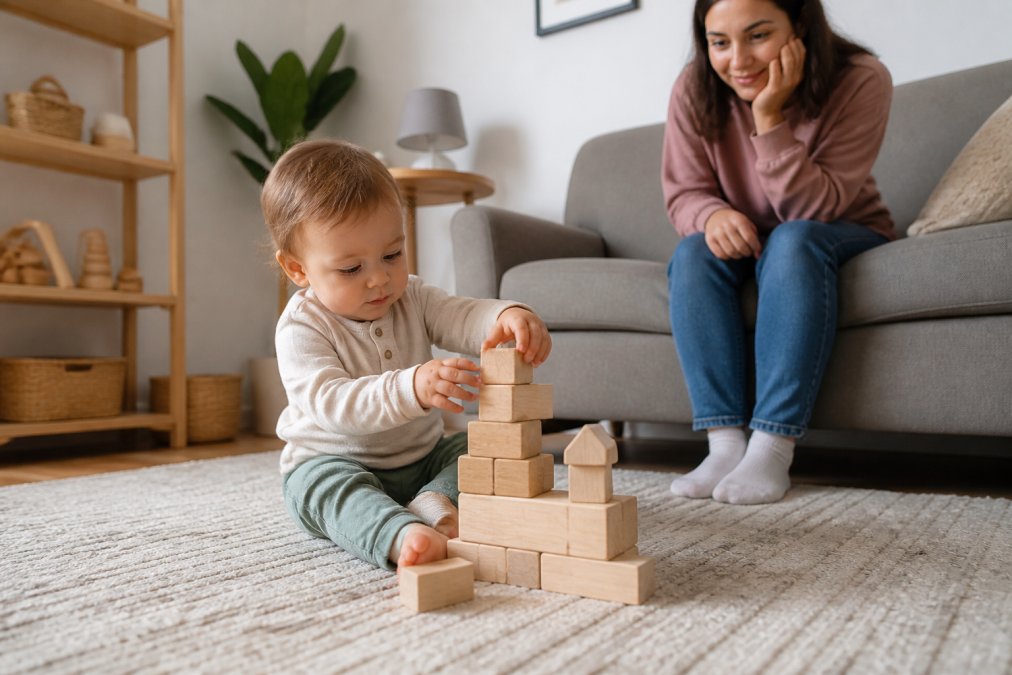
By this stage a child wants to build, stack, sort, and imitate. Three pieces cover that range.
How to Clean Wooden Baby Toys
Clean wooden baby toys with a damp cloth and mild soap, then dry immediately. Never soak them or put them in a dishwasher. Water is the enemy of solid wood: soaking swells the grain, which can crack the surface and lift the finish. A quick wipe is all a sealed toy needs.
For routine cleaning:
- Wipe with a cloth dampened in warm water and a drop of mild dish soap.
- Dry immediately with a soft towel, including the edges and any grooves.
- For deeper cleaning, use a 1:1 mix of white vinegar and water on a cloth, then dry.
- Re-oil unfinished wood occasionally with a food-safe oil to keep it from drying out.
Why Certain Cleaners Ruin Certain Finishes
The finish determines what a toy can survive, and the wrong cleaner can break down the coating itself:
- Oil and beeswax finishes. These are porous and absorb whatever touches them. Alcohol and bleach pull the oil out and leave the wood dry and prone to cracking. Re-oil instead of scrubbing.
- Water-based paint. Generally the most forgiving, but abrasive pads and disinfecting wipes wear through the paint film. A soft cloth and mild soap is the whole toolkit.
- Solvent-based lacquer. If a toy has this, it is already the finish you want to avoid on a mouthing-age piece. It chips rather than wears, and chips are the hazard.
Monthly Maintenance Checklist
Two habits keep a wooden toy safe and worth handing down:
- Store dry. Not a damp bathroom, not a basement. Humidity swings are what crack solid wood over time.
- Inspect monthly. Check every piece for splinters, cracks, loose parts, and chipped paint. Retire anything with a rough edge until it is sanded smooth and refinished.
- Re-oil unfinished pieces. A light coat of food-safe oil every few months keeps the grain sealed and the surface smooth.
- Tighten and re-glue. A loose wheel or knob is a choking risk, not a cosmetic issue.
What to Do When a Wooden Toy Is Damaged or Outgrown
Wood is one of the few toy materials with a real end-of-life plan:
- Repair first. A splintered edge can be sanded. A worn finish can be re-oiled. Most damage that would send a plastic toy to the trash is fixable on solid wood.
- Pass it on. A well-made hardwood toy is designed to survive a first child and reach a second. That is the durability benefit in practice, not just in the marketing copy.
- Compost untreated wood. Raw, unpainted, untreated solid wood can go into a home compost pile. Painted, oiled, or lacquered pieces should not, because the finish does not break down the same way.
- Recycle where accepted. Clean, untreated wood is accepted at many municipal yard-waste and wood-recycling drop-offs. Check locally before you toss it.
- Do not burn painted or treated wood. Burning releases the very compounds you spent the whole purchase avoiding.
Frequently Asked Questions
Are wooden toys safer than plastic for babies?
Wooden toys are a preferred choice for babies and young toddlers because they generally do not contain the chemical additives often found in plastic, according to Dr. Sathyanarayana of Seattle Children's. Solid hardwood versions avoid phthalates, BPA, and PVC entirely. That said, the finish matters as much as the material: a wooden toy coated in an unknown paint is not automatically safer. Check for water-based paint or a beeswax finish, and look for an ASTM safety label before buying.
What should I look for in non toxic wooden baby toys?
Start with the material: solid hardwoods such as maple, beech, or walnut are the safest choice, while plywood and MDF are more likely to contain formaldehyde-based adhesives. Next, check the finish. Industry guidance points to food-safe oils like coconut or linseed oil, beeswax, and water-based non-toxic paints. Finally, confirm the toy carries an ASTM safety standard label and has smooth, splinter-free edges. If a listing does not name its wood or finish, treat that as a red flag.
How do I clean and sanitize wooden baby toys?
Wipe wooden toys with a damp cloth and a small amount of mild soap, then dry them immediately. Never soak wooden toys or put them in the dishwasher, since moisture breaks down the wood grain and can loosen the finish. For deeper cleaning, a diluted white vinegar solution works well on sealed surfaces. Re-oil unpainted toys occasionally with a food-safe oil to keep the wood from drying out and cracking. Toys with sound modules should be surface-wiped only.
Why is the Montessori approach preferred for wooden toys?
Montessori materials favor natural, non-synthetic surfaces because they give children clearer sensory feedback than plastic. A wooden sorting game feels different in the hand than a plastic one, and that tactile stimulation supports fine motor skills and concentration. Montessori-style toys also tend to be open-ended, meaning a child can use the same piece for sorting, stacking, and pretend play as they grow. The result is a toy that stays useful across several developmental milestones instead of being outgrown in months.
Are water-based paints on wooden toys safe for teething babies?
Water-based, non-toxic paint is the industry standard for painted wooden toys and is considered the safer option compared to solvent-based finishes. Even so, a toy marketed for teething should ideally be unpainted or finished with beeswax or a food-safe oil, since paint can chip under constant chewing. Check the age rating before handing anything to a teething baby, and inspect painted toys regularly for flaking or worn edges.