

Best Educational Gifts for Toddlers: 2026 Picks
Table of Contents
- How to Choose Educational Gifts for Toddlers
- Quick Comparison: Top Picks at a Glance
-
Educational Toys for Toddlers: Our 7 Favorites
- Best All-Around: 6-in-1 Activity Cube
- Best for Little Hands: Montessori Catch & Count Fishing Set
- Best for First Words: Montessori Talking Flash Cards
- Best for Quiet Time: Montessori Sensory Book
- Best for Problem-Solving: Montessori Shape Sorting Cube
- Best for Building: Montessori Wooden ABC Building Blocks
- Best for Music and Movement: Montessori Wooden Music Instruments Set
- Best for Early Math: Montessori Wooden Number Train Set
- Learning Toys for 1-Year-Olds: What Actually Works
- Why Wooden Toys for Toddlers Make Better Gifts
- Gifts for Toddlers Ages 1-3: Matching the Toy to the Child
- Conclusion: Picking a Gift That Gets Played With
- Frequently Asked Questions
Last Updated: October 12, 2026
How to Choose Educational Gifts for Toddlers
The best educational gifts for toddlers let a child do something for themselves. A good gift matches the child's current stage, leaves room to grow, and doesn't need batteries.
Below are our seven favorite picks, how to match each to a child, and why wooden toys outlast plastic.
Before the picks, a quick word on what actually matters. The American Academy of Pediatrics guidance on play consistently points to open-ended, hands-on play as the foundation of early learning, not screens or electronic gimmicks.
Quick Comparison: Top Picks at a Glance
Every pick below comes from our own collection.
| Toy | Price | Best For | Age Range |
|---|---|---|---|
| 6-in-1 Activity Cube | $54.45 | All-around first gift | 1-4 years |
| Catch & Count Fishing Set | $39.95 | Counting and color sorting | 1+ years |
| Talking Flash Cards | $34.95 | First words | 2+ years |
| Sensory Book | $29.95 | Quiet time and travel | 2-5 years |
| Shape Sorting Cube | $34.45 | Problem-solving | 3+ years |
| Wooden ABC Building Blocks | $49.95 | Building and letters | 1-4 years |
| Wooden Music Instruments Set | $59.95 | Music and movement | 3+ years |
| Wooden Number Train Set | $49.95 | Early math | 1-3 years |
Educational Toys for Toddlers: Our 7 Favorites
Every toy here is hands-on, screen-free, and built for small hands, grouped by the skill each one develops best.

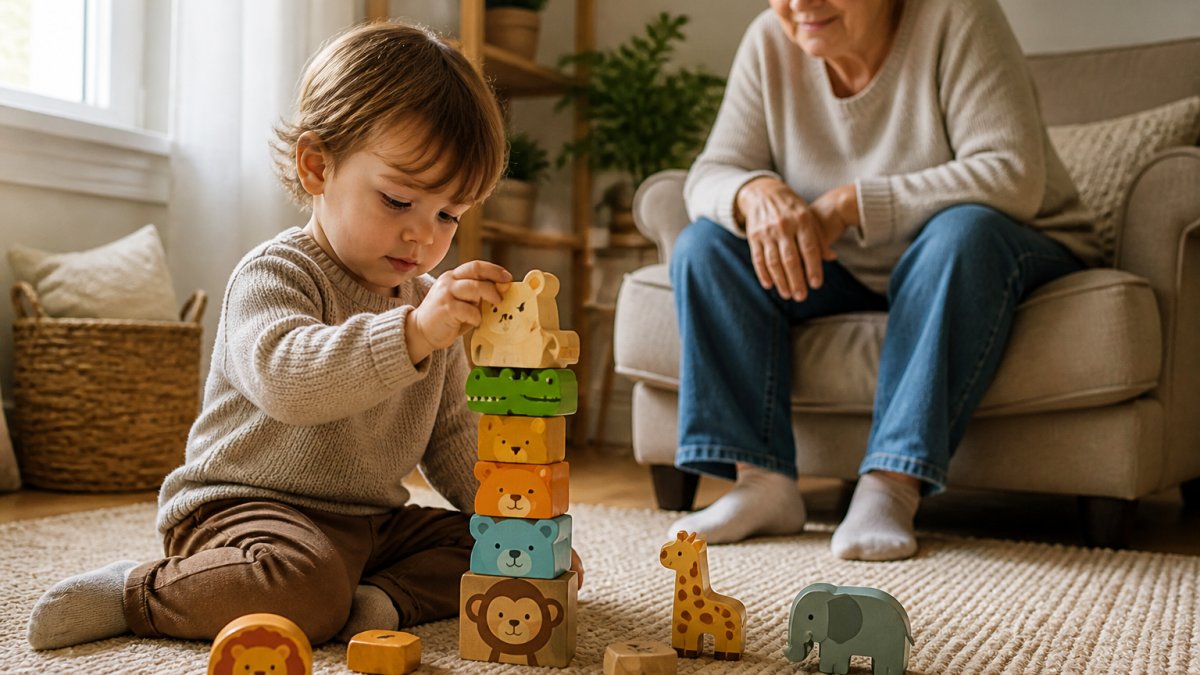
Best All-Around: 6-in-1 Activity Cube
If you only buy one gift, make it this one. The 6-in-1 Activity Cube packs six activities into a solid-wood frame and suits ages 1 to 4, so it grows with the child. It's made from real solid wood with non-toxic paint.
Best for Little Hands: Montessori Catch & Count Fishing Set
This fishing set uses hook-and-loop fastening instead of magnets, so fish grab with a gentle touch, and five numbered stacking cups turn every catch into counting and color-sorting practice.

You get 15 fabric fish in five colors, a soft rod, and a pond mat that folds into its own storage bag. It's made for ages 1 and up.
Best for First Words: Montessori Talking Flash Cards
The Talking Flash Cards reader says each word out loud when a card slides in, and a repeat button lets a child hear it again. Choose a 224-word or 510-word set, in pink or blue.

Themes cover animals, food, vehicles, colors, shapes, and people. It's rechargeable, pocket-sized, and built for ages 2 and up.
Best for Quiet Time: Montessori Sensory Book
For restaurants, car trips, and the quiet half-hour before dinner, this sensory book uses reusable peel-and-paste pieces, and its thickened cardboard pages have a waterproof, dustproof film.
It comes unassembled, so an adult attaches the pieces first, turning setup into a shared activity. It suits ages 2 to 5 and comes as a single book or a themed 4-pack.
Best for Problem-Solving: Montessori Shape Sorting Cube
The Shape Sorting Cube comes with 12 wooden shapes and a solid wood cube with smooth edges and non-toxic paint. Children work out which shape fits which hole, then repeat until it's second nature. It's recommended for ages 3 and up.
Best for Building: Montessori Wooden ABC Building Blocks
The Wooden ABC Building Blocks are a 26-piece bundle of solid wood blocks for ages 1 to 4, with vibrant colors and a size easy for small hands to grip.
Building play develops fine motor skills, coordination, and early letter recognition at once.
Best for Music and Movement: Montessori Wooden Music Instruments Set
This 10-instrument set includes maracas, a hand drum, a triangle, castanets, a tambourine, a chime bar, sleigh bells, and hand bells, all made from natural wood with no paint or coatings.
It's recommended for ages 3 and up and comes with a carrying bag. Rhythm play builds memory, attention, and motor skills.
Best for Early Math: Montessori Wooden Number Train Set
The Wooden Number Train Set turns ten magnetic, numbered cars into a hands-on lesson from 0 to 9. The number pieces pop off and snap back on, and it fits most major wooden train tracks.
It's built for ages 1 to 3 from solid wood with non-toxic water-based paint.
Learning Toys for 1-Year-Olds: What Actually Works
One-year-olds learn through their hands and mouths, not instruction. The toys that work are simple, sturdy, and safe to explore: stacking, sorting, grasping, and cause-and-effect play.
In the first three years, the skill changes faster than the toy: the same wooden block is a grasping object at 12 months, a stacking challenge at 18 months, and a letter-recognition tool at three.
What 1-year-olds are working on
At this stage, the developmental work is physical and sensory. Most children are learning to:
- Grasp and release objects on purpose, which is the foundation for every later fine-motor task.
- Stack two or three blocks before the tower falls, then knock it down and start again.
- Drop and retrieve items to test cause and effect.
Because mouthing is normal and expected well past the first birthday, the practical rule for gift-givers is simple: no part should fit entirely inside a cardboard toilet-paper tube. That is the same rough threshold the Consumer Product Safety Commission uses for small-part warnings, and it is a faster check than reading every label.
What 2-year-olds are working on
By two, the play gets more deliberate. You will typically see:
- Sorting by one attribute, all the red pieces, all the round pieces, even if the categories are not always right.
- Simple pretend play, like feeding a stuffed animal or pushing a train while making engine noises.
- Vocabulary bursts, with new words arriving faster than adults can track.
Toys that reward repetition do well here. A shape sorter solved the same way every time isn't boring to a two-year-old; it's reassuring.
What 3-year-olds are working on
Three is where longer attention spans and real problem-solving show up:
- Multi-step play, such as building a track, then running a train on it, then rebuilding it.
- Cooperative play, where children start negotiating turns and roles.
- Early counting and one-to-one correspondence, matching one number to one object.
This is also the age when a toy that was too advanced six months ago suddenly clicks. If a gift seems slightly out of reach, it may simply be early.
Matching the picks to the age
For a first birthday, the Catch & Count Fishing Set is gentle enough to start and grows into counting, while the Wooden ABC Building Blocks and Number Train Set begin as grasping and stacking toys and become more complex later.
For a two-year-old, the Sensory Book and the Talking Flash Cards fit the vocabulary and quiet-focus stage. For a three-year-old, the Shape Sorting Cube and the Music Instruments Set match the longer attention span and stronger hand control.
The most common mistake is buying for the age the child will be in six months. Buy for now, and let the toy grow with them.
Why Wooden Toys for Toddlers Make Better Gifts
Wooden toys for toddlers survive siblings, cousins, and a few moves. Solid wood doesn't crack the way thin plastic does, and it holds its shape after years of stacking and dropping.
There is a safety angle too, and it is the part most gift guides skip. The Consumer Product Safety Commission toy safety guidance advises checking age labels and avoiding small parts for children under three.
How to read an age label like a gift buyer
Age labels are safety ratings, not marketing suggestions. They reflect two things: whether the toy contains parts small enough to be a choking hazard, and whether it requires coordination the child is likely to have.
A few practical rules:
- "1+ years" generally means no small parts and no sharp edges, but it does not mean unsupervised. A one-year-old still needs an adult nearby.
- "3+ years" often signals small parts, magnets, or pieces that need finer hand control. If the child is two and a half, wait.
- "2+ years" is a middle band that usually assumes the child has stopped mouthing most objects. If they have not, treat the toy as a 3+ item for now.
Materials and finishes worth checking
For wooden toys, the questions that matter most are:
- Is the wood solid or composite? Solid wood holds up to teething and dropping. Composite boards can chip at the edges over time.
- What is the finish? Water-based, non-toxic paints and natural oils are the common safe choices.
- Are the edges rounded and sanded? Run a finger along the edges before handing a toy to a toddler.
Our own wooden pieces use sustainably forested wood, non-toxic paint, and recyclable packaging, and several carry safety certification for ages 1 to 4.
Supervision, storage, and the practical stuff
A few caregiver realities affect whether a gift actually gets used:
- Supervision is not optional for the youngest toddlers.
- Storage matters.
- Noise and batteries. Wooden toys are quiet and battery-free.
The upshot for a gift-giver: a wooden toy reads as a considered purchase. It looks substantial in the box, and it lasts.
Gifts for Toddlers Ages 1-3: Matching the Toy to the Child
The best gift for a toddler fits the child in front of you, not the highest price tag. Match the toy to how they already play, and you'll rarely go wrong.
Use this quick framework:
- The mover and climber: Choose the Music Instruments Set or the Fishing Set. Both need the whole body and burn energy.
- The focused sitter: Choose the Sensory Book or the Shape Sorting Cube. These reward patience and repetition.
- The talker: Choose the Talking Flash Cards. A child who repeats everything will love a toy that talks back.
Budget matters too, and there's no need to spend the most to give well. Our picks range from $29.95 for the Sensory Book to $59.95 for the Music Instruments Set, so a thoughtful gift is possible at every price point.
Conclusion: Picking a Gift That Gets Played With
The hardest part of buying for a toddler isn't finding something educational. It's finding something that gets picked up again next week.
That's the standard we hold every toy to at Project Montessori. Our educator-approved picks are rooted in the Montessori philosophy, designed to promote independence and creativity, and curated by developmental stage so you can choose with confidence.
Get started with Project Montessori and choose a gift that turns playtime into genuine learning.
Frequently Asked Questions
What are the best educational gifts for toddlers?
The strongest educational gifts for toddlers are open-ended and screen-free: shape sorters, stacking blocks, wooden building sets, sensory books, and counting games. Look for toys that match the child's current stage, use safe materials, and can be played with in more than one way. A shape sorting cube, a wooden number train, and a fabric fishing game all fit this brief, and each one grows with the child instead of being outgrown in a month.
What are good learning toys for a 1-year-old?
At age one, toddlers are working on grasping, stacking, dumping, and simple cause-and-effect. Chunky blocks, a busy board book, a bead maze activity cube, and soft fabric games suit this stage well. Choose pieces big enough to grip without choking risk, and skip anything with tiny parts or long cords. A toy like the Montessori Catch & Count Fishing Set works because the soft fish stick with a gentle touch, so a one-year-old gets a win on the first try.
Which toys help toddlers develop fine motor skills?
Fine motor skills build through pinching, stacking, threading, sorting, and placing. Shape sorters, stacking games, sensory books with peel-and-paste pieces, and building blocks all target these movements. The Montessori Sensory Book, for example, asks a child to attach velcro pieces and match cards to their spots, which works the same muscles used later for holding a pencil. Rotate a few of these toys rather than offering all of them at once.
Are wooden toys good educational gifts for toddlers?
Wooden toys hold up to rough play, feel good in small hands, and rarely need batteries, so they stay in the toy rotation longer than plastic alternatives. They also tend to be open-ended, meaning a block can be a tower, a car, or a pretend sandwich. Look for solid wood, non-toxic paint, and smooth edges. Sets like the Montessori Wooden ABC Building Blocks and the Wooden Number Train Set are built for years of daily use.
What should I look for in a safe wooden toy for a toddler?
Check the age label first, then the materials. A safe wooden toy for a toddler uses solid wood, non-toxic paint or no paint at all, and smooth rounded edges with no splinters. Avoid loose small parts on toys meant for children under three, and check that any magnets or connectors are firmly fixed. The Montessori Wooden Music Instruments Set, for instance, uses natural wood with no paint or coatings, and carries CPC certification.