

7 Benefits of Screen Free Play for Kids
Table of Contents
- Why Screen Free Play Matters More Than Ever
- 1. Creativity and Imaginative Play Get Room to Grow
- 2. Physical Activity, Motor Skills, and Spatial Awareness
- 3. Cognitive Growth, Problem-Solving, and Attention
- 4. Self-Regulation, Emotional Growth, and Sleep Quality
- 5. Social Skills, Teamwork, and Family Connection
- Screen-Free Play Ideas for Kids at Every Age
- Screen-Free Activities at Home and How to Encourage Independent Play
- Frequently Asked Questions
Last Updated: October 19, 2026
Why Screen Free Play Matters More Than Ever
Screen free play is time children spend in hands-on, self-directed activity without a screen in sight. Kids who build, dig, and pretend are kids who learn how to think for themselves.
Screens are everywhere now. They follow kids into the car, the kitchen, and the bedroom. That makes plain, unplugged play feel almost radical.
But here's what most guides get wrong. Screen free play isn't about banning technology or feeling guilty. It's about giving your child a daily stretch of time where their own ideas run the show.
Below, we'll walk through seven benefits and show you exactly how to build screen free play into a normal, busy week.
1. Creativity and Imaginative Play Get Room to Grow
A cardboard box beats a tablet almost every time. Give a child a box, some blocks, or a pile of sticks, and the story starts on its own.
Imaginative play is how kids test ideas. A toddler stacking cups is learning balance. A preschooler inventing a game is learning to plan.
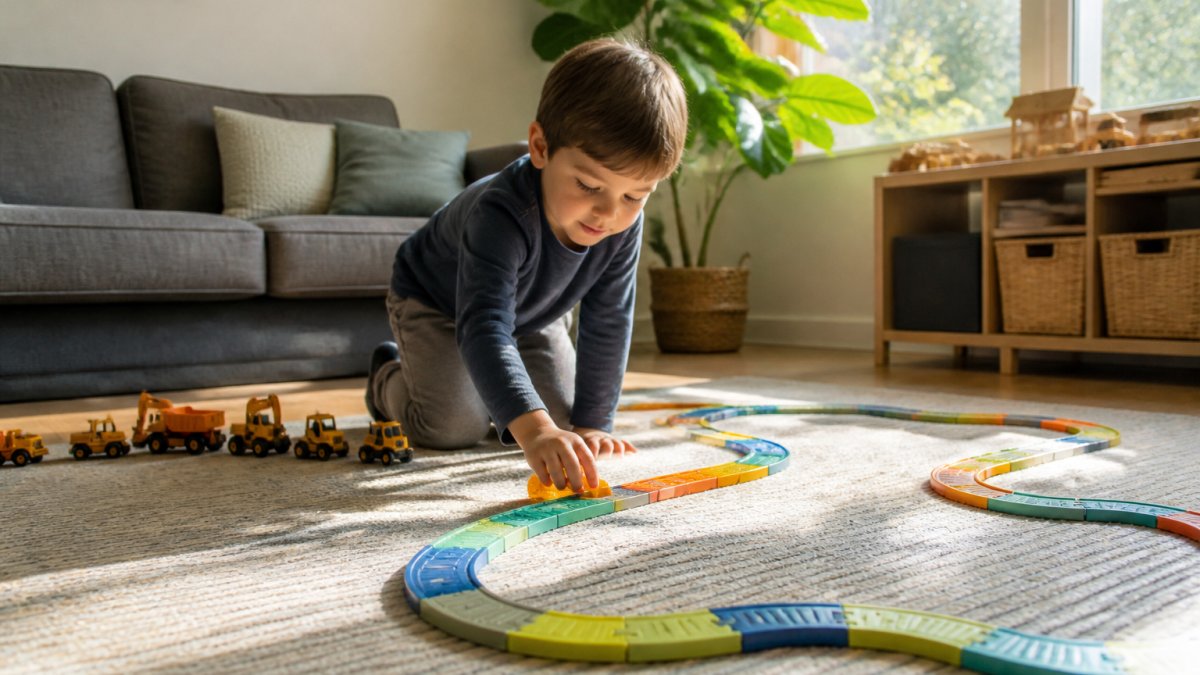
The catch? Imagination needs empty space. A screen fills every pause for them. Unplugged time leaves those pauses open, and that's where creativity grows.
2. Physical Activity, Motor Skills, and Spatial Awareness
Screen free play gets bodies moving. Running, climbing, tossing, and digging build strong muscles and steady hands.
Fine motor skills grow the same way. Pinching tweezers, threading beads, and gripping small tools train the same muscles kids need for writing later.
Spatial awareness comes from real objects. A child learns how things fit, stack, and balance by knocking them over and trying again.
3. Cognitive Growth, Problem-Solving, and Attention
Hands-on play is brain work. When a child builds a ramp and the car rolls off, they adjust the angle and try again. That loop, predict, test, revise, is problem-solving in its purest form, and it happens dozens of times an hour during open-ended play.
Attention grows through the same repetition. A screen hands kids constant novelty, so they practice switching, not sustaining. Open-ended play asks them to stay with one idea and go deeper. Screen free play gives the attention muscle the steady practice that school will later demand.
Here is what that looks like at different stages, so you can match the challenge to the child:
- Ages 1-2: Cause-and-effect play. Dropping a ball into a box, stacking two cups, pulling a scarf from a tube. The cognitive work is learning that actions produce results.
- Ages 3-4: Early planning. Building a block bridge that holds a toy car, sorting by color or size, simple pretend sequences like feeding a doll then putting it to bed.
- Ages 5-6: Multi-step problem-solving. Designing a marble run, following a simple pattern, inventing rules for a game and revising them when they fail.
- Ages 7+: Strategy and abstraction. Board games with turn-taking and planning, building projects with a goal, bug hunting that requires observation and classification.
A note on the evidence: research on screen time and attention is still developing, and outcomes depend heavily on age, content, and context. Most practitioners treat screen free play as one supportive input among many, not a guaranteed fix. The practical takeaway is simpler: a daily stretch of child-led, hands-on play gives attention and problem-solving regular exercise, and that is worth building into the week.
4. Self-Regulation, Emotional Growth, and Sleep Quality
Self-regulation is the ability to manage feelings and impulses. It's one of the quietest gifts of screen free play.
Play gives kids a safe place to act out big feelings. A child who is frustrated can build a tower and knock it down. That's practice.
Sleep quality improves when the evening winds down without bright screens. A calm bedtime routine, with books and quiet play, helps kids settle faster.
- Swap the last screen of the day for a story
- Keep playthings simple and quiet after dinner
- Dim the lights an hour before bed
5. Social Skills, Teamwork, and Family Connection
Play is where kids learn to share, wait, and take turns, none of which happen on a solo screen. But social play does not just happen; it needs the right setup and a little adult scaffolding.
Montessori Wooden Bug Catcher Kit →
Teamwork starts small. Two kids building one track have to agree on the plan, negotiate who places which piece, and recover when the tower falls. That is real negotiation practice, and it is messy by design. A common pattern is that the first few shared play sessions end in tears; that is normal, and it is the rehearsal that builds the skill. Establishing these collaborative boundaries requires consistent effort, which is why many parents eventually adopt a step-by-step plan to transition their household toward more independent and unplugged interactions.
Family connection grows from shared play too. A game of catch in the yard, a cooperative board game, or a kitchen helper stirring batter does more for family bonds than an hour of parallel scrolling. The key is that the adult is genuinely participating, not supervising from a phone.
Here is how social play looks across stages, plus how to adapt it for different abilities:
- Ages 1-2: Parallel play. Two toddlers in the same space with separate baskets of safe household items. They are learning that other children exist and are not a threat.
- Ages 3-4: Turn-taking with support. Rolling a ball back and forth, simple matching games, pretend play with an adult narrating. Keep turns short and predictable.
- Ages 5-6: Cooperative play. Building a joint fort, playing a simple rule-based game, acting out a story with assigned roles. Expect negotiation and coach through it.
- Ages 7+: Team projects and games with rules. Board games, building challenges, bug-hunting expeditions with a shared checklist. These require planning, compromise, and losing gracefully.
Inclusive play for different abilities and sensory needs: Not every child thrives in a loud group game. Adaptable options include:
- Offer a quiet parallel-play station nearby for a child who needs lower sensory input.
- Use visual turn cards or a simple timer for children who need predictable transitions.
- Choose activities with multiple entry points, a building set works for a child who wants to sort pieces alone and for one who wants to construct with a partner.
- Let a child opt out of group play without penalty; solo play beside the group still builds social comfort.
Screen-Free Play Ideas for Kids at Every Age
Match the activity to the stage. A toddler and a six-year-old need very different setups, and that's fine.
- Ages 1-2: Stacking cups, board books, a basket of safe household items
- Ages 3-4: Pretend kitchen, chunky puzzles, a ball to toss
- Ages 5-6: Simple building sets, nature walks, drawing
- Ages 7+: Board games, bug hunting, building projects
Screen-Free Activities for Toddlers
Toddlers need simple, sturdy things they can grab and explore. Skip anything fiddly or fragile.
Try these screen free activities for toddlers:
- Fill a low bin with safe kitchen items to dig through
- Offer a ball to roll back and forth
- Read the same book five times if they ask
- Let them help stir, pour, and wipe
The goal isn't a perfect activity. It's a yes-friendly space where little hands can explore.
Screen-Free Activities at Home and How to Encourage Independent Play
Independent play starts with a safe, reachable setup. Low shelves and open baskets let kids choose without asking.
Here's how to encourage independent play without a fight:
- Start with short stretches and build up
- Rotate toys so old ones feel new
- Sit nearby but stay quiet
- Let boredom happen, then wait
Screen free activities at home don't need a craft closet. A blanket fort, a box of blocks, or a bucket of water can carry an afternoon.
If you want toys built for this kind of open-ended play, our Montessori Wooden Bug Catcher Kit turns a backyard walk into a science adventure. The Kids Flexible Race Track Set gives kids 280 pieces to build and rebuild, and the Montessori Toss and Catch Ball Set makes catch easy enough for the whole family.


Frequently Asked Questions
What are the benefits of screen-free play for children?
Screen-free play supports creativity, physical activity, problem-solving, self-regulation, and social skills. When kids play without screens, they invent games, negotiate roles with siblings, and practice patience while building something that doesn't work the first time. Hands-on play also builds fine motor skills and spatial awareness. Many parents notice calmer bedtimes and longer stretches of focused play once screens come out of the daily routine. The benefits come from repetition, not from any single activity, so short daily blocks of screen-free play matter more than occasional long ones.
How can I encourage my child to play without screens?
Start with a short, predictable screen-free window, like the 30 minutes after breakfast, and keep it the same each day. Set out one or two open-ended toys rather than a whole shelf, since too many choices stall independent play. Sit nearby without directing the play, and narrate what you see instead of suggesting what comes next. Expect a few bumpy days while your child adjusts. A simple wooden bug catcher kit or a set of flexible track pieces gives kids a clear starting point without a screen telling them what to do.
What are some screen-free activities for toddlers and preschoolers?
Toddlers do well with simple, sensory, and movement-based play: stacking wooden blocks, scooping and pouring, scribbling with chunky crayons, and chasing bubbles outside. Preschoolers are ready for more structure, like pretend cooking, building tracks and ramps, sorting natural objects, and simple catch games with sticky paddles. Keep sessions short and follow your child's interest rather than finishing an activity. Household materials like cardboard boxes, cushions, and measuring cups work as well as bought toys for this age group.
Can screen-free play help children become more independent?
Yes, when the setup supports it. Independent play grows when a child can reach their own materials, choose what to do, and solve small problems without an adult stepping in. Try placing a few toys at child height, rotating them weekly, and resisting the urge to rescue every stuck moment. Start with five to ten minutes and build up. Toys with a clear purpose but no fixed outcome, like a bug observation kit or open-ended building pieces, give kids enough structure to start alone and enough freedom to keep going.
The hardest part of screen free play isn't finding activities. It's holding the line when screens are easier. Project Montessori makes that easier with educator-approved toys rooted in the Montessori philosophy, designed to promote independence and creativity at every stage. Start with a few pieces, set up a low shelf, and let your child lead. Shop now and turn playtime into discovery.