

How to Rotate Montessori Toys: Simple 2026 Guide
Table of Contents
- What Is Montessori Toy Rotation and Why It Works
- How Many Toys for Montessori Shelves
- Building a Montessori Toy Rotation Schedule by Age
- Step-by-Step: How to Rotate Montessori Toys
- Montessori Toy Storage Ideas for Small Spaces
- Troubleshooting: When Your Child Resists the Rotation
- Frequently Asked Questions
Last Updated: September 30, 2026
What Is Montessori Toy Rotation and Why It Works
Montessori toy rotation is the practice of keeping only a small set of toys on your child's shelf at one time, then swapping them out on a regular schedule. The goal is simple: fewer choices, deeper play.
The idea comes from the prepared environment, a core Montessori principle. When a space feels calm instead of cluttered, children focus longer and play with more purpose.
Research from Lovevery's guidance on developmental play shows that rotating toys supports deeper engagement and focus. It works by preventing overstimulation and letting children master specific skills before moving on.
So why does it beat the "more toys, more fun" approach?
- Less visual clutter means a calmer brain
- Fewer choices lead to longer concentration spans
- Familiar toys get mastered instead of ignored
- New toys feel exciting again after a short break
How Many Toys for Montessori Shelves
The short answer: aim for 8 to 12 items on display. For toddlers, 9-12 different items on low shelves are often recommended, and 8-10 total toys or activities in a rotation is a common suggestion.
That number feels low to most parents.
Here's a simple way to think about it:
| Age Range | Items on Shelf | Rotation Interval |
|---|---|---|
| 0-18 months | 4-6 | Every 5-10 days |
| 18 months-3 years | 6-8 | Every 1-2 weeks |
| 3-6 years | 8-12 | Every 15 days |
Building a Montessori Toy Rotation Schedule by Age
A good rotation schedule follows your child's development, not a calendar. Rotation intervals should change based on your child's age to support their developmental needs. But the more useful question is: which developmental leap is your child working on right now? That answer tells you what to put on the shelf.
Babies (0-12 Months): Sensory Input and Object Permanence
During the first year, the brain is building cause-and-effect understanding and the earliest form of object permanence, the realization that things still exist when they're out of sight.
- Rotate every 5-10 days
- Keep 3-5 items on the shelf
- Prioritize: grasping rings, textured balls, a single-shape object permanence box, soft blocks
- Skip: anything with more than one step, battery-operated toys, or busy light-and-sound boards
Toddlers (12-24 Months): Gross Motor and Early Problem-Solving
This is the walking, climbing, dumping, and stacking window. The developmental targets are gross motor control, hand-eye coordination, and the beginning of intentional problem-solving.
- Rotate every 7-10 days
- Keep 4-6 items on the shelf
- Prioritize: push-and-pull toys, a walker wagon, stacking cups, a simple shape sorter with 2-3 shapes, a ball drop box
- Watch for: the pincer grasp emerging around 9-12 months, which means small knobbed puzzles and transfer activities become useful
Two-Year-Olds: Language Explosion and Practical Life
Around age two, vocabulary accelerates and children want to do what you do. Rotation should shift toward practical life and language.
- Rotate every 10-14 days
- Keep 5-7 items on the shelf
- Prioritize: a small pitcher for pouring, a sponge for wiping, matching cards, a first knobbed puzzle, a basket of realistic animal figures
- Add: one practical life activity per rotation, like spooning dry beans between two bowls
Preschoolers (3-6 Years): Fine Motor, Concentration, and Independence
Older kids can handle more items and longer gaps between swaps. The developmental focus is fine motor precision, extended concentration, and self-directed work cycles.
- Rotate every 14-21 days
- Display 8-12 items
- Group by category: puzzles, art, practical life, language, sensorial
- Watch for the boredom threshold, not the calendar
A Quick Milestone-to-Toy Cheat Sheet
| Developmental Leap | Typical Window | Rotation Focus |
|---|---|---|
| Visual tracking | 0-3 months | High-contrast mobiles, black-and-white cards |
| Reaching and grasping | 3-6 months | Lightweight rings, fabric balls, grasping beads |
| Object permanence | 6-12 months | Object permanence box, peekaboo activities |
| Pincer grasp | 9-14 months | Knobbed puzzles, coin drop, transfer work |
| Gross motor / walking | 12-18 months | Push wagon, pull toys, stacking and dumping |
| Language burst | 18-30 months | Naming cards, realistic figures, simple books |
| Fine motor precision | 2.5-4 years | Lacing, tongs, scissors practice, small puzzles |
| Extended concentration | 4-6 years | Multi-step puzzles, building sets, practical life sequences |
Use the table as a starting point, not a rulebook. Every child moves through these windows at their own pace, and the shelf should follow the child.
Step-by-Step: How to Rotate Montessori Toys
Here's the full process. It takes about 20 minutes once you get the rhythm down.
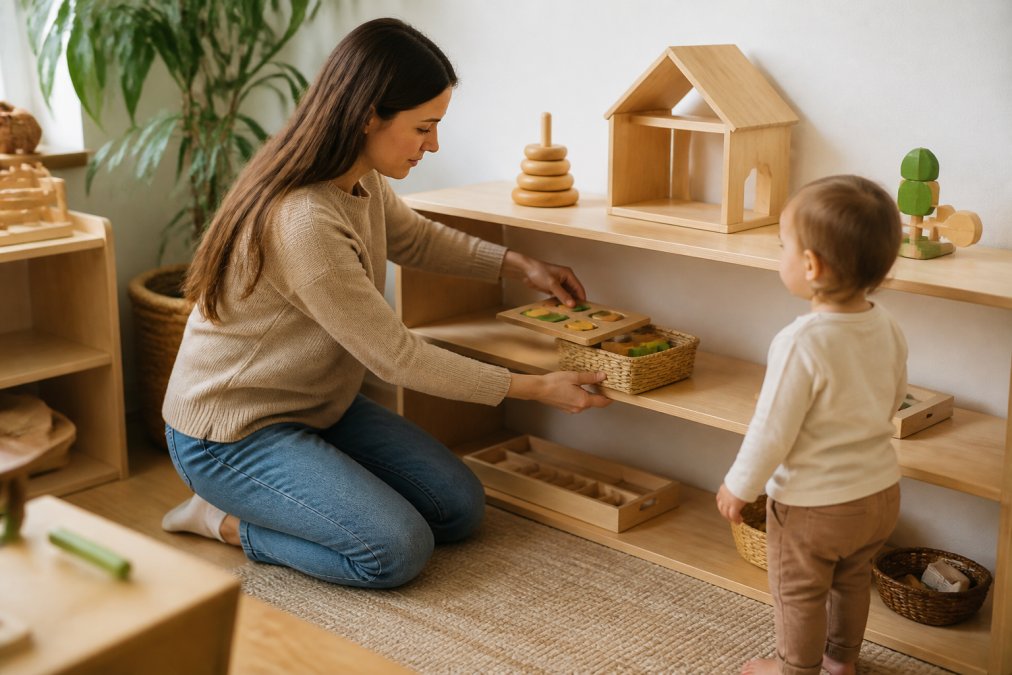
Step 1: Observe Before You Swap
Watch your child for a few days before you change anything. Which toys get picked up? Which ones sit untouched? This tells you what's working.
Step 2: Pull Out, Sort, and Store
Take the toys off the shelf and sort them into three piles:
- Still loved and in use: leave out
- Ignored for a week or more: store away
- Broken or missing pieces: repair or retire
Step 3: Arrange the Low Shelf
Put 8-12 items back on the shelf. Arrange them left to right, simple to complex. Leave space between items so each one stands out.
Montessori Toy Storage Ideas for Small Spaces
You don't need a playroom to make rotation work. Small spaces actually make it easier, because you're forced to keep the display minimal. But most rotation guides assume you have a closet, a basement, or a dedicated storage room. If you're in a 600-square-foot apartment or sharing a bedroom, here's how to make rotation work without a single spare shelf.
The Core Principle: Out of Sight, Within Reach
Inactive toys need to be invisible to your child but accessible to you. That's the whole game. If the storage is hard for you to reach, you'll stop rotating. If it's visible to your child, they'll demand it back.
No-Closet Storage Solutions
Under-bed bins. Flat, rolling bins fit under most beds and cribs. This is the single best storage zone in a small home because it uses dead space. Look for bins under 6 inches tall for puzzles, books, and flat materials.
The One-In-One-Out Rule
In a small space, you cannot store more than one full rotation cycle at a time. That means every time a toy comes onto the shelf, one goes into storage. If storage is full, something leaves the home. This rule prevents the slow creep of toy accumulation that defeats rotation entirely.
What to Do With Bulky Items
Blocks, plush toys, and large vehicles are the hardest to store. Options:
- A large fabric box that folds flat when empty, like the Montessori Large Toy Storage Box, holds 83 liters and collapses when not in use
- A storage backpack for on-the-go toys and travel
- A single deep bin under a couch or bed for oversized items
Shared Bedrooms and Multi-Child Homes
When two children share a room, each needs their own shelf and their own rotation. Keep the shelves separate and at each child's height. Storage can be shared, but label bins by child so rotations don't get mixed. If space is truly tight, rotate one child's shelf on week one and the other's on week two, so only one active rotation exists at a time.

A 15-Minute Small-Space Reset
Once a month, pull everything out of storage, lay it on the bed, and sort. Broken items go out. Outgrown items get donated. Anything that hasn't been on the shelf in two cycles gets reconsidered. This keeps storage from becoming a graveyard and keeps the rotation system honest.
Troubleshooting: When Your Child Resists the Rotation
Resistance is normal, and it usually means one of three things.
Frequently Asked Questions
How often should you rotate Montessori toys?
Most families rotate every 5 to 10 days, while a standard guideline is about two weeks. For children aged 5 to 6, a 15-day interval works well. Watch your child rather than the calendar: if a toy sits untouched for several days or the shelf looks cluttered, it is time to swap. Practitioners increasingly rotate based on engagement levels and shelf use instead of a rigid schedule.
How many toys should be out at one time for a Montessori environment?
Aim for 8 to 10 toys or activities in total, with 9 to 12 items displayed on low, open shelves. Fewer items make it easier for a child to choose, focus, and master each material. Everything else stays in storage and comes back in a later rotation. If your child flits between toys without settling, remove a few and see if concentration improves.
Can you rotate toys too often?
Yes. Swapping every day or two prevents children from reaching mastery, which is where deep concentration happens. A 5 to 10 day cycle, or roughly two weeks, gives a child enough time to explore, repeat, and build skill. Rotate sooner only when a toy is clearly abandoned or the space feels visually cluttered.
How do you store toys that are currently out of rotation?
Keep inactive toys out of sight but easy to reach. A large fabric storage box with a flip-top lid holds plush animals, blocks, and books, while small drawstring bags sort loose parts by category. Label bins by type, store them on a closet shelf, and bring one group back at a time. Out of sight means out of mind, which is exactly the point.
Rotating toys sounds simple until you're staring at a shelf that's either too full or too empty. The fix is a system, not more stuff. Project Montessori offers educator-approved toys rooted in the Montessori philosophy, designed to build independence and creativity at every stage. Start with a few pieces, a low shelf, and a two-week rhythm. Shop now and build a play space your child can actually use.